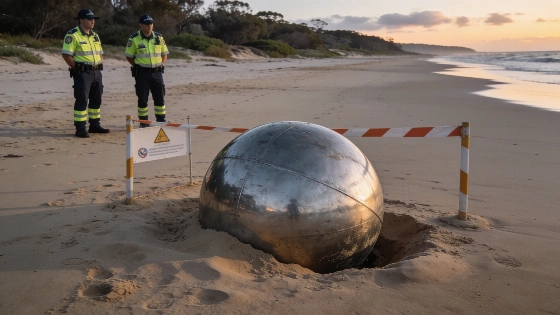
Six metallic spheres found on an Australian shoreline are believed to be remnants of a space launch vehicle, raising new questions about how space debris survives reentry and where it ultimately lands
Unidentified metallic spheres discovered on a remote Australian beach in July 2026 have drawn renewed attention to the unpredictable fate of space debris as it reenters Earth's atmosphere. The objects, recovered near Forrest Beach in Queensland, are believed by the Australian Space Agency to be pressure vessels from a space launch vehicle, but their precise origin remains under investigation. The incident underscores the ongoing challenge of tracking and managing human-made material returning from orbit, as well as the scientific uncertainties that persist around the survivability and dispersal of such debris.
Survival of Space Hardware
When space hardware reenters Earth's atmosphere, most components are expected to burn up due to intense frictional heating. However, certain materials and structures-such as pressure vessels made from titanium or composite overwrapped materials-are engineered to withstand extreme conditions. These properties make them more likely to survive reentry largely intact. In the Forrest Beach case, emergency services established a 50-meter exclusion zone around the debris, reflecting both the potential hazard and the rarity of such recoveries.
Australia has a long history of encountering space debris, from the U.S. Skylab station's fall in 1979 to more recent incidents involving SpaceX, Indian, and Chinese rocket components. The frequency of these events is increasing as global launch rates rise, but the physical processes that determine which objects survive and where they land remain only partially understood. The Australian Space Agency has formalized a response protocol: avoid handling suspected debris, alert local authorities, and notify the agency for technical assessment and international coordination.
Tracing Origins and Assessing Risk
Identifying the source of recovered debris is not always straightforward. While some components carry serial numbers or design features that can be matched to launch records, labels may not survive the heat of reentry. The vessels found in Queensland are typical of hardware designed to withstand high internal pressures, making them among the most likely to reach the surface. Yet, as experts note, traceability depends on rapid information sharing and detailed tracking of objects in orbit.
Atmospheric drag and the rotation of the Earth introduce significant uncertainty into where uncontrolled reentries will occur. Objects in low Earth orbit can pass over much of the planet, and the final descent point can shift by thousands of kilometers depending on when drag overcomes orbital velocity. Most debris falls into the ocean, but durable fragments occasionally reach land or wash ashore, as in the current case. The growing number of launches means that even rare survivals are becoming more visible to the public and authorities.
Scientific and Policy Implications
Analysis of recovered debris provides valuable data on the physical effects of reentry, including the temperatures reached and the structural changes experienced. Such studies help refine models of atmospheric breakup and inform risk assessments for future missions. However, the field still faces major gaps in understanding, particularly regarding the behavior of advanced materials and the unpredictability of uncontrolled reentries.
International agreements require countries to notify the launching state when foreign space debris is found and, if requested, to return the material. The Australian government has obligations under the Outer Space Treaty and related conventions, making accurate identification and reporting essential. As the number of launches grows, so does the importance of responsible end-of-life disposal, including controlled reentries that minimize risk to people and property. The challenge of managing space debris is not unique to Australia; similar incidents have occurred worldwide, as seen in the aftermath of high-profile missions such as Japan's Hayabusa2, which also raised questions about the fate of returned material (see our coverage of Hayabusa2's asteroid encounter).
Limits of Current Knowledge
Despite advances in tracking and modeling, the field of space debris reentry remains marked by uncertainty. Observers can sometimes estimate the time and location of a reentry event, but predicting the exact landing site for individual fragments is rarely possible. The survivability of specific components depends on their material properties, shape, and orientation during descent, as well as atmospheric conditions at the time.
Experts emphasize that while the risk to the public remains low, the increasing frequency of debris recoveries is a direct consequence of the expanding space sector. Each incident serves as a reminder that the operational life of a spacecraft or rocket does not end with its mission, and that end-of-life planning is now a central aspect of responsible space activity.
Understanding how and why certain objects survive reentry is essential for improving both safety and scientific knowledge. As more data is collected from recovered debris, researchers hope to close the gap between model predictions and real-world outcomes, ultimately reducing the uncertainty that still surrounds the fate of human-made objects returning from space.
To interpret events like the Forrest Beach debris recovery, it is important to understand the physics of atmospheric reentry. As an object descends from orbit, it encounters increasing air density, generating intense heat through friction. Most spacecraft components are designed to ablate or disintegrate under these conditions, but dense or heat-resistant materials-such as titanium pressure vessels-can survive. The trajectory, speed, and orientation of the object, as well as atmospheric variability, all influence whether debris burns up or reaches the surface. Accurate modeling of these processes is challenging, and direct analysis of recovered fragments remains a key source of empirical data for improving predictions.