Mesa Quantum has raised an oversubscribed $11.8 million round to move its chip-scale atomic clocks and inertial sensors from component research toward integrated systems and scaled manufacturing for GPS-denied environments.
Mesa Quantum is putting $11.8 million behind technology intended to keep timing and navigation systems operating when GPS signals are jammed or spoofed. The oversubscribed funding round, publicly confirmed on September 24, 2026, will move the Boulder-based company from component-level development toward full system integration and scaled production of ruggedized quantum timing and navigation units.
The financing is led by Playground Global through its $50 million Playground Genesis Fund, which is focused on quantum and enabling technologies. The company says the round brings total venture funding to nearly $16 million, following a separate $4 million round in 2024. Mesa Quantum has also received more than $5 million in non-dilutive awards from U.S. government agencies, including SpaceWERX. Its earlier financing history includes a $3.7 million seed round listed on the company's news page, indicating that the current raise follows several development stages rather than representing a single initial investment.
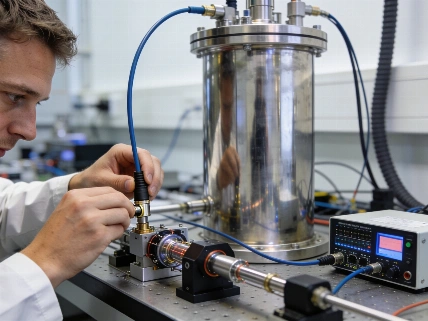
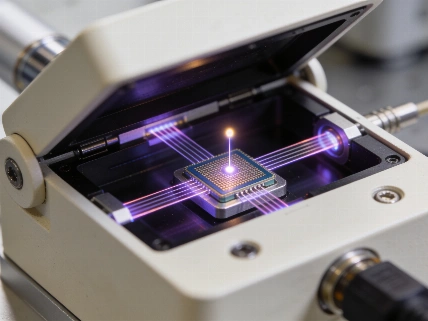
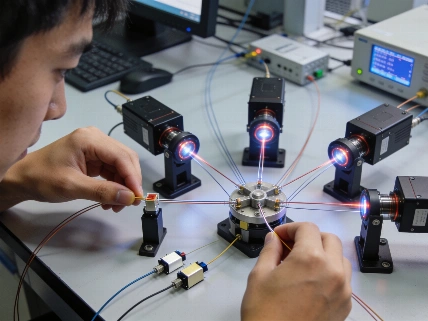
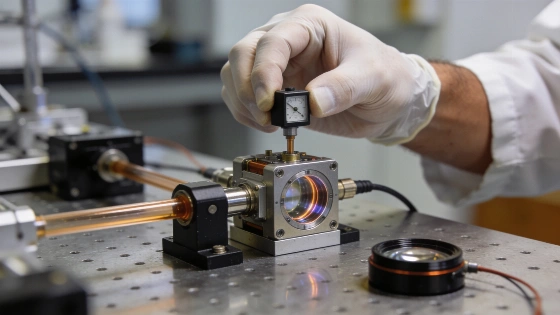
The company's hardware combines chip-scale atomic clocks with quantum inertial sensors built around miniaturized atomic vapor cells. In these devices, laser light passes through microscopic chambers containing atomic vapor. Measuring how atoms absorb that light provides a reference for timing and motion that does not depend on signals from navigation satellites. The basic principle is consistent with the broader physics of atomic standards: atomic transitions provide reproducible frequency references against which electronic oscillators can be stabilized.
Mesa Quantum describes the resulting performance as picosecond-level time synchronization and precision positioning. The announcement does not provide a full measurement protocol, sensitivity figure, operating-condition table, calibration record, or independent test result. Those omissions matter because a timing reference that performs well in a controlled setting still has to withstand temperature changes, vibration, frequency drift, packaging constraints, radiation exposure where relevant, and the calibration demands of a deployed navigation system.
Research programs at NASA and MIT have helped establish the wider scientific and engineering importance of compact atomic clocks, but miniaturization does not automatically make a device field-ready. The central engineering challenge is reducing size, weight, and power consumption without losing the stability, repeatability, and environmental tolerance that make atomic standards useful outside the laboratory.
A useful distinction is between a clock and a navigation solution. A clock supplies a stable timebase, while inertial sensors estimate motion from acceleration and rotation. Inertial estimates can continue during a GPS outage, but small biases and scale-factor errors generally accumulate over time. A deployable system therefore needs sensor fusion, calibration, environmental compensation, and an error model that remains valid as conditions change.
Playground Global led the round, with DCVC, J2 Ventures, and other institutional backers also participating. The new capital will support final product assembly, system optimization, and early deployment of ruggedized, field-ready systems for defense and commercial customers. Independent coverage describes the intended use cases as GPS-denied timing and navigation, including hardware small and inexpensive enough for platforms such as drones.
The company says the capital will support several proposed applications: sensor fusion in GPS-denied drone swarms, space-rated chip-scale atomic clocks for low-Earth-orbit alternative positioning, navigation and timing satellites, frequency references for M-Code GPS receivers, and synchronization for data centers and energy grids. These remain target applications rather than evidence that every listed system is already operating with Mesa Quantum hardware.
The strategic logic is straightforward. GPS offers a widely used timing and positioning reference, but receivers can lose trust in its signals under jamming, spoofing, or electronic warfare. An onboard atomic reference and inertial measurement unit could give a platform an independent source of timing and motion information. The practical value will depend on how errors accumulate during GPS outages and how effectively the system combines quantum measurements with conventional sensors.
For comparison, the research literature on atomic frequency standards, including a Nature review of optical clocks, shows why stability is evaluated through metrics such as fractional frequency uncertainty, frequency instability over averaging time, and systematic-shift budgets. Mesa Quantum's announcement does not report equivalent figures for its commercial devices, so its performance claims cannot yet be compared quantitatively with established laboratory or industrial standards.
Mesa Quantum is expanding its operational footprint in New Mexico through work with Sandia National Laboratories and the Center for Integrated Nanotechnologies. The planned pipelines are intended to support domestic characterization and manufacturing of quantum-optimized vertical-cavity surface-emitting lasers and photonic integrated circuits.
Those components are central to the company's miniaturized architecture. The laser must interact reliably with the vapor cell, while photonic integration must preserve optical performance across fabrication and packaging. Moving from laboratory components to production introduces device yield, process variation, thermal management, optical alignment, contamination control, and long-term stability as system-level constraints.
Photonic integration also creates a metrology problem: every packaged unit must be tested for optical power, wavelength behavior, frequency response, thermal sensitivity, and interaction with the atomic reference. A production process is not demonstrated merely by fabricating a working prototype; it must show repeatable performance across batches and under the environmental conditions expected in service.
The announcement does not state how many units have been built, what proportion passed testing, or whether the manufacturing process has reached repeatable volume output. It also does not report field trials or independent characterization. The New Mexico work should therefore be understood as infrastructure for commercialization rather than proof that commercial-scale production has already been achieved.
The funding is significant because it supports the less visible part of quantum technology: integration. A vapor-cell sensor can demonstrate a useful atomic reference, but a deployable product requires lasers, photonic structures, electronics, packaging, control software, calibration procedures, thermal management, and a means of maintaining performance outside the laboratory.
That distinction also separates Mesa Quantum's announcement from claims of quantum advantage in computing. There is no processor, qubit count, algorithmic benchmark, or comparison with classical computation here. The relevant question is not whether the device is more powerful than a conventional computer, but whether its atomic reference and inertial measurements retain enough accuracy and stability to improve navigation and synchronization when satellite signals are unavailable.
Mesa Quantum's earlier work sits within a wider quantum hardware landscape that also includes photonic links and network architectures, such as the earlier quantum networking study. The comparison is useful only at the infrastructure level: both fields must convert delicate optical or atomic behavior into systems that tolerate loss, drift, and imperfect components. They are not the same experiment and do not establish the same capability.
The hard numbers currently describe financing rather than sensor performance: $11.8 million in new capital, nearly $16 million in total venture funding, more than $5 million in non-dilutive government awards, and a $50 million fund through which Playground Global led the round. No sensitivity, stability interval, outage duration, manufacturing yield, or field-validation result is supplied, so the announcement cannot establish how Mesa Quantum compares with the best conventional timing and inertial systems.
That is the correct reading of this round. It funds a credible route from atomic vapor-cell components to integrated alternative positioning, navigation and timing hardware, but it does not by itself demonstrate a finished product or field performance. Mesa Quantum's progress will be measured by reproducible devices, quantified drift and error under realistic conditions, and manufacturing evidence that survives beyond a small number of selected components.
Chip-scale atomic clocks use atomic transitions as frequency references rather than relying only on the stability of ordinary electronic oscillators. Inertial sensors estimate motion from changes in acceleration or rotation and can operate without an external position signal, but their errors generally accumulate over time. The quantum label identifies the atomic measurement mechanism; it does not remove calibration, environmental noise, or integration limits. For this project, the decisive achievement will be turning that mechanism into a repeatable instrument that remains useful when GPS cannot be trusted.