A survey of 160 quantum enterprises across 15 countries finds that 90% depend on foreign suppliers while 74% sell abroad, revealing why protectionist controls could disrupt the sector.
National borders do not contain the quantum industry's hardware base. A new international survey finds that 90% of quantum companies depend on at least one foreign supplier for specialized components or software, while 74% serve commercial customers outside their home countries.
The figures describe industrial connectivity, not quantum performance. They do not establish processor fidelity, coherence time, logical-qubit counts, computational advantage, or the usefulness of any particular machine. They show instead that the physical infrastructure required to build quantum systems is already distributed across national economies.
Released on 23 September 2026 at the Quantum World Congress, the Global Quantum Supply Chain Flows report tracks cross-border trade among 160 quantum companies headquartered in 15 countries. The study was conducted in March and April 2026 and included firms from the United States, Canada, Europe, the United Kingdom, South Korea, Japan, and India. China was not represented among the headquarters of participating companies, although it appeared among the countries identified as suppliers or other commercial counterparties.
The study was jointly associated with the Quantum Economic Development Consortium (QED-C), European Quantum Industry Consortium (QuIC), Quantum Industry Canada (QIC), UK Quantum, Japan's Q-STAR, the Korea Quantum Industry Association (KQIA), and the QURECA ecosystem in India. Research organizations were excluded from the survey; the final sample consisted of companies meeting the stated selection criteria.
The survey maps an industry whose critical inputs are spread across borders rather than concentrated inside national markets. Companies reported sourcing from 36 supplier countries, selling to customers in 49 countries, and maintaining manufacturing operations across 25 countries. The result is a supply network that reaches well beyond the locations where quantum firms are headquartered.
That pattern is visible even among small companies. Respondents ranged from micro-SMEs with one to nine employees to large enterprises with 250 or more, yet early-stage firms also reported dependence on international suppliers. The survey does not provide p-values, confidence intervals, or a probability sample designed to estimate the entire global industry, so its percentages should be read as descriptive measurements of the participating companies rather than as universal estimates.
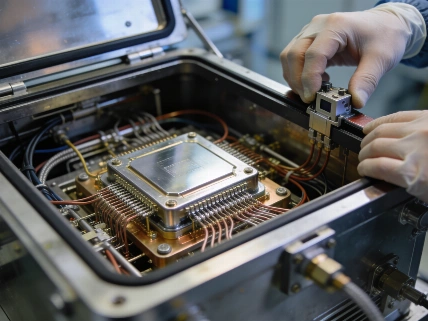
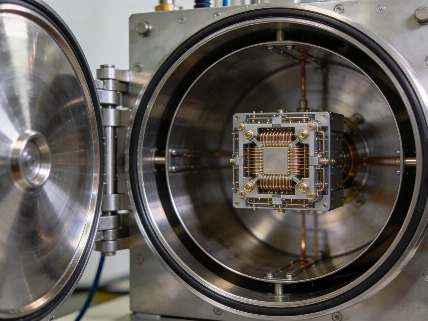
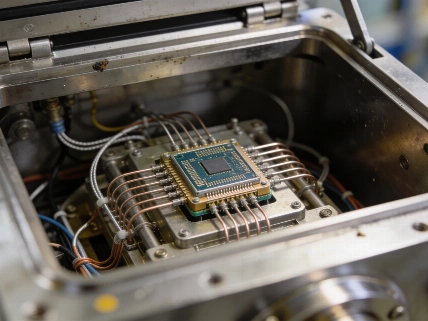
In scientific terms, quantum hardware is a layered engineering system. Depending on the architecture, it may require cryogenic refrigeration, microwave or optical control, low-noise amplification, vacuum equipment, precision packaging, semiconductor devices, lasers, detectors, and specialized materials. These dependencies resemble the systems-engineering challenges emphasized in work from institutions such as MIT and CERN, where experimental capability depends on integrating many tightly specified subsystems rather than on a single component.
The most internationally exposed parts of the sector are not necessarily complete quantum processors. Suppliers of cryogenics, photonics, control electronics, and specialized materials reported broader export reach than developers of full-system quantum processing units. That difference fits the industry's current stage: subsystem manufacturing is further along commercially than the delivery of mature end-user quantum computing hardware.
The survey's core measurements are straightforward. Ninety percent of respondents relied on foreign suppliers, with a median of three supplier countries per company. Seventy-four percent served customers in other countries, also with a median of three customer countries. Manufacturing extended across 25 countries, while the United States, Germany, the United Kingdom, Canada, and Japan emerged as leading geographic hubs; taken as a bloc, the European Union was identified as the second-largest hub.
These patterns are consistent with the technical reality that different quantum platforms have different infrastructure bottlenecks. Superconducting circuits generally require dilution refrigeration and microwave control, trapped-ion systems depend on lasers, vacuum hardware, and optical control, while photonic approaches require specialized light sources, waveguides, detectors, and packaging. A Nature quantum-information overview reflects the breadth of this research field, whose experimental methods span condensed matter physics, atomic physics, photonics, materials science, and computer engineering.
That distinction matters as governments consider national controls on sensitive technology. Cryogenic systems, lasers, control electronics, and specialized materials can be essential to quantum hardware, but the survey shows that access to such inputs often crosses several jurisdictions. Restricting trade without preserving trusted alternatives could therefore affect companies that do not manufacture complete processors but supply the systems around them.
The issue is not abstract for hardware developers. A recent hardware verification report described a Maryland facility built around quantum hardware testing and control engineering, illustrating how processor development already depends on a wider ecosystem of equipment and technical capabilities. The supply-chain study adds the international dimension: those capabilities may be assembled through vendors and manufacturing sites spread across multiple countries.
International cooperation was also visible alongside the report's release. South Korean media reported plans for SDT, IonQ, North Gyeongsang Province, and the city of Gumi to pursue a four-party memorandum covering quantum technologies and supply-chain cooperation. Such arrangements may help connect local manufacturing, system integration, clinical or industrial applications, and access to overseas technology partners, although the reported plans do not by themselves demonstrate a completed facility or commercial deployment.
Industry leaders from QED-C, QuIC, UK Quantum, QIC, KQIA, and QURECA argued that technology sovereignty and economic security require multilateral frameworks. Their stated aim is to preserve trusted trade channels while protecting sensitive dual-use technologies. The report presents that approach as an alternative to controls that treat national self-sufficiency as the default industrial model.
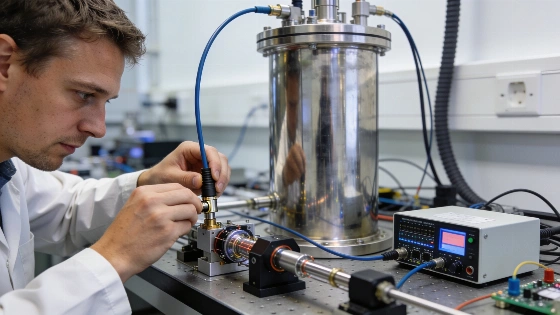
The policy challenge extends beyond quantum processors. Electronics used to generate and measure control signals, optical components that shape and detect photons, and cryogenic assemblies that suppress thermal noise can all become critical-path items. In research environments, including those associated with CERN and major university laboratories, performance is often limited by the weakest interface between subsystems: a connector, amplifier, material impurity, calibration step, or refrigeration stage can determine whether a complete experiment operates reliably.
The data also clarifies what "quantum scale" must mean outside the laboratory. More companies or more qubits alone would not resolve shortages in cryogenic equipment, photonic components, control electronics, or specialized materials. A quantum architecture can be scientifically promising and still depend on a supply network that no single country currently reproduces in full.
The report does not quantify the value of trade flows or rank individual suppliers, and it does not show how disruptions would affect particular devices. It does, however, identify a measurable structural fact: the sector's commercial reach and production base are already international. That makes trusted coordination an engineering requirement as much as a policy preference.
Quantum companies are therefore operating in an industry that is global before it is mature. The survey's numbers make protectionist isolation look less like a route to security than a potential constraint on the components needed to build secure and capable systems. Any serious quantum strategy should protect sensitive technologies while keeping the cross-border supplier relationships that the sector demonstrably relies on.
Quantum hardware is assembled from physical systems that require specialized infrastructure rather than from qubits alone. Cryogenics provides the low-temperature environment used by some platforms, lasers and photonic components support optical control or measurement, and control electronics translate instructions into physical operations. A supply chain is not evidence of quantum advantage or fault tolerance, but it determines whether the devices and subsystems behind those claims can be produced, integrated, calibrated, and maintained at all.