Cornell researchers used a 397 nm standing wave on a fabricated ion-trap chip to cool a single 40Ca+ ion near its motional ground state in 150 microseconds
A trapped ion reached near-ground-state motion in 150 microseconds under a cooling method that suppresses the usual carrier excitation instead of merely overpowering it. Researchers at Cornell University, working with Professor Karan Mehta, reported the first experimental demonstration of standing-wave Electromagnetically Induced Transparency cooling for trapped ions. The result, described in a Nullspace announcement, builds on a standing-wave proposal dating to 1992 and uses an integrated surface trap rather than a conventional free-space arrangement.
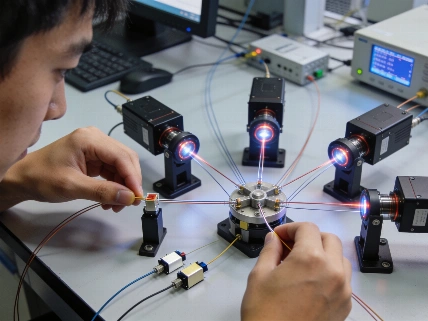
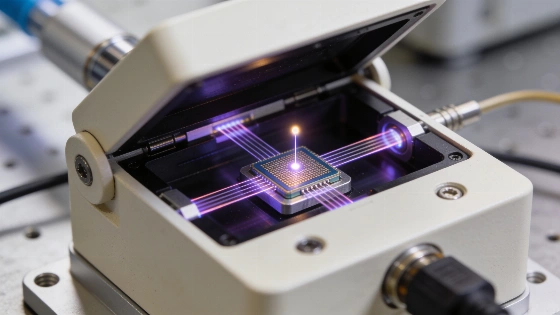
The experiment used a single 40Ca+ ion held 50 micrometers above a foundry-fabricated chip. The device incorporated photonic waveguides spanning ultraviolet to near-infrared wavelengths, including an integrated 397 nanometer optical path that formed a standing wave above the trap surface. The chip-scale architecture brought optical delivery and electrostatic confinement into the same experimental platform.
The ion was positioned at an intensity node of that standing wave. At this location, the first-order coupling that drives carrier transitions was nulled, while red-sideband transitions remained available. Those red-sideband processes remove motional energy from the ion, allowing its motion to cool without the same level of unwanted carrier excitation present in a running-wave arrangement.
That distinction is the physical core of the result. EIT cooling uses interference between optical pathways to reshape the ion's absorption spectrum; the standing-wave geometry adds spatial control over where carrier coupling vanishes. The combined method therefore does two different jobs: EIT suppresses carrier excitation spectroscopically, while the optical node suppresses the relevant coupling spatially. The demonstration tests a specific theoretical proposal associated with Cirac and colleagues from 1992 rather than presenting a generic improvement to laser cooling. Independent technical coverage has likewise characterized the experiment as a long-awaited realization of that standing-wave idea.
The reported benchmark was 500 microseconds for conventional running-wave EIT and 150 microseconds for standing-wave EIT. For the target radial mode, the final mean phonon occupancy was n̄ = 0.050 ± 0.003 with the standing wave, compared with 0.088 ± 0.005 for the running-wave method. The standing-wave protocol also cooled all three single-ion motional modes across an approximately 5 MHz bandwidth.
A phonon occupancy near zero means that the ion's quantized motion is concentrated close to its lowest vibrational state; it does not mean that every measurement produces a motionless ion. The target mode's reported n̄ of about 0.05 is the relevant measured outcome, while the broader bandwidth describes how many motional frequencies can be cooled effectively with one drive field. The reported values indicate both faster cooling and a lower final average occupation than the stated running-wave comparison.
The comparison favors the standing-wave scheme on three linked measures: speed, final occupancy, and off-target mode coverage. The available public summaries do not provide a complete statistical analysis, confidence intervals for every comparison, or a benchmark against every alternative cooling architecture. Nor do they establish a system-level advantage for a complete quantum computer. They do show that optical field geometry can directly affect the time and range of a trapped-ion control operation.
Positioning an ion at a sub-micron-scale optical feature requires more than an optical design. Cornell used Nullspace ES electrostatic simulation software to calculate three-dimensional potential landscapes and the direct-current voltage sets needed for axial confinement, precise ion positioning, and a 45-degree rotation of the radial motional modes. The reported workflow also included voltage bases for axial trapping, radial-mode control, and sub-micron positioning on the chip.
The team also developed the open-source Python package trap_sim_nullspace. It ingests GDS chip layouts, runs Method-of-Moments electrostatic calculations in Nullspace ES, and produces voltage sets that can be used in experiments. That workflow connects a lithographic layout to the electrode controls required to test the cooling protocol, reducing the manual work between chip design and laboratory operation.
This software contribution matters because the optical result depends on electrical placement. The standing wave only provides the desired carrier null if the ion can be brought to the correct location while the trap frequencies and mode orientations are controlled. The reported experiment thus combines photonic integration, electrostatic modeling, and trapped-ion spectroscopy rather than isolating any one component. It also illustrates a broader point familiar from large research programs at MIT and NASA: predictive modeling can be part of the instrument, not merely a post-experiment interpretation tool.
Nullspace has framed the Cornell result as evidence that simulation should advance alongside hardware, or even ahead of it. That claim should be read as an engineering interpretation rather than as an independently measured performance metric, but it accurately identifies the dependency between the simulated voltage landscape and the experimentally required optical positioning.
The practical motivation is QCCD architecture, in which ions are moved between zones for operations and reconfiguration. Repeated cooling cycles can add latency after shuttling, so a method that cools several motional modes with one drive field could reduce that part of the operating sequence. The result is still a laboratory demonstration on a single ion, not evidence that a complete QCCD processor has been accelerated.
The open-source toolkit places the work in the same broader hardware-software conversation as an earlier quantum study, although the physical problem here is control of ion motion rather than simulation of circuit noise. In both cases, the engineering value lies in making a difficult experimental constraint measurable and repeatable enough to study. The distinction between a demonstrated device operation and a scalable architecture is also consistent with the cautious standards normally associated with journals such as Nature and Science.
The evidence supports a narrower conclusion than the promotional language often attached to quantum hardware. Cornell has shown that standing-wave EIT can cool a trapped 40Ca+ ion faster than the stated running-wave baseline while reaching a lower reported occupancy and covering a wider motional bandwidth. It has not shown fault-tolerant computation, logical-qubit performance, independent replication, or commercial readiness.
That boundary is important. Cooling is an enabling operation, not a computation, and faster cooling does not by itself remove errors from gates, readout, transport, or calibration. Even so, this is a technically meaningful advance: it attacks a concrete control bottleneck with a geometry that suppresses carrier excitation at the point where the ion is held. For trapped-ion architectures, that combination of mode coverage and speed is more consequential than a vague claim of quantum acceleration.
In this experiment, a motional mode is quantized like a harmonic oscillator, with phonons representing discrete vibrational energy. A mean occupancy n̄ below one indicates that the lowest energy state dominates the distribution, but it is not identical to a perfect ground-state preparation. The standing-wave node controls optical coupling, while the electrostatic trap determines where the ion sits and how its modes are oriented. Those distinctions are why this result is best read as a demonstrated control improvement with a clear engineering use, not as proof that trapped-ion systems have crossed the broader scalability barrier.