Laboratory analysis of the Teghaza 001 meteorite, recovered in Mali, reveals evidence of ancient Martian crust formation and early atmospheric loss, offering new constraints on Mars' geological evolution
A rare Martian meteorite recovered from the deserts of Mali is providing planetary scientists with a direct sample of Mars' ancient crust, offering new evidence about the planet's early geological processes and the timing of its atmospheric loss. The meteorite, known as Teghaza 001, is now the subject of detailed laboratory analysis, with results that challenge assumptions about how Mars formed and evolved.
Oldest Martian Material Identified
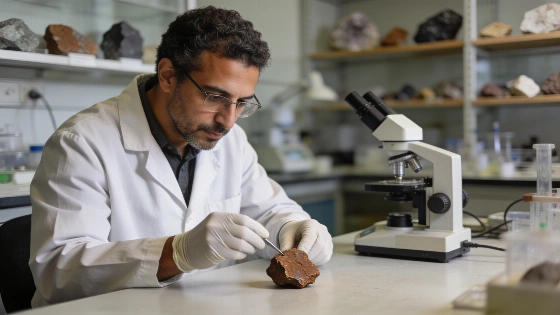
Teghaza 001 consists of eight fragments totaling 800 grams, collected in 2022 near the Taghaza archaeological area. Researchers have used radiometric dating techniques, including uranium-lead analysis of zircon crystals embedded in the meteorite, to estimate its age. Multiple independent decay systems converge on an age of at least 4.1 billion years, making Teghaza 001 potentially the oldest known piece of Martian crust available for study on Earth. This age predates most previously analyzed Martian meteorites, such as Allan Hills 84001 and NWA 7034, which either lack mineral diversity or represent mixtures of older components.
Clues to Martian Crust Formation
Geochemical analysis reveals that Teghaza 001 is unusually rich in silica, a composition more typical of granite than the basaltic rocks that dominate Mars' surface today. On Earth, granite forms through processes associated with plate tectonics, which drive the melting and slow cooling of continental crust. Mars, however, lacks evidence for active plate tectonics, raising questions about how such silica-rich rocks could have formed. Seismic data from NASA's InSight lander, combined with modeling of Mars' interior, suggest that the planet may once have harbored extensive, interconnected magma systems capable of producing complex crustal rocks without the need for plate boundaries. This finding supports the idea that early Mars could have developed continental-like crust through alternative geological mechanisms.
Early Loss of Martian Water
In addition to its implications for crust formation, Teghaza 001 provides new constraints on the timing of Mars' atmospheric escape. By measuring the ratio of hydrogen to deuterium-an isotope of hydrogen-in the meteorite and comparing it with younger Martian samples, researchers reconstructed the planet's hydrological evolution. The data indicate that Mars lost a significant portion of its original atmosphere, and thus its water, within a few hundred million years after its crust solidified. This rapid loss is consistent with a scenario in which Mars' habitability window was brief, with much of its water escaping to space by 4.1 billion years ago. The study's approach parallels recent efforts to reconstruct planetary atmospheres elsewhere in the solar system, such as the use of occultation techniques to monitor Pluto's changing atmosphere, as described in a recent Science Report article.
Limits and Future Directions
While Teghaza 001 offers a rare glimpse into Mars' earliest history, scientists caution that conclusions drawn from a single meteorite must be treated with care. The sample's unique composition and age provide valuable data, but broader understanding will require additional Martian samples, ideally from targeted sample-return missions. Ongoing analysis of Teghaza 001 and comparison with other meteorites will help refine models of Martian crust formation, atmospheric loss, and the planet's potential for early habitability.
Radiometric dating is a cornerstone of planetary science, allowing researchers to determine the age of rocks and minerals by measuring the decay of radioactive isotopes. In the case of Teghaza 001, uranium-lead dating of zircon crystals provides a robust minimum age for the meteorite's formation. By comparing isotopic ratios across different minerals, scientists can cross-check results and reduce uncertainty. These methods are essential for reconstructing the timing of major events in planetary evolution, from crust formation to atmospheric escape, and for placing new findings in the broader context of solar system history.