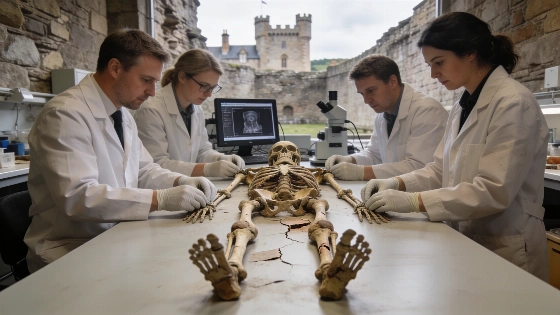
Bioarchaeologists have re-examined a 14th-century skeleton from Stirling Castle, Scotland, identifying over 160 perimortem fractures. New analysis suggests the individual may have died from a high-velocity impact during the Wars of Scottish Independence
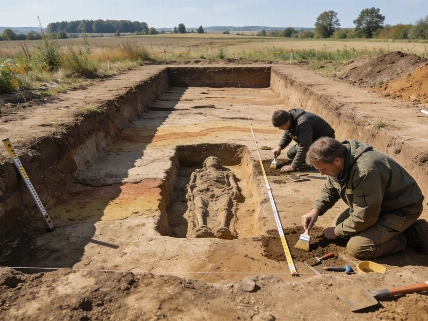
Archaeological analysis of a medieval skeleton recovered from Stirling Castle in Scotland has revealed an extraordinary pattern of trauma, offering rare insight into the violence of siege warfare during the early 14th century. The remains, designated Skeleton 150, were excavated in 1997 from the castle's chapel alongside seven other individuals. Unlike typical medieval burials, which were usually located in parish cemeteries, these interments within the royal chapel suggest a context of conflict or emergency.
Evidence of Extreme Trauma
Detailed osteological study identified 167 distinct fractures across Skeleton 150, with the majority affecting the skull and upper torso. The pattern included 61 cranial fractures and 57 rib breaks, as well as injuries to the vertebrae, arms, and right shoulder. Notably, the fractures displayed a zigzag morphology more commonly associated with high-energy trauma in modern forensic cases, such as road traffic collisions, rather than with typical medieval weapon injuries or accidental falls.
All eight skeletons from the chapel context showed evidence of perimortem trauma, including sharp-force and blunt-force injuries. However, only Skeleton 150 exhibited such an extensive and concentrated pattern of breakage. The distribution and morphology of the fractures led researchers to consider the possibility of a high-velocity projectile impact, consistent with the use of large siege engines.
Siege Context and Dating
Radiocarbon analysis places Skeleton 150's death around 1300 CE, during the First War of Scottish Independence. Historical records document that Stirling Castle was besieged in 1304 by forces of Edward I of England, who deployed multiple siege engines, including the massive trebuchet known as the "War Wolf." This device was reputedly capable of launching projectiles with enough force to breach castle walls. While it is not possible to attribute the injuries to a specific weapon, the evidence supports the interpretation that Skeleton 150 was killed by a high-velocity impact, likely from a siege engine projectile.
Forensic imaging, including micro-CT and 3D scanning, confirmed that the fractures occurred around the time of death rather than as a result of postmortem disturbance. The preservation of the remains allowed for detailed analysis, and the absence of healing indicates that the injuries were fatal and likely instantaneous. The individual's estimated age at death was in the twenties, based on skeletal development.
Alternative Interpretations and Limitations
Researchers considered alternative explanations for the trauma, such as accidental falls from the castle walls or deliberate postmortem damage. However, the specific fracture patterns and concentration of injuries to the upper body are inconsistent with typical fall injuries or trampling. The context of siege warfare and the presence of other trauma among the chapel burials further support the interpretation of conflict-related deaths.
Despite the compelling evidence, it remains impossible to conclusively identify the exact weapon or event responsible for Skeleton 150's injuries. The interpretation relies on the convergence of archaeological, forensic, and historical data, but the absence of direct association with a specific projectile or siege engine limits certainty. Similar challenges arise in other conflict contexts, such as the analysis of mass burials from Roman-era sites, where trauma patterns must be interpreted within broader historical and archaeological frameworks. For example, the study of a Roman-period well in Croatia, which yielded dozens of skeletons, required careful assessment of trauma and burial context to distinguish epidemic from violent causes (see related research).
Understanding Perimortem Trauma
The case of Skeleton 150 highlights the importance of distinguishing perimortem trauma-injuries occurring at or near the time of death-from postmortem damage caused by taphonomic processes or later disturbance. Perimortem fractures typically show sharp edges and lack signs of healing, while postmortem breaks often appear more irregular and brittle. Accurate identification of perimortem trauma is essential for reconstructing the circumstances of death and understanding the impact of conflict on past populations. In siege contexts, such analysis can reveal not only the mechanisms of injury but also the broader social and historical consequences of warfare.