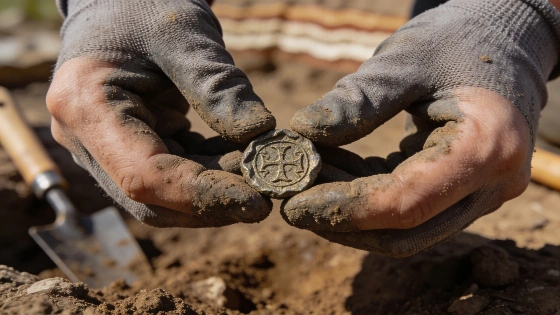
Archaeologists in Vladimir have uncovered rare lead seals from a medieval neighborhood, offering new evidence for the administrative role of Princess Maria Vsevolzha in pre-Mongol Rus'. The finds shed light on elite women's authority in the 12th-13th centuries
Archaeological excavations in the historic center of Vladimir, Russia, have revealed a group of rare lead seals attributed to Princess Maria Vsevolzha, a prominent figure in the late 12th and early 13th centuries CE. The discovery, made during controlled excavations by the Institute of Archaeology of the Russian Academy of Sciences on Volodarsky Street, provides new material evidence for the administrative activities of elite women in pre-Mongol Rus'.
The excavation exposed approximately 400 square meters of a well-preserved cultural layer dating to the late 1100s and early 1200s CE. Within this context, archaeologists identified residential structures, storage pits, and a range of domestic artifacts, including imported amphora fragments, glass vessels, jewelry, metal ornaments, knives, spindle whorls, and a stone cross. The site's stratigraphy and associated finds support a secure dating to the decades before the Mongol invasion.
Lead Seals and Attribution
Among the most significant finds are two lead bullae-pendent seals that would have been attached to official documents, most of which have not survived. Each seal features an image of Saint Mary on one side, identified by a Greek inscription, and Saint Demetrius on the other, depicted with a spear and shield. The iconography is consistent with the baptismal patron of Prince Vsevolod III, Maria's husband, whose Christian name was Demetrius. The presence of these saints, combined with the seals' findspot in Vladimir-the political center of Vsevolod's principality-strengthens the attribution to Princess Maria Vsevolzha.
Researchers also recovered a seal directly linked to Vsevolod III, bearing images of Saint Demetrius and Saint George, in line with established patterns for princely seals in medieval Rus'. The co-occurrence of these seals in the same stratigraphic context provides rare comparative evidence for the identification of female elite seals, which are otherwise difficult to assign due to the limited mention of women's names in medieval chronicles.
Context and Rarity
Over 1,000 princely seals from the Rurik dynasty are known, but those attributed to women remain extremely rare. Fewer than 20 distinct types of female-associated seals have been identified, and only five examples of the Saint Mary-Saint Demetrius type are currently documented, four of which originate from northeastern Rus'. The Vladimir discoveries represent the strongest archaeological context for linking this seal type to Maria Vsevolzha.
The seals were recovered alongside a broad assemblage of everyday objects, reflecting urban life in Vladimir during a period of political consolidation and social complexity. The preservation of the cultural layer and the association of the seals with other high-status artifacts support their interpretation as evidence of elite administrative activity.
Historical Implications
Maria Vsevolzha, married to Vsevolod III by 1175 CE, was the mother of twelve children and is considered the matriarch of the Rurikid line that later produced the princes of Moscow. Chronicles suggest she may have been of Alanian (Ossetian) origin, though this remains uncertain. She is credited with founding the Princess's Assumption Monastery (Knyaginin Monastery) around 1200 CE, which became a dynastic burial site, including her own interment after her death in 1206 CE.
The use of personal seals by Maria Vsevolzha indicates her direct participation in legal and administrative affairs, a role rarely documented for women in medieval Rus'. The evidence suggests that she exercised a degree of authority in issuing documents and managing estates, challenging assumptions about the limits of female power in the period. However, the precise scope of her administrative activities remains difficult to reconstruct from the surviving material and textual evidence.
According to a report from HeritageDaily, the discovery of these seals provides rare archaeological support for the political influence of elite women in northeastern Rus' on the eve of the Mongol conquest. The finds contribute to a growing body of evidence that women of high status could hold significant, if often underdocumented, roles in medieval governance.
The excavation yielded more than 1,000 artifacts, with the lead seals representing a small but highly significant subset. The secure stratigraphic association and the presence of both male and female elite seals in the same context offer a unique opportunity to study the mechanisms of authority and representation in medieval Rus'.
Understanding the significance of lead seals in medieval Rus' requires attention to their function as markers of authenticity and authority. Bullae were typically attached to documents to verify their origin and legitimacy. While most documents themselves have not survived, the seals provide indirect evidence for the administrative systems and social hierarchies of the time. The rarity of female-associated seals reflects both the limited documentary survival and the historical marginalization of women's names in official records, complicating efforts to reconstruct their roles from the archaeological record alone.