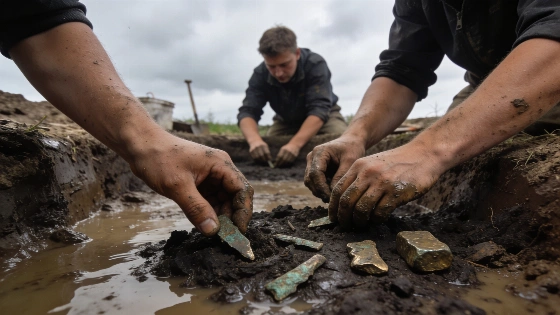
Archaeologists have uncovered a Bronze Age hoard of bronze tools and fragments near Kojetín, Czech Republic, during railway modernization works. Analysis suggests the objects were deliberately deposited in a wetland over 3,000 years ago, possibly as a ritual act.
Archaeological monitoring along the Brno-Přerov railway modernization in central Moravia, Czech Republic, has revealed a significant Bronze Age hoard that may represent a deliberate ritual deposition. The discovery was made near Kojetín, in an area that was historically a wetland, during systematic fieldwork by the Olomouc Archaeological Centre. The assemblage, recovered in late May, consists primarily of bronze tool fragments and appears to date to the Urnfield culture, which flourished in Central Europe during the Late Bronze Age.
Wetland Context and Recovery
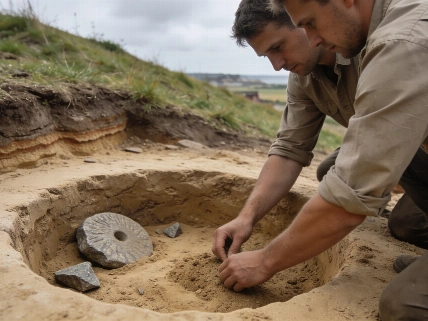
The hoard was found in a recently flooded zone, a context that has been associated with intentional deposition in other European Bronze Age sites. Archaeologists identified eight deliberately deformed sickles, one complete sickle, a fragment of a bronze sword blade, several ornament fragments, three bronze ingots, and two unfinished metal objects. The presence of both used tools and raw materials suggests the deposit was not simply a cache for later retrieval, but may have held symbolic or ritual significance.
Traceological analysis-microscopic examination of wear and modification-was conducted to assess the use and treatment of the objects prior to deposition. Most tools showed evidence of extensive use, while several items, including the sword fragment and multiple sickles, had been intentionally damaged. The sword blade, for example, was severed by a single forceful blow, likely with an axe or chisel, and several sickles were bent or deformed immediately before being placed in the wetland environment.
Interpretation and Comparative Evidence
Researchers interpret the find as unlikely to represent a utilitarian stockpile, given the deliberate damage and the challenging wetland context. Instead, the evidence is consistent with a broader pattern of Bronze Age ritual deposition in waterlogged settings, where valuable objects were placed in rivers, lakes, or wetlands as part of symbolic or religious practices. This interpretation is supported by similar finds across Europe, though the precise motivations and meanings remain debated.
The Kojetín site has previously yielded an Early Medieval iron hoard, discovered in a craftsman's workshop, which appears to have been associated with economic activity rather than ritual. The contrast between these two deposits highlights the diversity of deposition practices over time and underscores the importance of context in archaeological interpretation. Comparable discoveries, such as the Iron Age child burial with a sword in France, have also prompted discussion about the relationship between material culture, ritual, and social identity in prehistoric Europe. For example, a recent analysis of a Gaulish child burial with an iron sword provides further insight into how objects and mortuary practices intersected in the past (see this related report).
Ongoing Research and Limitations
The bronze hoard is currently undergoing conservation, documentation, and further scientific analysis. Archaeological supervision along the Brno-Přerov railway has been ongoing since September 2025 and is expected to continue through 2029, following earlier rescue excavations that revealed a large prehistoric settlement in the area. The current research aims to clarify the circumstances of the hoard's deposition and to determine whether it represents a ceremonial offering or another form of structured deposit. However, without direct written records or unambiguous contextual evidence, the precise motivations behind such Bronze Age practices remain open to interpretation.
In total, the Kojetín hoard includes at least eight sickle fragments, one complete sickle, a sword blade fragment, three ingots, two unfinished objects, and several ornament fragments. The deliberate damage to multiple items, combined with their placement in a waterlogged environment, provides a strong basis for interpreting the deposit as ritual rather than economic. Nevertheless, the possibility of alternative explanations, such as symbolic disposal of worn-out tools or community-wide acts of deposition, cannot be excluded.
Understanding Ritual Deposition
Ritual deposition refers to the intentional placement of objects in specific locations-often waterlogged or liminal environments-as part of symbolic, religious, or social practices. In the European Bronze Age, wetlands, rivers, and lakes were frequently chosen for such acts, possibly reflecting beliefs about boundaries, transformation, or communication with supernatural forces. Archaeologists rely on contextual clues, patterns of damage, and comparative evidence to distinguish ritual deposits from utilitarian caches, but the absence of written records means that interpretations must remain cautious and open to revision as new evidence emerges.