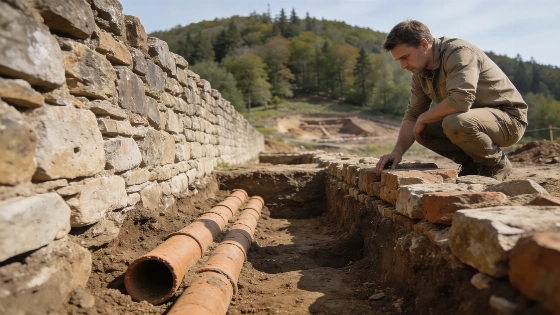
Excavation and geophysical survey around Lismore's 13th-century cathedral exposed burial grounds, early structures and signs of precious-metal work, suggesting a substantial religious community whose full extent remains unknown
Casting moulds for penannular brooches and a touchstone used to test gold point to skilled metalworking at Lismore, an island off western Scotland. The finds add material evidence to the picture of an important early medieval religious center, while leaving its size and precise layout unresolved. The excavation also recovered more than 1,000 fragments of non-ferrous metalworking debris, including crucibles, crucible lids and mould fragments; some crucibles showed traces of gold and silver.
The investigation was organized by the Lismore Historical Society and began in 2016. It combined excavation, geophysical survey and participation by local volunteers to test whether the island's 13th-century cathedral stood on the site of a monastery associated with Saint Mo Luóc. Dr Clare Ellis of Argyll Archaeology led the archaeological work. The project's findings were reported by Earth.com.
Evidence on the island
The work identified burial grounds and early structural remains. At least six burials remained in place, mostly those of adults. Radiocarbon dates for the dated graves span approximately 650-780 CE for the earliest and 900-1040 CE for the latest, placing the cemetery's use across several centuries of the early medieval period.
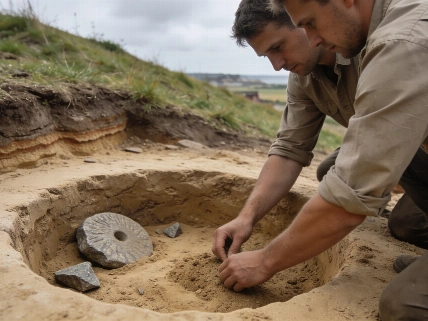
Excavation also revealed an oval structure about eight metres in diameter, with a thick dry-stone wall, a paved floor and a narrow west-facing entrance. Its remains were found alongside evidence of specialized craft production, including moulds for making penannular brooches, a form of jewellery made as an open ring with a movable pin. Decorated animal bones and the gold-testing touchstone add to the evidence for skilled work with valuable materials.
These objects indicate that the community had access to craft expertise and precious-metal working. They do not, by themselves, establish who made or used the objects, how production was organized, or whether every artifact belonged to the same period of activity. The burial dates provide a chronology for the cemetery, while the archaeological evidence does not directly date the monastery's traditional sixth-century foundation.
The scale of the burial grounds, together with evidence for buildings and metalworking, supports an interpretation of Lismore as a substantial ecclesiastical settlement. The evidence also points to activity beyond worship: the site included craft production, with moulds for brooches and traces of work with precious metals. The excavated and surveyed remains have not yet established the settlement's full boundaries.
Monastery and kingdom
Historical tradition places the monastery's foundation in the sixth century CE, under Saint Mo Luóc. It lay within the Gaelic-speaking kingdom of Dál Riata, which included Argyll. Its territory extended into the Hebrides and what is now Northern Ireland. The exact location and archaeological extent of the monastery had remained uncertain despite references in historical sources.
Within Dál Riata, Iona became one of the region's best-known religious communities. Researchers interpret the Lismore discoveries as evidence that the island may also have supported an establishment of considerable importance, potentially comparable with prominent monasteries in Britain and Ireland. Gordon Noble, the study's senior author, described Lismore as a center of worship, craftsmanship and learning whose importance may have rivaled that of some well-known early medieval monasteries. The comparison remains an interpretation of the evidence, not a direct measurement of Lismore's influence or standing.
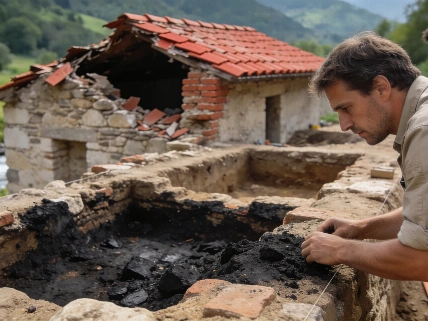
A separate report on monastic remains at Posa Hill describes another archaeological investigation of a religious complex. That comparison offers context for the kinds of structures and activity examined at monastic sites, but it does not establish a connection between Posa and Lismore.
What remains open
The findings provide archaeological evidence for a settlement previously known mainly through written accounts and local tradition. The earliest dated burials fall in the seventh century, while the monastery's sixth-century foundation remains part of the historical tradition. The discoveries do not yet define the settlement's organization, establish how long particular buildings or workshops operated, or show the monastery's connections with other religious centers. The evidence supports a substantial community without fixing its full extent or ranking.
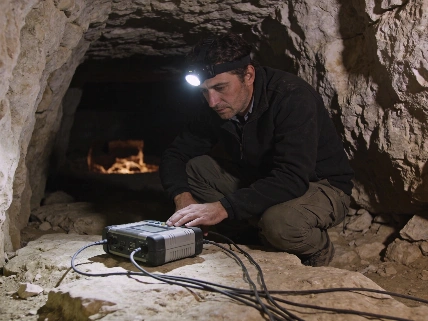
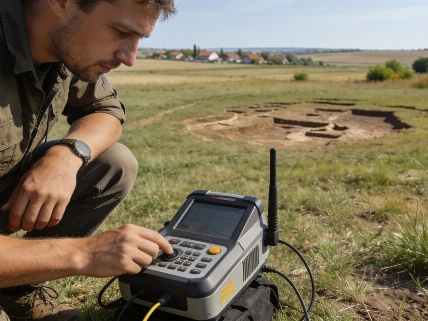
Geophysical survey detects contrasts in the ground that may reflect buried features; it does not identify those features on its own. Excavation can test selected anomalies and expose material in context, but the area examined is still only part of a wider landscape. The combination of methods makes it possible to map and investigate remains, while interpretation depends on what is actually exposed and securely associated.