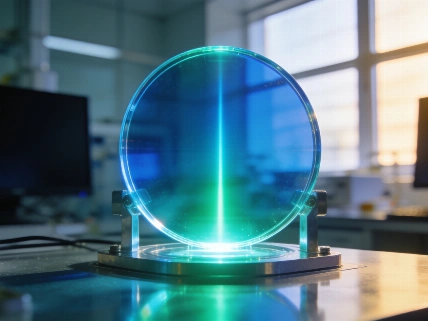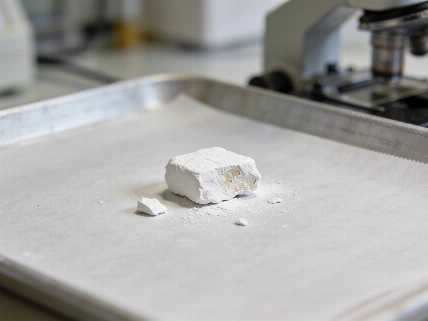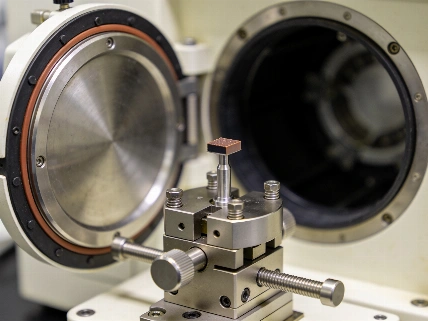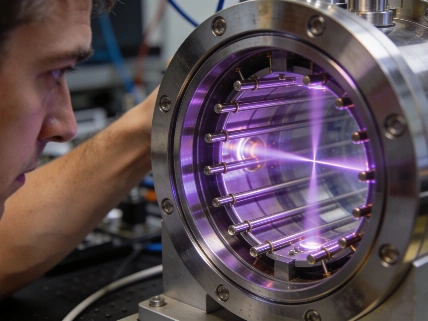
Cerium-doped lanthanum bromide can distinguish gamma-ray energies more precisely than common sodium iodide detectors while operating at room temperature. Its performance depends on crystal quality and detector configuration.
At 662 keV, common NaI(Tl) detector configurations typically have energy resolution of about 6-7%; cerium-doped lanthanum bromide, LaBr3(Ce), is reported at roughly 2.6%. That difference can help separate gamma-ray signatures that overlap in less precise detectors. It does not make LaBr3(Ce) equivalent to high-purity germanium, whose resolution can be below 0.2% but whose operation traditionally requires cryogenic cooling. Resolution figures depend on gamma-ray energy and detector configuration. The crystal and photosensor matter, as do the electronics and measurement geometry.
The comparison matters in field instruments, where cooling requirements and the ability to identify radioactive materials affect how a detector can be used. LaBr3(Ce) offers a compromise: improved resolution over traditional scintillators, with room-temperature operation a typical advantage of the scintillation approach, though that does not guarantee identical temperature requirements for every complete system.
Turning light into a spectrum
Scintillation detection converts radiation into a measurable flash of light. A gamma-ray photon deposits energy in the crystal, which emits scintillation light; a photomultiplier tube or silicon photomultiplier then converts that light pulse into an electrical signal. The pulse amplitude estimates the photon's energy, and repeated detections build a spectrum that can help distinguish radioactive sources.
The approach has a long history. In 1948, physicist Robert Hofstadter identified thallium-activated sodium iodide, NaI(Tl), as an effective material for gamma-ray detection. That helped establish practical gamma-ray spectroscopy. NaI(Tl) remains widely used because it is multifunctional and relatively inexpensive, but its moderate resolution can make it difficult to identify multiple radioactive species with nearby energy signatures.
LaBr3(Ce) also responds quickly. Its primary decay time is approximately 25 nanoseconds, compared with hundreds or thousands of nanoseconds for some other scintillators. That short response can support high count-rate measurements and faster data collection when radiation levels are intense.
Where the detector is used
Potential applications include border screening. Gautier, a product manager at Excelitas Technologies, says the detector can help distinguish signatures associated with nuclear materials from those of radioisotopes encountered in medical settings. Its practical value depends on resolving gamma-ray energies that are close together. No test results or detection rates are given for a specific border system.
Luxium(TM) Lanthanum bromide detectors have also been used to survey areas around Fukushima after the nuclear accident, and agencies use LaBr3(Ce) detectors for routine environmental monitoring. These applications map field contamination and include checks of soil and agricultural runoff. No measurement uncertainties or comparisons with other detector types are specified.
In mining, prompt gamma neutron activation analysis (PGNAA) uses neutrons to excite nuclei in a target material. The nuclei emit characteristic gamma rays, which a detector can measure to help determine the material's composition. Excelitas product manager Guillaume Gautier describes field analysis of raw material for valuable elements such as lithium or rare-earth elements before extraction begins. No accuracy figures or independent performance comparisons are provided for this use.
Detector specifications do not necessarily reflect a system's overall capability. The same distinction between a component-level measurement and system performance appears in a separate account of spin-wave isolation, where a reported result applies to a particular transmission peak.
Crystal quality and claims
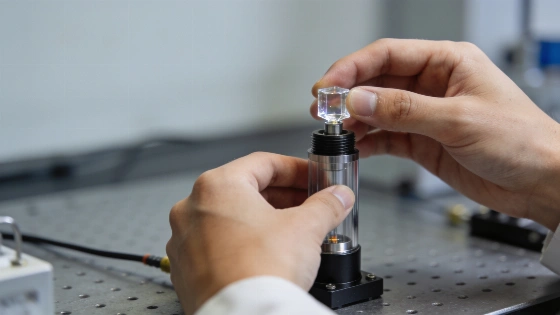
LaBr3(Ce) crystals are sensitive to ambient moisture, and impurities during growth can compromise their structure and optical clarity. Excelitas says it controls purification and material refinement in-house to improve consistency between crystals. The company does not report production yields or independent measurements of crystal-to-crystal variation.
The company also describes a strontium co-doped version branded Luxium(TM) Enhanced Lanthanum bromide. It says the added dopant improves scintillation proportionality, increasing light output and sharpening energy resolution. Excelitas reports a standard-product guarantee below 3% and a threshold below 2.5% for the enhanced version, with values of 2.3% or 2.2% in optimum conditions. These are product specifications, not universal values for every LaBr3(Ce) crystal. Measured resolution varies with crystal size and quality. It also depends on the photosensor. Results vary with the electronics and measurement geometry, as well as the conditions of the test. The measurement protocol and uncertainty for the quoted figures are not specified.
Saint-Gobain Crystals commercialized LaBr3(Ce) after its development through academic research in Europe in the early 2000s. The business later operated briefly as Luxium Solutions before becoming part of Excelitas Technologies. Excelitas now says it supplies detector assemblies as well as crystals, integrating them with photomultiplier tubes or silicon photomultipliers. The performance of these assemblies across different field conditions is not specified.
A scintillator's energy resolution describes how precisely it separates events with different energies: narrower peaks in the spectrum make nearby gamma-ray signatures easier to tell apart. The quoted percentage is tied to a particular energy and detector arrangement, so it is not a universal measure of identification accuracy. A sharper spectrum can aid analysis, but conclusions also depend on the radioactive source and measurement setup.