On 12 November 2026, a live session sponsored by SmarAct will examine how flexible sample positioning can support complementary measurements on a single specimen across microscopy and spectroscopy.
A live webinar sponsored by SmarAct on 12 November 2026 will examine how flexible sample positioning can support complementary nanoscale measurements on a single specimen. Physics World describes the session as focusing on sample manipulation that lets complementary techniques work together on the same specimen.
One specimen many views
Scanning electron microscopy (SEM), transmission and scanning transmission electron microscopy (TEM/STEM), and 4D-STEM can reveal different aspects of a sample. SEM is used for surface and morphological imaging, while TEM/STEM requires electrons to pass through a suitably thin part of the specimen. Other ways to investigate its properties include spectroscopy and nanoindentation, as well as nanoCT and CryoSEM. The announcement also names tomography and in-situ experiments among the approaches under discussion. The methods are presented as complementary, not as techniques that must all be combined in one instrument or applied to every specimen.
In experimental work, a measurement may depend on the sample's orientation, the geometry of access or how a probe reaches the area of interest. Bringing imaging and spectroscopy into a process, along with diffraction or probing, places demands on sample positioning and access. When researchers want to examine the same specimen with more than one method, positioning becomes part of the process, not merely a preliminary step. The session will explore how flexible multi-axis motion may support alignment and changes in measurement geometry.
Motion as infrastructure
The webinar will consider transitions between imaging and spectroscopy, alongside diffraction or probing. Tomography and in-situ experimentation are also named as application areas. These are workflows the speakers intend to discuss, not demonstrations with specified performance.
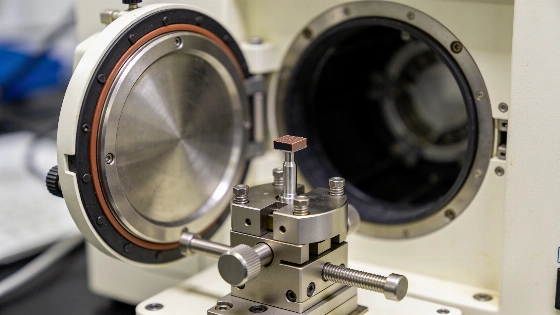
SmarAct's customizable SEM platform and related positioning solutions will provide examples. The announcement describes flexible, multi-axis positioning as a way to support sample alignment and different measurement geometries. It gives no technical specifications for the systems, identifies no particular specimen and describes no completed experiment. So it offers no basis for comparing positioning accuracy, travel range or repeatability with other equipment.
The session is described as a discussion of practical approaches to integrating precise motion into advanced microscopy and characterization workflows. It reports no measured improvements in image quality, analytical yield or throughput. It also does not establish that moving a sample between methods will be straightforward in every setup: compatibility depends on the instruments and the requirements of each measurement.
What the session covers
The focus is sample manipulation across complementary measurements, rather than a detailed account of one technique. Participants will hear how flexible positioning may support alignment and changes in geometry as a specimen is investigated using different analytical approaches. The announcement specifies no case study and promises no particular scientific result.
The live webinar is scheduled for 12 November 2026 at 14:00 GMT / 15:00 CET and is sponsored by SmarAct. The supplied information gives no registration details, duration or recording arrangements.
Speaker and scope
Alexandra Glück is a physicist turned technical sales engineer. She studied in Freiburg and Berlin and completed a doctorate in experimental physics at German Aerospace Center (DLR). At SmarAct, she is in contact with researchers and companies working in materials science and related fields, and takes part in technical discussions about developments in science and technology.
Multimodal characterization means examining a specimen with different methods whose outputs can complement one another. Precision positioning can help place the sample for those measurements, but does not itself combine the resulting evidence or guarantee compatibility between methods. The webinar will address how flexible motion can fit into such workflows, using SmarAct solutions as examples.