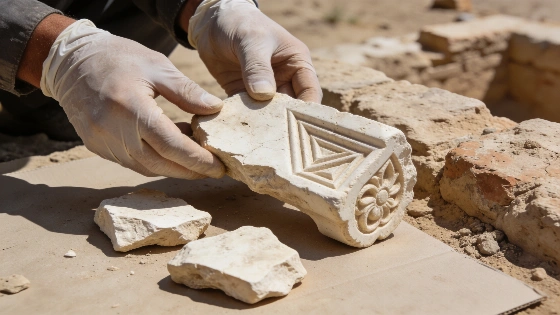
Fragments of carved ganch bearing Kufic inscriptions have been recovered at Bukhara's Shahristan site. Their fragile condition limits what can be read but preserves evidence of Samanid religious architecture and the international archaeological work now documenting it.
Fragments of a carved ganch panel carrying Kufic inscriptions have emerged from the Shahristan archaeological site in Bukhara. Uzbek reports associate the pieces with the architectural decoration of a congregational mosque from the Samanid period, adding material evidence to the study of one of Central Asia's most important medieval urban centers. The discovery was reported by Uzbekistan's Academy of Sciences.
The find matters less as a complete inscription than as surviving evidence of how carved plaster and writing were combined in religious architecture. Because the panel is incomplete, the fragments cannot by themselves provide a full reading or a definitive reconstruction of the mosque. Their value lies in the combination of material, script, archaeological setting, and conservation history.
Ganch is a gypsum-based plaster traditionally used across Central Asian architecture. Craftspeople could shape it into elaborate surface decoration, and the Shahristan pieces show that this medium was also used for epigraphic work. Kufic refers to one of the oldest styles of Arabic calligraphy, characterized in many applications by angular, geometric forms and widely used in Islamic architecture as part of monumental decoration.
The surviving material is poorly preserved and has reached the present in incomplete fragments. That condition prevents a secure reconstruction of the full panel or a complete reading of its inscription. The discovery therefore supports an interpretation of the building's decorative program without supplying a full text or a definitive account of the mosque's design.
As with earlier field discoveries, the archaeological value depends on context as much as on the object itself. Here the reported association with a congregational mosque gives the plaster a setting that an isolated fragment would lack. The relationship between script and ornament is especially important for understanding how written language functioned as part of the visual environment of Samanid Bukhara.
The expedition attributes the decoration to the Samanid era, when the dynasty ruled large parts of Central Asia and Iran during the ninth and tenth centuries. Bukhara served as one of the Samanids' most important political and cultural centers. That historical setting makes the fragments relevant to reconstructing the architecture of a period in which regional building traditions interacted with the expanding artistic language of the Islamic world.
The available reports do not identify a radiocarbon, luminescence, petrographic, or other laboratory dating method for the plaster. The chronological claim is presented as an archaeological attribution to the Samanid period and an architectural association with the mosque. That distinction matters: the fragments can inform the history of Samanid decoration, but the reports alone do not establish a precise construction year.
The fieldwork is being carried out by an Uzbek-American international archaeological expedition. Reports describe participation by researchers from Uzbekistan and the United States alongside archaeologists from Russia and Iran, with artists, draughtspeople, and representatives of the Bukhara State Museum-Reserve documenting the site and its architectural elements. This collaborative structure is significant because fragile architectural fragments require excavation records, conservation expertise, and museum documentation to remain scientifically useful.
Any future material study should distinguish clearly between observations made on the fragments and interpretations derived from comparison. A laboratory record could eventually describe the plaster's mineral composition, manufacturing additives, pigments, tool marks, or weathering, but no such analytical results are provided in the current account. The same separation between measured evidence and historical inference is expected in conservation research reported by journals such as Nature and in laboratory-based heritage studies associated with institutions such as MIT.
Expedition leader Jamoliddin Mirzakhmedov has reported that the panels are in poor condition and have not survived in full. Conservation specialists are stabilizing and protecting the fragments before further examination, an essential step when the surviving surface may contain the only evidence for how the decoration was carved and arranged. The ongoing work is described in the expedition's latest report.
The immediate task is not to turn incomplete pieces into a confident reconstruction. It is to preserve their surfaces, record their shapes, and compare them with other architectural elements from the site. Further scientific analysis may clarify the plaster's composition or help researchers assess how the fragments belonged together, but no compositional measurements, sample sizes, statistical tests, or laboratory affiliations are provided in the current reports.
Excavations at Shahristan continue while strengthening, conservation, documentation, and scientific study proceed in parallel. The work may improve understanding of carved plaster and epigraphic decoration in Bukhara, but it cannot by itself establish the full appearance of the mosque, the complete wording of the inscription, or the wider distribution of this design.
In archaeological terms, the key evidence is material and contextual: fragmented gypsum plaster, carved angular script, and an association with religious architecture. Preservation affects interpretation because missing surfaces can erase letters, motifs, and joins between pieces. An inscription attributed to a period is not the same as a fully recovered text, and an architectural association is not proof that every fragment came from one original panel.
The international character of the expedition also places the discovery within a broader system of archaeological and museum-based research rather than presenting it as an isolated find. Continued documentation can help establish fragment dimensions, surface condition, carving sequences, and relationships to nearby architectural remains. Until those records and any future analyses are published, the strongest conclusions remain deliberately limited.
The Shahristan discovery is consequently a valuable addition to the record of Samanid Bukhara rather than a license for sweeping historical claims. Its strongest contribution is precise: even in fragments, the ganch demonstrates that carved plaster and Kufic epigraphy formed part of the city's religious architectural vocabulary. Conservation and careful documentation now matter more than dramatic reconstruction because they offer the best chance of separating what the surviving material shows from what later interpretation merely suggests.