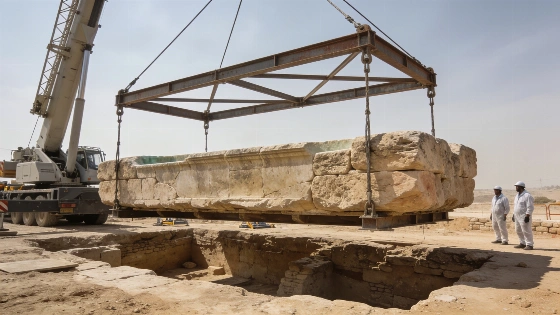
A 2,000-year-old mikveh has been lifted intact from Carmei Gat using a 300-tonne crane after archaeologists linked it with a previously unknown Jewish settlement of the Second Temple period.
A 25-tonne Jewish ritual bath has been raised intact from the ground at Carmei Gat in Israel after conservation specialists built a temporary support system beneath its ancient masonry. The four-metre-wide mikveh was then placed on a specialized transporter and moved to state storage at Beit Guvrin. The excavation was conducted by the Israel Antiquities Authority during archaeological work connected with the expansion of Kiryat Gat.
The decision to move the structure whole was driven by preservation rather than spectacle. Dismantling would have separated the bath from its surviving construction and plaster, while leaving it in place would have exposed it to neighborhood development. The planned solution keeps the mikveh available for a future public display near the location where it was found, while retaining the physical relationships between its masonry, plaster and architectural form.
The settlement context
Archaeologists uncovered the bath during Israel Antiquities Authority excavations at the Carmei Gat neighborhood of Kiryat Gat. The work was carried out ahead of development funded by the Israel Land Authority and identified evidence for a previously unknown Jewish settlement dating to the Second Temple period, approximately 2,000 years ago. Because the excavation preceded construction, the project illustrates the role of salvage archaeology in recording remains that might otherwise be lost beneath modern infrastructure.
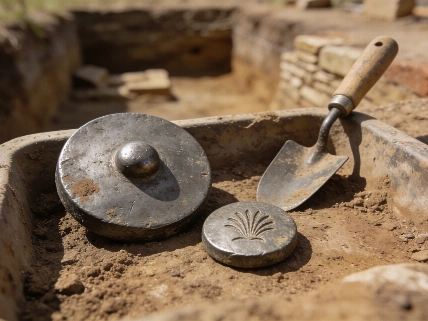
The bath is not the only evidence behind that interpretation. Excavators also recovered stone measuring vessels. Such vessels were important in Jewish communities of the period because Jewish ritual law regarded stone as resistant to ritual impurity. In combination with a purpose-built purification bath, the vessels provide a strong material basis for identifying the settlement as Jewish, although they cannot by themselves describe every resident's identity or daily practice. As in broader archaeological research, the conclusion depends on the combination of architecture, associated artifacts and stratigraphic context rather than on one object considered in isolation.
The excavation directors Elena Kogan-Zahavi, Ma'an Margolis and Shira Lipshitz said the find fills a gap in the archaeological record between the Judean Lowlands and the northern Negev. Jewish settlements are known from the Judean Lowlands during the Roman period, but the directors reported that no comparable settlement had previously been identified in this transitional region. The interpretation remains archaeological rather than demographic: the evidence supports a settlement tradition and material culture, not a complete census of its inhabitants.
Evidence of abandonment
Archaeological evidence suggests that the community was abandoned around the time of the Bar Kokhba Revolt against Roman rule in the second century CE. The site was occupied again roughly 500 years later during the Byzantine period, when archaeologists consider a different population to have lived there. The proposed sequence therefore rests on the relationship between occupation layers and datable materials, while the precise cause of abandonment remains unresolved.
That sequence matters because the mikveh belongs to a specific settlement context rather than standing as an isolated ancient object. The evidence supports a Jewish community at Carmei Gat around 2,000 years ago and a later change in occupation; it does not establish the precise circumstances of abandonment or prove that the later Byzantine inhabitants were connected to the earlier community. This distinction between observation and interpretation is central to archaeological reporting and parallels the evidentiary discipline expected in journals such as Nature and PNAS.
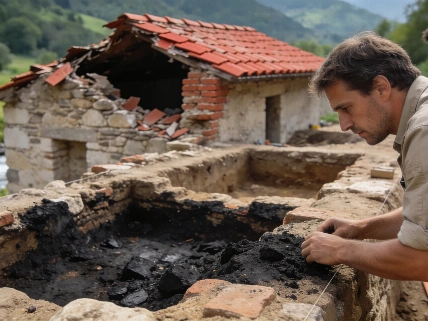
The central measurements are unusually demanding for a conservation move: the bath weighed approximately 25 tonnes, measured about four metres across and required a crane with a lifting capacity of roughly 300 tonnes. Four IAA conservators spent about two weeks excavating around the structure, drilling closely spaced openings beneath it, inserting steel beams and reinforcing the masonry before transport. The much greater crane capacity reflects operating distance, load geometry and safety margins rather than the weight of the mikveh alone.
A controlled lift
Surviving ancient plaster created the greatest preservation risk. Vibrations from lifting and road transport could have cracked or detached it, so conservators covered vulnerable areas with gauze and adhesive before adding protective foam around the structure. The steel framework allowed the mikveh to be separated from the ground without taking it apart. Such measures are forms of preventive conservation: they reduce movement and isolate fragile surfaces before an object is exposed to transport stresses.
The crane was much larger than the bath because it had to operate at a distance from the archaeological remains. Once raised, the mikveh was lowered onto equipment designed for unusually wide loads. Roads were temporarily closed during the journey to Beit Guvrin, with escort vehicles traveling ahead of and behind the lorry. Officials characterized the operation as an exceptional engineering intervention, and available reports indicate that the structure was preserved whole rather than dismantled.
The structure will remain in temporary storage while construction continues. Officials plan to return it to Carmei Gat and incorporate it into a public open space in the center of the neighborhood, preserving a direct physical connection between the modern development and the settlement that preceded it. No reported account indicates that the mikveh was destroyed or abandoned after extraction; the stated conservation plan is based on future public access.
In archaeology, context is the relationship between an object and the layers, structures and associated materials around it. Here, the bath's value comes not only from its age or size but from its association with a settlement and with stone vessels interpreted through Second Temple-period ritual practice. The successful lift therefore protects more than a heavy masonry object: it preserves a documented piece of evidence for a Jewish community previously absent from this regional record, making the decision to conserve and return the mikveh the most responsible outcome described by the excavation.