Astronomers and photographers documented the July Buck Moon on July 29, 2026, as it rose through wildfire smoke and atmospheric haze, producing striking images across multiple continents and urban skylines
The full Buck Moon of July 2026 offered a rare opportunity for observers to document the interplay between lunar light and Earth's changing atmosphere. As the Moon rose on July 29, its appearance was shaped not only by its orbital position but also by environmental conditions, including widespread wildfire smoke in parts of Europe and North America. The resulting images, captured by both professional and amateur photographers, reveal how atmospheric particles and local landscapes can dramatically alter the visual experience of a full Moon.
Observing the Buck Moon
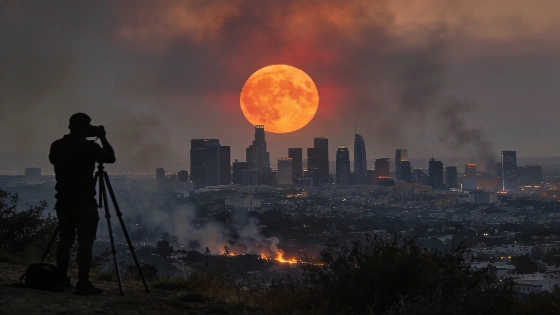
The Buck Moon, a traditional name for July's full Moon, is associated with the period when young deer begin to grow new antlers. This year, the Moon's rise coincided with sunset, allowing for extended observation as it climbed above the horizon. In Türkiye, Mesut Karaduman photographed a ballerina silhouetted against the Moon's disk, while in Balıkesir, Sergen Sezgin documented the Moon's deep red hue as it rose through wildfire smoke. These images highlight the influence of atmospheric conditions-particularly aerosols and particulate matter-on the color and clarity of lunar observations.
Elsewhere, the Moon was observed in a variety of settings. In Charlotte, North Carolina, Kevin McCarthy recorded the Moon's warm tint, attributing the coloration to its low altitude and the increased path length through the atmosphere. In San Francisco, Tayfun Coskun captured the Moon rising above the Golden Gate Bridge, with atmospheric turbulence distorting its shape and a flock of birds crossing its face. Such observations underscore the importance of local conditions in shaping astronomical imaging.
Atmospheric Effects and Wildfire Influence
Wildfires across southern Europe and North America contributed to unusually vivid lunar displays. Smoke particles in the atmosphere scatter shorter wavelengths of light, allowing longer red and orange wavelengths to dominate the Moon's appearance near the horizon. This effect was especially pronounced in regions affected by active fires, where the Moon appeared deep crimson or orange as it rose through smoke-laden skies. In Toronto, Mert Alper Dervis photographed the Moon emerging from behind dense clouds, while in New York, Gary Hershorn timed his image to coincide with the Moon's alignment above One World Trade Center.
In Ankara, Ismail Kaplan used a telephoto lens to frame the Moon beside Ankara Castle, demonstrating how urban and historical landmarks can be integrated into astronomical photography. In Hungary, Robert Nemeti captured the Moon shining through the wheel of a child's bicycle, and in Sydney, Australia, Izhar Khan recorded a bat silhouetted against the lunar disk. These diverse scenes illustrate the adaptability of astrophotography to different environments and atmospheric conditions.
Technical Details and Measurement Context
The full Moon occurred on July 29, 2026, with maximum illumination reached at 18:54 UTC. Observers across multiple continents reported significant atmospheric effects, including color shifts and apparent size distortion, particularly in areas affected by wildfire smoke. Photographers employed a range of equipment, from standard digital cameras to telephoto lenses, to document the event. Exposure times and ISO settings varied depending on local light pollution and atmospheric transparency, with longer exposures often required to compensate for haze and smoke.
These observations were not limited to visual documentation. The interplay between lunar light and atmospheric particles provides valuable data for atmospheric scientists studying aerosol distribution and optical scattering. The event also served as a practical demonstration of how environmental factors can affect astronomical measurements, a topic explored in related research on lunar and planetary imaging. For readers interested in the broader context of lunar observation, a recent report on spacecraft imaging of Earth and the Moon in multiple wavelengths is available at this link.
Upcoming Astronomical Events
The Buck Moon marks the beginning of an active period for skywatchers. In August 2026, a total solar eclipse will be visible from parts of Spain, Iceland, and Greenland, coinciding with the peak of the Perseid meteor shower. Two weeks later, a deep lunar eclipse is expected to produce a pronounced reddish coloration as the Moon passes through Earth's shadow. These events will offer further opportunities to study the interaction between celestial bodies and Earth's atmosphere, as well as to test the capabilities of modern imaging equipment under challenging conditions.
For those preparing to document these phenomena, selecting appropriate cameras and lenses for astrophotography remains essential. Atmospheric transparency, local weather, and light pollution will continue to play a decisive role in the quality of observations. As demonstrated by the Buck Moon, even routine astronomical events can yield scientifically valuable and visually compelling results when observed under variable environmental conditions.
Understanding how atmospheric particles affect the appearance of the Moon is central to both astronomy and atmospheric science. When the Moon is low on the horizon, its light passes through a greater thickness of Earth's atmosphere, increasing the scattering of shorter blue wavelengths and enhancing red and orange tones. Wildfire smoke and other aerosols amplify this effect by adding additional scattering and absorption, sometimes producing dramatic color changes. These phenomena are not only visually striking but also provide a natural laboratory for studying the physics of light transmission through complex atmospheric layers.