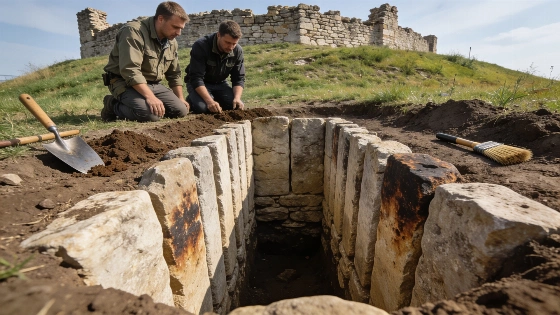
Archaeologists in Basel have documented a rare, almost completely preserved medieval hot-air heating system beneath the former Gnadental Monastery, including a stone heat-storage chamber, a masonry fire channel and eight controllable openings.
Eight openings in the floor of a former monastery refectory once controlled the movement of heated air through a medieval dining hall in Basel. The exceptionally well-preserved installation was found beneath the remains of the Gnadental Monastery at Petersgraben 52, where excavations are taking place in connection with construction of the new University Library. A archaeological report places the system broadly in the 13th or 14th century.
The discovery matters because it preserves not merely the idea of a heating system but many of its physical working parts: an underground stone-lined chamber, heat-retaining fieldstones, a fire channel built from stone blocks and bricks, and two pointed arches still standing in their original positions. The arrangement is considered a rare example of this type of medieval heating technology in Switzerland. City authorities and archaeological specialists are examining options for integrating or protecting the remains as the building project continues.
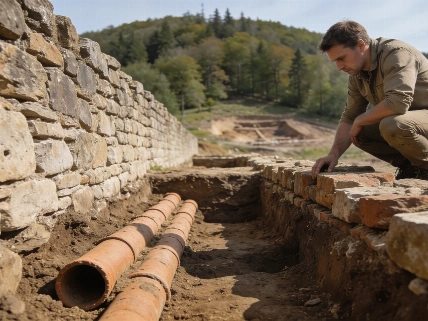
The installation used a basic physical principle with sophisticated masonry execution. A fire burned in a channel constructed from stone blocks and brick beneath an underground chamber. Heated air moved through the chamber and warmed the fieldstones, which could absorb thermal energy and release it gradually into the room above. This is an example of thermal storage: energy was transferred from combustion to a dense material before being delivered to the occupied space.
Smoke and other combustion products were separated from the main room before the warmed air reached the refectory. The arrangement therefore avoided simply filling the dining hall with the products of an open fire. Instead, the system relied on convection, in which warmer, less-dense air rises and cooler air moves in to replace it, while the masonry moderated the rate of heat release. The eight openings in the ceiling could be closed or opened to regulate airflow, although the surviving evidence does not establish the exact operating sequence or the temperature achieved in every part of the hall.
Modern heat-transfer studies describe the same broad processes through conduction, convection and thermal radiation. Those concepts help explain the architecture but should not be mistaken for a measurement of the Basel installation's efficiency. No experimentally validated performance figure, fuel consumption estimate or temperature profile has been reported for the medieval structure.
The Gnadental Monastery was founded in the 13th century outside Basel's city walls. Several monastic communities later occupied the complex, but the buildings gradually disappeared after the Reformation, leaving relatively little visible evidence of the site's earlier layout. The heating system thus provides unusually direct material evidence for the infrastructure that supported communal religious life.
A refectory was not a private room. Its size and shared use required a method capable of distributing warmth beyond the immediate reach of a fire, especially during cold seasons. The Basel installation shows how builders combined a remote fire, a masonry air path and a heat-storage mass to address that practical problem without placing the combustion source in the dining space.
The reported date falls in the 13th or 14th century, but the available account does not provide a radiocarbon result, inscription or other precise dating measurement. That range should therefore be treated as an archaeological attribution rather than a calendar date fixed by laboratory analysis. The structure's form and its position within the former refectory establish its context more securely than they establish the exact year of construction.
Comparisons with the engineering history discussed by institutions such as MIT and the Max Planck Society can clarify general principles of heat transfer, but they cannot supply missing evidence about this particular building. The Basel interpretation must remain grounded in the surviving masonry, its stratigraphic setting and future conservation documentation.
Several measurable features define the surviving installation: the proposed date spans the 13th and 14th centuries, the ceiling contained eight controllable openings, and two pointed arches remain in place. Archaeologists also identified the underground stone chamber, its fieldstone fill and the fire channel made from stone blocks and bricks. Together, these components distinguish the installation from a simple hearth or an unstructured underfloor fire.
Researchers documented the remains through conventional archaeological recording and created a detailed three-dimensional model. The model will allow specialists to examine and measure the structure if parts of it are later covered or removed during construction. In that respect, the digital record is not a substitute for preservation, but it protects spatial information that would otherwise become harder to access. Similar documentation practices are increasingly important in heritage science, where geometry, material condition and construction sequence can be re-evaluated as analytical methods improve.
The Basel find can be read alongside earlier monastery research, where excavation also showed how religious complexes depended on practical infrastructure as well as ceremonial spaces. The comparison is useful only at that broad level: the Basel evidence concerns a heating installation, not a wider network of buildings or services.
Future study could examine soot deposits, firing damage, mortar composition, stone alteration and the relationship between the vents and the room above. Such observations might help distinguish original construction from later repair and clarify how intensely the system was used. At present, however, no published sample size, statistical analysis or laboratory attribution is available for the discovery, so claims about operating temperature or efficiency would be premature.
The installation demonstrates that medieval builders could engineer controlled hot-air circulation using masonry, combustion and thermal storage. It does not by itself establish how often the system was used, how efficiently it operated or whether every part of the refectory received equal warmth. Those questions would require evidence not described in the excavation account, such as surviving vents, soot patterns, repairs, fuel residues or experimental testing.
Its strongest significance lies in the survival of the mechanism itself. The remains make medieval indoor heating tangible without requiring a romanticized picture of monastic life: people constructed a system that addressed a practical problem, and they embedded that system beneath the room where communal meals took place. The rarity of the find in Switzerland also reflects how vulnerable such installations are to rebuilding, demolition and the removal of usable stone over later centuries.
Hot-air heating works by transferring energy from a fire into a separate mass that can retain warmth before releasing it through controlled openings. That distinction is central to interpreting the Basel structure because the stones and channels are direct evidence of heat management, while claims about comfort, efficiency or daily use remain interpretations. The principles are compatible with modern scientific descriptions of energy transfer used across research fields, including work published in journals such as Nature, but no modern model can replace measurements from the archaeological remains.
Preserving both the masonry and its three-dimensional record is therefore the most responsible outcome. The find is already important as rare evidence of medieval engineering, and its value would be reduced if the physical context were lost without documentation. The current public accounts describe consideration of protection or integration within the redevelopment; they do not report a final conservation decision or a complete halt to construction.