

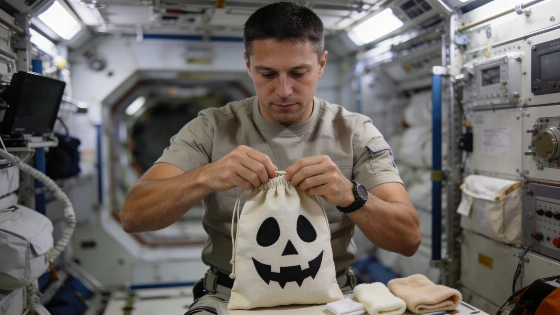
Expedition crews have marked Halloween with improvised outfits and cards aboard the orbiting laboratory. Photos from 2009 through 2025 show how available station materials and playful character ideas found a place in life in orbit
In 2022, Expedition 68 crew members Koichi Wakata of JAXA and NASA astronauts Francisco "Frank" Rubio, Nicole Mann and Josh Cassada incorporated stowage containers into their Halloween outfits and held improvised trick-or-treat bags. NASA's caption describes the costumes as popular video game and cartoon characters. The photos show how station supplies could become part of a celebration far from a neighborhood doorstep.
Outfits in Orbit
NASA's captions document a range of costume ideas. In a Halloween photograph from the Kibo Japanese Experiment Module, Expedition 57 crew members posed as familiar characters: Roscosmos flight engineer Sergei Prokopyev dressed as Elvis Presley, ESA commander Alexander Gerst as Darth Vader, and NASA flight engineer Serena Auñón-Chancellor as a mad scientist.
In 2017, Expedition 53 crew members posed in Halloween costumes. The station's costumes are often designed from materials available aboard the orbiting laboratory.
Cards and Characters
Some crews marked the holiday with cards. NASA astronauts Shane Kimbrough and Mark Vande Hei, ESA astronaut Thomas Pesquet and JAXA astronaut Akihiko Hoshide displayed Halloween cards as Expedition 66 crew members.
Expedition 70 astronauts celebrated in 2023. A later image shows three Expedition 73 astronauts dressed for Halloween in 2025.
A Scientific Workplace
Holiday photos are one small view of life aboard a station that also serves as a scientific platform. A student team's model of when acoustic tank measurements could work on Intuitive Machines' IM-3 lander offers another example of spaceflight research, described in a lunar-lander analysis.
The International Space Station has supported more than 25 years of continuous human presence. NASA describes its research as a foundation for preparing people to "survive and thrive" farther from Earth. The station combines life and work in orbit, with crews carrying out scientific investigations while living aboard an international research facility.







