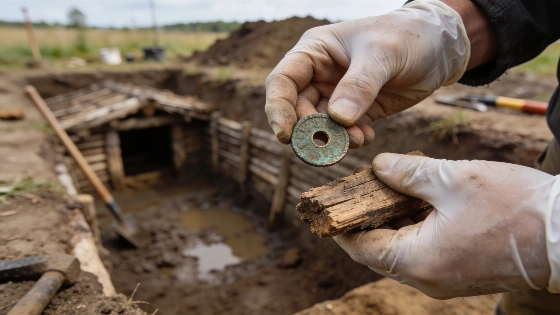
Excavations at Łysa Góra in central Poland have uncovered a 2,500-year-old longhouse and a rare Thracian coin, providing new insight into Iron Age settlement patterns and long-distance contacts across Europe
Archaeologists working at the Łysa Góra site in Mazovia have identified a 17.5-meter-long timber structure and a pierced bronze coin minted over 2,300 years ago in Thrace, nearly 1,500 kilometers from the site. These finds, recovered during recent fieldwork by the State Archaeological Museum in Warsaw, offer direct evidence for both the architectural practices of Iron Age communities in north-central Poland and their participation in far-reaching networks of exchange.
Evidence from the Settlement
The longhouse, measuring approximately 17.5 meters in length and 4 meters in width, was constructed with timber and divided into residential sections. Its architectural form is consistent with the West Baltic Barrow Culture, an Iron Age society known from northeastern Poland and adjacent regions. While similar buildings are documented in southwestern Poland, such structures are rare in Mazovia, making this discovery a significant addition to the regional archaeological record.
Excavation revealed that features initially interpreted as defensive or ritual ditches were in fact part of the building's footprint. The structure is estimated to date to the fifth century BCE, based on its construction style and associated material. The presence of residential compartments suggests a planned domestic space, comparable in arrangement to the well-studied prehistoric settlement at Biskupin.
In addition to the longhouse, the team recovered a bronze coin minted during the reign of Seuthes III, ruler of the Odrysian kingdom of Thrace between 323 and 316 BCE. The coin, found pierced and worn as a pendant, is the oldest securely excavated coin yet documented in Poland. One side depicts a horseman with a mint mark, while the other shows Zeus with a laurel wreath. The coin was produced at Seuthopolis, near present-day Kazanlak in Bulgaria, and its presence at Łysa Góra demonstrates the movement of objects-and potentially people-across considerable distances during the Iron Age.
Long-Distance Exchange and Cultural Contact
The discovery of the Thracian coin at Łysa Góra is not an isolated case of nonlocal material at the site. Previous seasons have yielded a rare Celtic helmet from the fourth century BCE and a possible trepanation instrument, indicating both martial and medical practices with external influences. The coin's journey northward may have involved Celtic groups, as Seuthopolis was attacked by Celts in the early third century BCE. Archaeologists suggest the object could have been carried by individuals involved in these incursions or acquired through subsequent exchange networks.
Two additional small objects recovered during the same excavation season may be Greek obols, though their identification remains under specialist review. If confirmed, these would further support the interpretation of Łysa Góra as a node in a broader web of cultural and material connections linking southeastern Europe to the Baltic region.
Such evidence complicates any simple narrative of isolated Iron Age communities. Instead, the finds at Łysa Góra point to a settlement engaged in long-distance contacts, with material culture reflecting both local traditions and external influences. This pattern echoes discoveries at other multi-period sites, such as those described in the previous investigation of Huttons Ambo, where artifacts from different eras and regions were found in close association.
Archaeological Context and Ongoing Research
The Łysa Góra site has a history of investigation dating back to the 1970s and 1980s, but renewed excavations began in 2024 as part of efforts to develop an educational trail and protect the archaeological remains. The current research is led by the State Archaeological Museum, with conservation underway for the most significant artifacts, including the Thracian coin, the Celtic helmet, and the trepanation tool. Plans are in place to display these objects in a dedicated exhibition marking the museum's centenary.
Archaeologists emphasize that the settlement's material record is far from exhausted. The combination of architectural remains, imported artifacts, and evidence of specialized practices suggests that further excavation may yield additional insights into the community's organization, external contacts, and daily life. The identification of the longhouse in particular provides a rare opportunity to reconstruct domestic arrangements and settlement planning in a region where such evidence is scarce.
During the most recent field season, researchers documented not only the longhouse and coin but also a range of associated features and artifacts. The scale of the building, the diversity of imported objects, and the stratigraphic integrity of the site together support a robust interpretation of Łysa Góra as a significant Iron Age settlement with connections extending well beyond its immediate environment.
The finds at Łysa Góra challenge assumptions about the insularity of Iron Age communities in north-central Europe. Instead, the evidence points to a dynamic landscape of interaction, where people, objects, and ideas moved across considerable distances. The presence of a Thracian coin, a Celtic helmet, and possible Greek obols in a single settlement underscores the complexity of cultural and economic relationships during this period. As further analysis and excavation continue, Łysa Góra is likely to remain central to debates about mobility, exchange, and identity in Iron Age Europe. The careful contextual recovery of these artifacts, combined with ongoing conservation and public engagement, sets a standard for responsible archaeological practice and interpretation.
Numismatic evidence-such as coins-can provide valuable chronological markers for archaeological contexts, but their interpretive value depends on secure recovery and clear association with other material. Coins may travel far from their place of origin through trade, migration, or as personal possessions, and their presence in a given context does not always indicate direct contact between communities. When pierced or worn, coins may have served as ornaments or amulets rather than currency. Establishing the archaeological provenance of such objects is essential for reconstructing patterns of exchange and cultural interaction in the past.