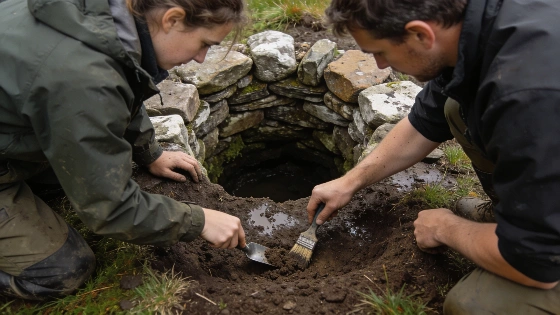
Archaeologists have uncovered a rare Iron Age grave at the base of a stone-lined well in northern Scotland, raising questions about ritual closure practices and the relationship to nearby settlements
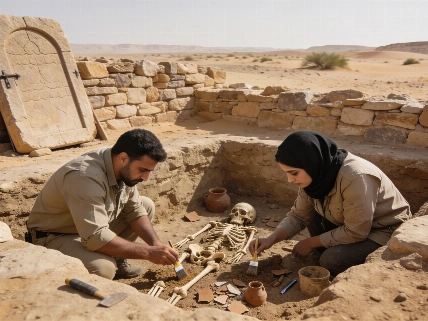
A newly excavated burial at the bottom of a stone-lined well in the Scottish Highlands is providing rare evidence for Iron Age mortuary practices in northern Britain. The grave, discovered during a quarry expansion, contained the remains of an adult individual placed within a structure interpreted as a well, with animal bones deposited above the human skeleton. The context suggests the burial may have been part of a deliberate closure event marking the abandonment of the well.
Excavation and Context
The well, measuring approximately 3 meters in length and 1 meter in depth, was constructed with stone slabs and sealed with clay between the stones, likely to improve water retention. The burial was found at the base, with no associated grave goods apart from the animal bones. The site lies about 1.6 kilometers from the Iron Age settlement at Camore Wood, where at least 20 hut circles have previously been identified. Additional possible roundhouse remains were noted near the well, but the direct relationship between the burial and these settlements remains uncertain.
Iron Age burials in northern Scotland are infrequently documented, making this find particularly significant for understanding regional variation in funerary treatment. The presence of animal bones above the human remains, and the lack of other artifacts, is consistent with other examples of ritual closure or transition at significant sites, though alternative explanations such as practical disposal cannot be excluded without further evidence.
Dating and Analysis
Artifacts recovered from the vicinity of the well suggest a date within the Iron Age, broadly spanning 800 BCE to 400 CE. However, direct dating of the human remains and the well structure is still pending, with laboratory analysis expected to clarify the chronological framework in the coming months. The sex, age-at-death, and cause of death for the individual have not yet been determined, as osteological and potentially biomolecular analyses are ongoing. Preservation of the skeleton appears sufficient for further study, but the degree of completeness and any pathological features have not been reported.
Stone-lined wells and water-related features have been associated with ritual activity in Iron Age Britain, including burials interpreted as closure deposits. Comparable practices have been documented at sites such as High Pasture Cave on Skye, where human remains were placed at the entrance during ceremonial closure. The current find adds to a growing body of evidence for complex relationships between water, ritual, and burial in later prehistoric Scotland.
Regional Comparisons and Limitations
The burial's proximity to Camore Wood and other Iron Age structures raises questions about its social and cultural context. While the well is located near known settlement features, the absence of direct stratigraphic or material links means that its association with a specific community or household cannot be confirmed. The lack of grave goods, aside from animal bones, limits interpretation of the individual's status or role within Iron Age society.
Similar discoveries elsewhere in Europe have highlighted the diversity of mortuary practices involving wells and water features. For example, research on a Roman-period well in Croatia, which yielded multiple skeletons, has contributed to broader discussions of burial in water-related contexts and the challenges of interpreting such deposits (see analysis of Croatian well burials). The Scottish find, while unique in its local context, fits within a wider pattern of complex funerary behavior at the interface of settlement, water, and ritual.
Ongoing Research
Further analysis of the skeleton and associated materials is underway, including osteological examination to estimate sex, age, and health status, as well as radiocarbon dating to refine the chronology. Three-dimensional scans of selected finds have been produced to aid in documentation and future research. The results of these studies are expected to clarify the circumstances of the burial and its significance within Iron Age mortuary traditions in northern Scotland.
Understanding the interpretation of unusual burials such as this one requires careful consideration of archaeological context, taphonomy, and comparative evidence. As new data emerge, the Scottish well burial may offer important insights into the diversity of ritual and practical responses to death in later prehistoric communities.
Osteological sex estimation is a standard method in bioarchaeology for assessing the probable biological sex of skeletal remains. This process typically relies on morphological features of the pelvis and skull, which show population-level differences between males and females. However, preservation, age, and population variation can complicate diagnosis, and incomplete remains may yield only indeterminate results. In cases where DNA preservation allows, genetic analysis can supplement or confirm osteological estimates. It is important to distinguish biological sex estimation from social gender, which cannot be directly inferred from skeletal evidence alone.