IonQ has introduced the Superion 256 quantum processor, a trapped-ion chip platform with on-chip electronic control and CMOS integration, aiming to reduce cost and enable standard data center deployment. Commercial delivery is targeted for 2027
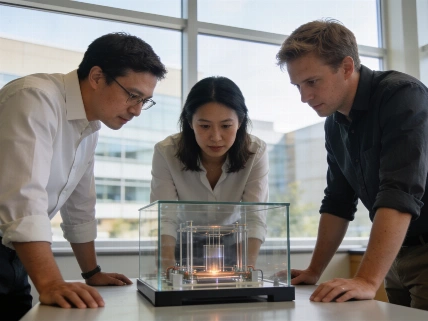
IonQ's latest quantum hardware announcement signals a decisive shift in trapped-ion processor engineering: the Superion 256 quantum processing unit (QPU) is designed for high-volume semiconductor fabrication and direct integration into standard data center racks. The company claims this sixth-generation platform eliminates the need for complex laser-based control systems by embedding microwave and radio-frequency circuitry directly onto the chip, a move intended to cut cost-per-qubit by more than two orders of magnitude and shrink the physical footprint to fit conventional server infrastructure.
On-Chip Electronic Control
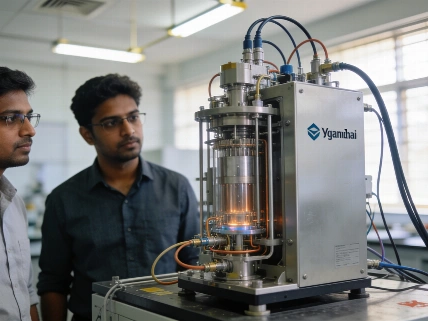
The Superion 256 QPU departs from traditional trapped-ion architectures by replacing external free-space laser addressing with Electronic Qubit Control (EQC). This approach, developed following IonQ's acquisition of Oxford Ionics, leverages planar semiconductor fabrication to integrate control electronics within the chip substrate. By embedding microwave and RF drivers, the system aims to deliver qubit manipulation and readout without the alignment, vibration sensitivity, and maintenance overhead of bulk optics. IonQ reports that initial prototype hardware has successfully trapped ions and demonstrated basic control operations at its U.S. facilities, though detailed performance metrics remain undisclosed.
Foundry Fabrication and Roadmap
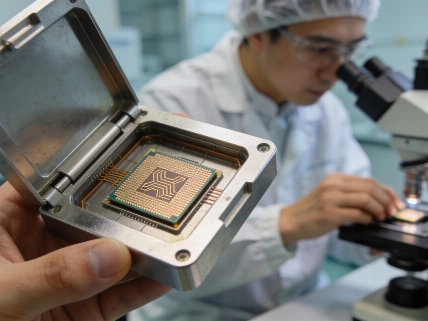
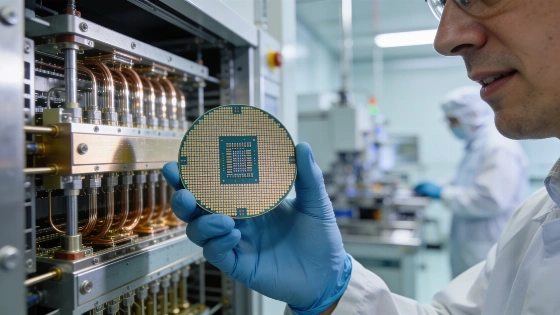
Fabrication of the Superion 256 chip uses SkyWater Technology's foundry processes, marking a transition from boutique cleanroom runs to scalable semiconductor manufacturing. IonQ states that six rapid tapeout cycles were completed in the first half of 2026, reducing design iteration time from nine months to two months and increasing wafer lot output by a factor of twelve compared to previous partnerships. The company positions this foundry-compatible architecture as the baseline for its next-generation Superion 10K platform, which is projected to integrate cryogenic CMOS logic for multi-qubit routing, classical-quantum instruction execution, and error-correction scheduling directly on the QPU substrate.
IonQ's roadmap sets commercial customer deliveries of Superion 256 for 2027, with pre-orders already open and production-grade systems planned for both cloud-based remote access and on-premises deployment. The company's stated goal is to achieve laboratory-level fault tolerance on the Superion 10K platform by 2027, scaling to volume manufacturing in 2028. However, these targets remain projections rather than demonstrated capabilities, and independent verification of device performance and error rates is not yet available.
Technical Evidence and Limitations
While IonQ highlights a projected 300-fold reduction in cost-per-qubit and the elimination of custom cryogenic or optical infrastructure, the company has not released detailed benchmarking data for the Superion 256. Key figures such as gate fidelity, coherence time, error rates, and device yield have not been independently reported. The transition to on-chip control addresses a major bottleneck in scaling trapped-ion systems, but the practical impact on multi-qubit operation, crosstalk, and calibration stability will depend on experimental results that have yet to be published. The integration of cryo-CMOS logic for error correction and instruction execution remains a roadmap objective rather than a demonstrated feature.
IonQ's approach reflects a broader industry trend toward foundry-scale quantum hardware, as seen in recent efforts to address wiring density and thermal management in large-scale quantum processors. For context, recent developments in cryogenic interconnects have targeted similar engineering constraints, though with different physical qubit platforms and control architectures.
Commercialization and Scalability
By targeting standard data center integration, IonQ is attempting to position trapped-ion quantum computing as a practical option for enterprise and cloud deployment. The move away from bespoke laboratory setups toward rack-mountable, foundry-fabricated QPUs is a necessary step for any claim of commercial scalability. However, the absence of published device-level benchmarks, logical qubit demonstrations, or independent system-level testing means that the Superion 256 remains a prototype platform rather than a proven commercial product. The company's timeline for fault-tolerant operation and volume manufacturing is ambitious, and will require not only successful hardware integration but also reproducible error correction and robust system calibration at scale.
IonQ's Superion 256 announcement marks a technical inflection point for trapped-ion quantum hardware, but the gap between prototype demonstration and reliable, scalable quantum computation remains substantial. Until detailed performance data and independent validation are available, claims of cost reduction, scalability, and fault tolerance should be treated as engineering objectives rather than established facts. The shift to on-chip electronic control is a credible response to the scaling bottlenecks of laser-based architectures, yet the true test will be sustained multi-qubit operation, error-corrected logical qubits, and reproducible device yield in a foundry environment. For now, the Superion 256 represents a significant architectural experiment rather than a finished solution.
Understanding the distinction between physical and logical qubits is essential for evaluating quantum processor claims. A physical qubit is a single controllable quantum system, such as a trapped ion or superconducting circuit, that can be prepared, manipulated, and measured. However, physical qubits are prone to errors from noise, crosstalk, and environmental disturbance. Logical qubits encode information across multiple physical qubits using error-correcting codes, allowing the system to detect and correct certain errors. Achieving fault-tolerant quantum computation requires not only high-fidelity physical qubits but also the successful implementation of logical qubits with error rates below a defined threshold. The transition from physical to logical qubits is a central engineering challenge for all quantum computing platforms.