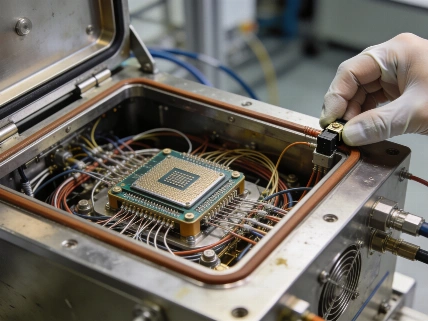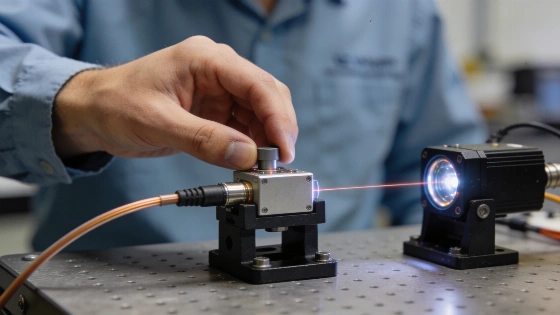
At AFRL's Rome site the planned work would connect trapped-ion hardware with other quantum processors over fiber and open air. The announcement reports no conversion-efficiency or network-rate results
Trapped-ion photons emerge at atomic-transition wavelengths that can be attenuated in telecommunications fiber or by the atmosphere. That mismatch is one obstacle the next phase of the Rome network is intended to address.
On October 27, 2026, IonQ announced $7.5 million in follow-on funding from the Air Force Research Laboratory (AFRL) for Phase 2 of its quantum-networking work in Rome, New York. IonQ said the award is part of the previously announced $21.1 million collaboration, not supplemental to it. The company described Phase 1 as establishing the network's basic physical foundation; Phase 2 adds optical, hardware and software capabilities intended to connect different kinds of quantum hardware beyond laboratory settings. IonQ's October 27 announcement says the contract expands the first-generation quantum network previously delivered in Rome.
The work falls under a broader $21.1 million multi-year collaboration initiated after IonQ acquired quantum networking specialist Qubitekk. Phase 1 focused on establishing a fiber-based physical network foundation. Phase 2 is designed to develop the Rome installation as an interoperable research platform combining optical, hardware and software layers.
Bridging wavelengths
Phase 2 includes two Quantum Frequency Converter modules alongside O-band-compatible networking components. IonQ says the converters are intended to support interoperability between heterogeneous quantum and classical hardware using standard telecommunications-wavelength infrastructure. The converters are intended to shift photons from trapped-ion systems into telecom bands, allowing the Rome installation to connect with external quantum processors and optical channels.
The planned hardware package also includes enhanced polarization controls and upgraded quantum network interface cards (QNICs). The announcement describes conversion as a way to address transmission losses, but gives no measured conversion efficiency, quantum-state fidelity or end-to-end network performance. A separate variational-circuit study examined dissipative methods for training circuits, a distinct research question from the optical hardware planned for Rome.
Links through open air
Free-space optics would add line-of-sight paths to the network alongside fiber. IonQ's Phase 2 plan includes an optical system with automatic pointing, acquisition and tracking (PAT), intended to maintain alignment and support entanglement distribution over secure channels in the C-band spectrum. The stated goal is to evaluate quantum communication protocols in tactical settings where fixed fiber is unavailable.
The work is framed as a step toward mobile and satellite-compatible links. The Phase 2 plan describes capabilities for research and evaluation; the announcement does not report a satellite connection or mobile deployment. It also gives no link distance or entanglement-distribution rate.
Demonstration still ahead
The project builds on a $54.5 million computing and networking research agreement signed in 2024. IonQ has also deployed an on-site trapped-ion quantum computing system at AFRL's Rome facility.
The earlier milestones include the first remote photonic interconnect demonstration under DARPA's HARQ program. For Phase 2, IonQ has identified planned free-space links, frequency converters, upgraded network hardware and on-premises control-plane software. The software is intended to support automated self-tests, real-time monitoring, failure handling, experiment execution and automated export of results.
The funded work is intended to expand the Rome research platform toward metropolitan and defense-network applications by connecting heterogeneous quantum systems across fiber and free-space links. Phase 2 integration and evaluation are the next steps; the announcement reports no completed operational defense network or satellite link.