The Montreal project will explore whether controlled dissipation can limit barren plateaus in variational quantum circuits. Its announcement reports no hardware benchmarks or performance figures
When the gradients used to train a quantum circuit fade, an optimizer can struggle to find settings that improve its result. A new Montreal research project will investigate whether carefully introduced dissipation can help keep that improvement process on track for telecommunications problems.
What dissipation may change
Ericsson Canada and École de technologie supérieure (ÉTS) announced the collaboration on October 22, 2026. The project, titled "Toward Able to grow Variational Quantum Algorithms: A Dissipative Approach to Mitigation and Improvement," is supported by Mitacs Accelerate and brings together ÉTS Professor Jacob Biamonte and his research team with researchers from the Ericsson Quantum Program. Ericsson described the work in its Montreal announcement as an effort to address hardware limitations affecting variational methods.
Ericsson Canada and ÉTS are collaborating on variational quantum algorithms, or VQAs. These hybrid methods use a parameterized quantum circuit alongside a classical optimizer: the circuit produces results, and the optimizer updates its settings. The team will study dynamic routing in telecom networks. It will also examine traffic scheduling and resource allocation.
The project is led by Professor Jacob Biamonte at ÉTS with researchers from the Ericsson Quantum Program. Its focus is open quantum systems and dissipative engineering. In this context, dissipation is a controlled part of the circuit design under investigation, intended to counter noise-induced barren plateaus and improve convergence. Ericsson said variational quantum algorithms have potential for complex telecom improvement, but that realizing it depends on overcoming current hardware limitations.
A barren plateau is a region where changes in circuit parameters produce gradients too small to guide the optimizer effectively. Noise can contribute to this problem, but the announcement does not report a measured reduction in gradient loss. It describes a research aim, not a demonstrated improvement.
Telecom benchmarks matter
The proposed test has two settings: near-term quantum hardware and digital emulators. The researchers plan to evaluate algorithm performance against classical telecommunications benchmarks. That comparison will be impressive: a quantum circuit's ability to return an answer does not by itself show that it solves a network task better than existing classical methods.
The announcement does not specify which hardware platform will be used, how many qubits will be involved, or which network instances and classical methods will form the comparison. It also gives no results for runtime, solution quality, circuit depth, or noise. Without those details, the project's practical performance cannot yet be assessed.
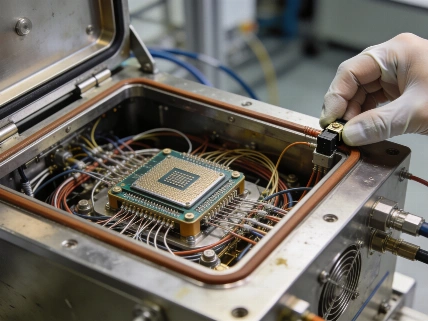
Researchers at ÉTS are expected to work directly with physical quantum hardware backends. That is a planned evaluation, not evidence that a telecom improvement task has already run successfully on a quantum processor. The supplied information does not identify a completed experiment, a publication, or independent replication.
Evidence still to come
The announcement identifies this as the second Mitacs-funded academic project under the Ericsson Canada Quantum Research Hub in Montreal, founded in 2022. The earlier project is an ongoing collaboration with the Université de Sherbrooke. The hub investigates quantum algorithms for telecom-processing acceleration and distributed quantum computing. Graduate students and postdoctoral researchers at ÉTS are to take part in the hardware work, while the company's other quantum collaborations include work on quantum communication and distributed processing with the Université de Sherbrooke.
ÉTS Director General Kathy Baig said the partnership gives the university's researchers the means to pursue work at the frontier of quantum computing and contribute to Canada's long-term scientific and technological leadership. Academica Group reported her remarks following the announcement.
The project sits within a broader quantum-technology field, but its research question is distinct from cryptographic migration. Science Report has covered that separate issue in its German PQC migration report, which concerns planning for post-quantum cryptography rather than the performance of quantum algorithms on telecom networks.
For this study, the next meaningful evidence will be measured performance under stated hardware conditions, alongside a clearly described classical baseline. Until those results are reported, "able to grow" remains part of the project's research goal rather than an established property of the algorithms.
A variational circuit's parameters are adjustable controls, not guaranteed solutions. The classical optimizer relies on information about how those settings affect the circuit's output. When gradients become too small, useful guidance can disappear; changing the circuit's dissipative dynamics is one proposed way to address that training difficulty. Whether it helps on telecom workloads is the question the collaboration has set out to test.