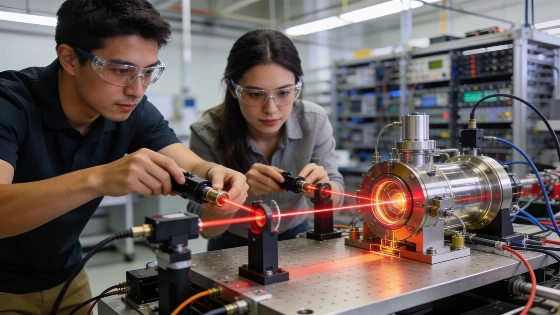
Infleqtion has announced a roadmap to deploy a neutral-atom quantum computer at Illinois Quantum & Microelectronics Park by 2027, aiming for over 50 logical qubits and integration with GPU clusters for hybrid quantum-classical workflows
Infleqtion has outlined plans to install a neutral-atom quantum computer at the Illinois Quantum & Microelectronics Park (IQMP) in Chicago, with hardware delivery targeted for 2027. The system, based on laser-controlled neutral atoms, is designed to support fault-tolerant operation and will be integrated into the IQMP campus alongside other quantum hardware developers. The company has also opened a Chicago Quantum Innovation Center to focus on quantum applications in energy grid optimization and related infrastructure challenges.
Neutral-Atom Platform and Architecture
The announced system will use neutral atoms manipulated by laser fields to implement quantum logic gates. Infleqtion reports that the initial deployment aims to demonstrate more than 50 logical qubits, with a roadmap toward 100 logical qubits, supported by a physical architecture scalable beyond 1,000 physical qubits. The platform will feature direct NVQLink interconnects, enabling low-latency, high-bandwidth coupling between the neutral-atom quantum processing unit (QPU) and GPU-accelerated classical computing clusters. This hybrid architecture is intended to facilitate quantum-classical workflows, particularly for optimization and simulation tasks that require rapid data exchange between quantum and classical resources.
Access and Software Integration
Users and research institutions will access the system through the National Quantum Algorithm Center (NQAC), utilizing Infleqtion's Superstaq quantum compilation and optimization software. This approach is intended to streamline the development and execution of quantum algorithms, with a focus on practical applications in energy, materials, and grid management. The company's roadmap includes collaborative projects with academic and industrial partners, including the University of Chicago, Constellation Energy, and the Electric Power Research Institute (EPRI), to address computational bottlenecks in the U.S. energy grid and explore quantum approaches to fuel loading optimization, grid contingency analysis, and next-generation materials simulation.
Energy Applications and Regional Impact
The Chicago Quantum Innovation Center will initially focus on quantum optimization for electrical grid management, targeting challenges posed by increasing data center loads and artificial intelligence power demand. Key research areas include hybrid quantum-classical algorithms for nuclear fuel assembly optimization, real-time grid contingency modeling, and simulation of advanced battery chemistries and superconducting materials. These efforts build on Infleqtion's participation in ARPA-E's ENCODE project and the NQAC Grand Challenges program. The deployment at IQMP is part of a broader regional strategy to establish Chicago as a hub for utility-scale quantum hardware and applied quantum algorithm development, joining other anchor tenants such as PsiQuantum and IBM. For context on the competitive landscape, PsiQuantum's photonic quantum hardware has recently undergone expanded DARPA scrutiny, highlighting the diversity of quantum hardware approaches under development at the campus.
Technical Milestones and Remaining Challenges
While Infleqtion's roadmap targets over 50 logical qubits in the initial demonstration, the company has not yet published peer-reviewed data on logical error rates, gate fidelities, or long-term system stability for the planned deployment. Achieving fault-tolerant operation at scale will require not only high-fidelity control of thousands of physical qubits but also robust error correction, real-time decoding, and stable integration with classical computing resources. The integration of NVQLink for QPU-GPU coupling is intended to address some of the latency and bandwidth challenges in hybrid workflows, but the practical performance of this architecture remains to be demonstrated in hardware. As with other quantum computing platforms, the transition from laboratory prototypes to reliable, reproducible, and commercially useful systems will depend on advances in device yield, calibration, error correction, and software integration.
Understanding the distinction between physical and logical qubits is central to evaluating progress in quantum computing. A physical qubit is a single controllable quantum system, such as a neutral atom or superconducting circuit, while a logical qubit encodes information across multiple physical qubits using error-correcting codes. Logical qubits are designed to detect and correct errors, but require significant overhead in terms of physical resources and control complexity. Demonstrating a large number of logical qubits with low logical error rates is a key milestone for fault-tolerant quantum computing, but remains a major engineering challenge across all hardware platforms.