BQP has secured an $8 million investment led by IBM Ventures to expand its quantum-accelerated physics simulation platform. The company aims to bridge the gap between classical high-performance computing and hybrid quantum-classical workflows for engineering applications.
Physics simulation for engineering design is colliding with the limits of classical high-performance computing, and BQP is betting that quantum acceleration can break the bottleneck. The company has raised $8 million in new funding, led by IBM Ventures, to push its BQPhy platform from laboratory demonstration toward commercial deployment in aerospace, defense, and advanced manufacturing.
GPU Utilization and Software Bottlenecks
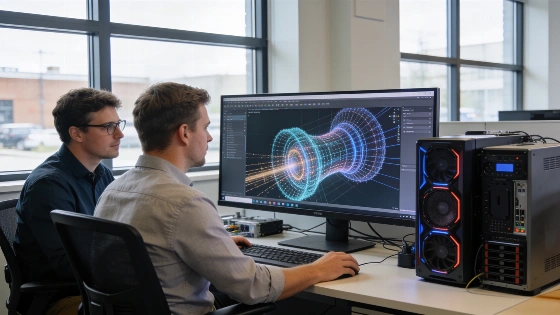
BQP's core claim is that traditional physics solvers, even when run on modern GPUs, leave most of the available floating-point capacity idle. According to the company, legacy algorithmic code can waste up to 85% of GPU compute resources, limiting the speed and scale of engineering simulations. BQPhy is designed as a software acceleration layer that integrates with established environments such as MATLAB, Python, and Julia, aiming to optimize GPU usage without forcing engineering teams to revalidate their workflows or rewrite code from scratch.
In practical terms, BQP reports that its solvers can deliver up to a tenfold speedup for certain simulation tasks within native engineering environments. The company's approach is to maximize classical hardware first, then prepare workloads for a future transition to hybrid quantum-classical execution as quantum processing units (QPUs) become more capable.
Quantum Roadmap and Hybrid Integration
The BQPhy platform is not a quantum computer, but it is engineered to bridge the gap between today's classical simulation and tomorrow's quantum-accelerated workflows. BQP's QuantumMAX engine is described as a native solver architecture that can configure classical workloads for seamless migration to hybrid quantum-classical systems. This staged roadmap is intended to allow organizations to adopt quantum acceleration incrementally, without abandoning existing simulation infrastructure.
BQP's integration with the IBM Quantum Network since 2023 has coincided with an eightfold increase in contracted revenue, driven by deployments in sectors where simulation speed and scale are critical. The company's solvers have been tested under federal contracts with the U.S. Space Force, SpaceWERX, and the Air Force Research Laboratory, where they reportedly achieved up to a 250× speedup in space object orbit propagation compared to legacy classical baselines.
Benchmarks and Commercial Claims
While BQP's reported performance gains are substantial, the company has not released detailed technical benchmarks or independent peer-reviewed studies to support its claims. The $8 million funding round, which includes participation from Venn10 Capital and Monta Vista Capital, is intended to support commercial deployment and further integration with quantum hardware as it matures. The company's focus on defense and industrial contracts reflects a broader trend toward hybrid quantum-classical workflows in mission-critical environments, but the practical utility of these systems will depend on reproducible performance and transparent benchmarking.
Recent developments in hybrid quantum-classical integration, such as the Jülich supercomputing cluster integration of trapped-ion processors, highlight the technical and engineering challenges that remain before quantum acceleration becomes routine in commercial simulation workflows.
Engineering Limitations and Next Steps
BQP's approach relies on optimizing existing GPU hardware while preparing for a gradual transition to quantum acceleration. The company's roadmap depends on the availability of reliable, scalable quantum processors and robust software integration layers that can handle the complexity of real-world engineering tasks. Until fault-tolerant quantum computers are available, the value of hybrid workflows will be determined by the efficiency of classical acceleration and the ability to transfer workloads without introducing new sources of error or instability.
IBM Ventures' investment signals confidence in the software layer as a critical component of future quantum infrastructure, but the absence of independent technical validation means that BQP's claims should be treated as preliminary. The next phase for BQP will require transparent benchmarking, reproducible results, and clear evidence that quantum acceleration can deliver practical benefits beyond what is possible with optimized classical hardware alone. For now, the company's strategy of targeting underutilized GPU capacity and building a bridge to quantum-classical integration is a pragmatic response to the slow pace of quantum hardware progress, but the burden of proof remains on the developers to demonstrate real-world utility at scale.
Understanding the distinction between classical and quantum acceleration is essential for evaluating claims in this field. Classical acceleration leverages existing hardware, such as GPUs, to speed up simulations by optimizing code and resource allocation. Quantum acceleration, in contrast, depends on the availability of quantum processors capable of handling specific computational tasks more efficiently than classical systems. Hybrid quantum-classical workflows aim to combine the strengths of both approaches, but the transition introduces new engineering challenges, including error management, software compatibility, and the need for reproducible benchmarks. Until these challenges are addressed, the promise of quantum-accelerated simulation will remain contingent on both hardware progress and transparent technical evidence.