A trapped-ion quantum processor using ytterbium ions and microwave control has been integrated into the Jülich Supercomputing Centre, allowing hybrid quantum-classical workloads and direct access to high-performance computing infrastructure
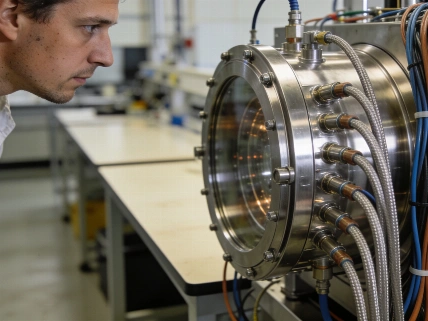
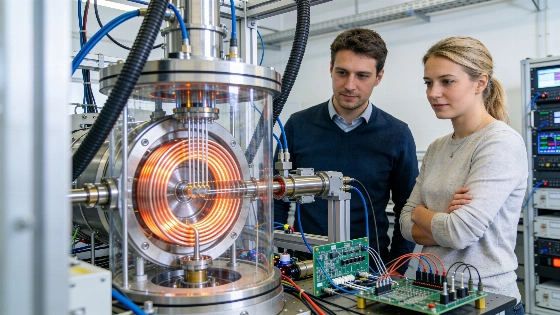
For the first time, a trapped-ion quantum processor operating at room temperature has been directly connected to a European supercomputing cluster, marking a technical milestone for hybrid quantum-classical computing. The JION (Jülich trapped-ION) system, developed by eleQtron GmbH in partnership with Forschungszentrum Jülich, is now accessible through the Jülich Supercomputing Centre's (JSC) unified quantum infrastructure, JUNIQ. This integration allows researchers to offload quantum workloads to the JION processor and combine them with classical high-performance computing resources, including the JUPITER exascale system.
MAGIC Control and Room-Temperature Operation
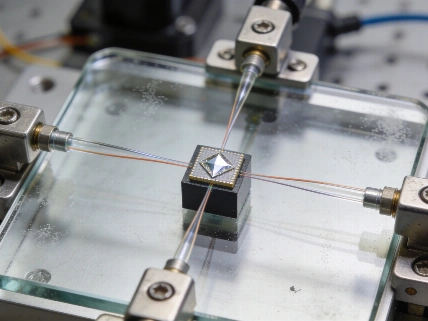
Unlike most trapped-ion quantum computers, which rely on complex laser systems for qubit control and require cryogenic cooling, the JION processor uses a proprietary technique called MAGIC (Magnetic Gradient Induced Coupling). This approach replaces individual laser beams with static magnetic field gradients and globally applied microwave pulses, enabling precise single- and multi-qubit gate operations through radio-frequency signals. The hardware traps ytterbium-171 ions (171Yb+) in a radio-frequency Paul trap, allowing the core assembly to operate at room temperature and eliminating the need for dilution refrigerators.
MAGIC control fields also enable all-to-all qubit connectivity within the ion chain, allowing direct gate operations between non-adjacent ions. This reduces the need for compiler-inserted SWAP gates, which can otherwise increase circuit depth and error rates. The room-temperature operation simplifies infrastructure requirements and may improve system uptime, but the approach still faces challenges in scaling up the number of high-fidelity qubits and maintaining stable control over longer periods.
Integration with Supercomputing Infrastructure
The JION processor is directly linked to JSC's modular supercomputing cluster, making it possible to run hybrid quantum-classical algorithms for tasks such as transport optimization, materials modeling, and chemical simulation. The JUNIQ platform provides user access and workflow management, allowing researchers to combine quantum circuits executed on JION with classical computation on the JUPITER exascale system. This architecture is designed to support workloads that benefit from both quantum and classical resources, but the practical utility of current quantum hardware remains limited by qubit number, gate fidelity, and error rates.
JION's commissioning is part of a broader regional and European funding strategy. The EPIQ (Development Partnership for Ion-Trap Quantum Computers in NRW) project, funded by the North Rhine-Westphalia Ministry of Culture and Science, provided €21 million over four and a half years for hardware development and integration. Additional funding includes €25 million from the EU's ERDF/JTF program for the SQALING project, which aims to transition MAGIC-based systems toward scalable, planar chip architectures, and €35 million from the Q-STAR.NRW initiative to procure a semiconductor quantum computer for the region.
Technical Evidence and Remaining Barriers
While the JION system demonstrates room-temperature operation and direct supercomputing integration, key technical details such as the number of operational qubits, gate fidelities, and error rates have not been independently published. The use of trapped 171Yb+ ions and microwave-based control is consistent with recent trends in ion-trap research, but the absence of peer-reviewed benchmarking data limits direct comparison with other platforms. Previous efforts to connect trapped-ion hardware to supercomputing resources, such as those described in reported earlier, have typically relied on cloud-based access rather than direct physical integration.
State and EU funding for JION and related projects reflects a strategic push to establish regional quantum infrastructure and accelerate the transition from laboratory prototypes to scalable, manufacturable systems. However, the technical and engineering challenges of scaling trapped-ion processors-especially in terms of control complexity, error correction, and device reproducibility-remain unresolved. The current demonstration is a step toward hybrid quantum-classical workflows, but the gap between laboratory integration and practical quantum advantage is still substantial. Until independently verified performance data are available, claims of scalability and utility should be treated with caution. The decision to prioritize room-temperature operation and microwave control is a calculated bet on engineering simplicity, but the long-term competitiveness of this approach will depend on its ability to deliver high-fidelity, large-scale quantum circuits under real-world conditions.
Funding and Policy Context
The JION project is embedded in a dense landscape of regional, national, and European quantum funding. The EPIQ partnership between Forschungszentrum Jülich and eleQtron GmbH anchors the hardware development, while the SQALING and Q-STAR.NRW programs target future scalability and economic transformation in the Rhenish mining region. These investments are part of a broader European trend toward integrating quantum processors with established high-performance computing infrastructure, as seen in recent national strategies and cross-border collaborations. The policy emphasis on hybrid quantum-classical systems reflects a pragmatic recognition that near-term quantum devices will require close coupling with classical resources to deliver any measurable advantage. However, the ultimate value of these investments will depend on the ability of hardware developers to overcome persistent engineering barriers and deliver reproducible, high-quality quantum operations at scale.
In trapped-ion quantum computing, a physical qubit is typically realized by encoding quantum information in the internal states of a single ion, such as the hyperfine or Zeeman levels of ytterbium-171. These ions are confined in electromagnetic traps and manipulated using laser or microwave fields. Coherence times can be long, but gate operations must be precise and fast enough to outpace decoherence and technical noise. All-to-all connectivity allows any pair of ions to interact directly, but as the number of ions increases, control complexity and crosstalk become significant challenges. Room-temperature operation removes the need for cryogenic cooling, but does not eliminate the need for precise electromagnetic control and environmental isolation. The distinction between physical and logical qubits is critical: while physical qubits are the building blocks, logical qubits require error correction across many physical qubits, and no trapped-ion system has yet demonstrated large-scale, fault-tolerant logical qubits in a practical computing context.