Utah has approved Nolla Health's system to issue initial and repeat topical-acne prescriptions without prior doctor approval in every case. The 12-month pilot uses questionnaires and facial scans, restricts treatment to eligible adults with mild or moderate acne, and escalates uncertain cases to licensed physicians.
Utah has authorized a healthcare system to issue initial acne prescriptions without a doctor approving each case in advance. The pilot gives Nolla Health's software a decision normally reserved for a licensed clinician while keeping the system inside a narrow set of physician-approved treatment pathways. The arrangement is a limited exception to Utah's general requirement that medicines be prescribed by a licensed professional, not a repeal of that rule.
This is not an unrestricted digital doctor. Nolla's system cannot invent a regimen or select freely from every available prescription drug. It combines a patient questionnaire with facial-image analysis, chooses from a limited list of topical treatments, and sends the case to a physician when it cannot make a sufficiently confident selection. The permitted population is adults with mild or moderate acne; severe acne, oral medicines, and isotretinoin are outside the pilot.
The system can reportedly handle both initial prescriptions and refills, but only for topical creams and gels included in a predefined list and in treatment pathways approved by physicians. That restriction is clinically important: the software is being tested within a bounded decision space rather than being allowed to generate novel prescribing strategies.
The distinction matters because much of digital health remains clinician-led. Software may collect symptoms, organize information, or support a consultation, but the medical professional still makes the prescribing decision. Nolla's Utah pilot is designed to move that decision into software under predefined conditions, creating a test of operational autonomy rather than proof that autonomous prescribing is ready for unrestricted clinical use.
Utah's Office of Artificial Intelligence Policy developed the program with Nolla under the state's framework for testing new AI applications. The pilot is scheduled to run for 12 months, with the possibility of extension for up to two additional years at the discretion of the office. Its estimated addressable group is roughly 5,500 to 11,000 Utah residents with acne who seek dermatology care each year.
Human oversight is reduced in stages. A physician will approve every prescription for the first 100 patients. The next stage covers up to 500 patients and allows the system to send prescriptions to a pharmacy before review, with a physician examining the decisions retrospectively. After that, available reporting describes a minimum monthly review of at least 10 percent of prescriptions. Some accounts have instead described weekly sampling, so the precise later-stage schedule remains inconsistently reported.
That structure creates a measurable boundary between automation and autonomy. The software may make the initial selection, but doctors remain responsible for escalation, review, and support when a case falls outside the system's operating limits. The pilot is available through the Nolla Derm app to Utah residents aged 18 and older.
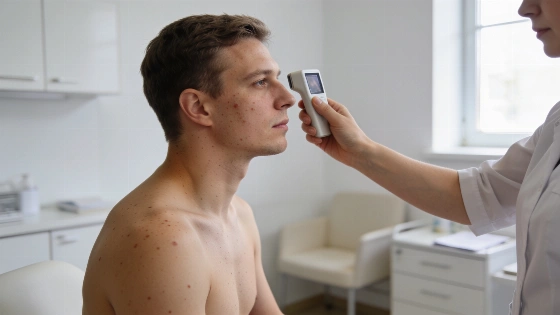
Patients complete a questionnaire lasting 10 to 15 minutes and provide a facial scan. The system then assesses the skin and selects an acne treatment from the approved pathways. Nolla says it can produce a treatment plan and prescription within minutes, after which patients can choose home delivery or pharmacy pickup.
The company describes its broader platform as using multimodal machine-learning systems, including vision transformers that analyze image patterns alongside other patient information. Nolla also says its wider systems have been trained on more than 3 million labeled clinical cases. That figure describes the company's broader systems; the material available does not establish that every case was acne-related or that the dataset independently validates this Utah pilot.
After treatment begins, the app uses daily skin scans to track changes and reviews plans monthly according to the patient's response. Patients can contact a licensed physician directly when they need additional help. The service costs $4.99 per month under the Utah pilot.
Facial-image analysis also introduces technical questions that are separate from prescription rules. Lighting, camera quality, skin tone, image framing, cosmetics, and temporary irritation can all affect what a model detects. A clinically meaningful evaluation would therefore need to report performance across relevant patient groups, image conditions, referral rates, and cases that the system declines to handle, rather than relying only on average agreement.
Nolla says licensed clinicians agree with its treatment recommendations in more than 96 percent of real-world cases. The company says disagreements have generally involved adjustments such as changing the strength of a topical medication rather than selecting an entirely different treatment. That percentage is a company-reported claim; available reporting does not identify the sample size, validation design, confidence interval, independent audit, or peer-reviewed analysis behind it.
The figure also does not by itself show that the system is safe for every eligible patient. Agreement with a clinician is not the same as improved patient outcomes, and the announcement does not provide a detailed breakdown of false negatives, difficult cases, demographic performance, or outcomes after treatment. Nor does it establish how the system performs when images are unclear or a patient's condition does not fit the predefined pathways. These distinctions are central to the evidence standards expected in clinical AI research and to the kind of transparent reporting associated with journals such as Nature.
The handoff rule is therefore one of the pilot's most important technical safeguards. The system is permitted to choose only within a constrained clinical space; uncertainty is supposed to stop automation rather than trigger a more creative response. That design reduces the range of possible errors, but it also makes referral behavior central to the system's safety. A model that refers too rarely may miss atypical disease, while one that refers too often may offer little practical advantage over conventional telehealth.
Nolla says it is the first organization in the United States and possibly the world to receive regulatory approval for an AI system to issue initial prescriptions. That priority claim comes from the company and is not independently verified in the available announcement. The system's broader app has been downloaded more than 175,000 times across 44 states, but autonomous initial prescribing is currently limited to eligible adults in Utah.
The pilot is significant because it tests not only a model's image analysis but an entire decision pipeline: patient intake, facial scanning, treatment selection, prescription issuance, escalation, follow-up, and physician review. A failure in any part of that chain could affect care even if the underlying image classifier performs well. Researchers at Stanford and MIT have emphasized in broader clinical-AI work the importance of evaluating systems in real workflows, where human responses and operational constraints can change performance.
It is also a test of institutional control. The staged rollout gives regulators a way to observe prescriptions before reducing review, while the limited treatment list narrows the consequences of an incorrect selection. The announcement does not provide independent audit results or evidence that the system improves outcomes compared with conventional telehealth.
For readers, the practical message is narrower than the company's AI-doctor description. Nolla has received approval to test autonomous initial prescribing for adult acne within Utah's controlled framework, not to replace dermatologists or make unrestricted medical decisions. The arrangement is an important deployment experiment precisely because it exposes where autonomy stops: at uncertain cases, limited treatment choices, physician escalation, and retrospective oversight. In healthcare AI, that boundary is not a footnote; it is the part that determines whether automation is a useful clinical tool or an unverified source of risk.
Automation bias occurs when people give an automated recommendation more weight than its evidence deserves. Daily and staged physician review can reveal disagreement and unusual cases, but review quality depends on clinicians having enough information and authority to challenge the system. A high agreement rate therefore measures alignment with selected clinical decisions, not independent proof of diagnosis, treatment effectiveness, or universal reliability.