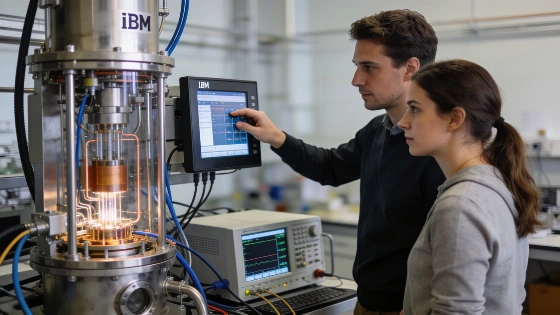
Researchers tested hybrid quantum-classical machine learning algorithms on IBM Quantum hardware with over 100 qubits to forecast electricity demand across smart grids, comparing performance and noise sensitivity to classical methods
The Washington Institute for STEM, Entrepreneurship and Research (WISER) and E.ON have reported results from a research collaboration evaluating hybrid quantum-classical machine learning for forecasting electricity demand in smart grids. The study, published as a preprint on arXiv, focused on whether current noisy intermediate-scale quantum (NISQ) devices can model complex, correlated consumption patterns across multiple households-a task that challenges classical statistical methods due to nonlinearities, cross-stream correlations, and multi-scale seasonality.
To address these challenges, the team developed two hardware-aware quantum algorithms. The first, Kernelized Quantum Reservoir Computing with Repeated Measurement (KQRC-RM), combines coupled quantum reservoirs, ancilla-assisted repeated measurement feedback, and kernel ridge regression. This approach leverages recurrent quantum dynamics to capture temporal dependencies and cross-customer correlations, but is limited to smaller household subsets due to hardware constraints. The second, Projected Quantum Kernel Gaussian Process (QGP), replaces global fidelity-based quantum kernels with projected kernels derived from local reduced-density state observables. This local measurement strategy is designed to reduce sample variance and improve resilience to device noise, enabling the model to scale to larger customer groups.
Benchmarking Quantum and Classical Methods
The researchers benchmarked both quantum algorithms using an anonymized dataset from 103 smart meters, comparing simulated and physical hardware executions against established classical baselines. In simulation, the QGP model achieved a 62.01% reduction in mean absolute error (MAE) compared to a classical multi-output Gaussian Process baseline. When run on IBM Quantum hardware, the QGP model still delivered a 40.37% MAE reduction, though the performance gap narrowed due to hardware noise and sampling limitations.
The KQRC-RM algorithm, when compared to a classical Echo State Network with kernel ridge regression, achieved a 36.92% MAE reduction in simulation. However, its performance on physical quantum hardware was more sensitive to environmental noise, highlighting the ongoing challenge of maintaining coherence and fidelity in NISQ devices during repeated measurements and feedback cycles.
Scaling to 100-Qubit Experiments
In a larger-scale experiment, the team executed a topology-aware QGP model on a 100-qubit IBM Quantum device, simultaneously forecasting 100 multi-output customer time series. The results showed that 80% of forecasted outputs fell into low or medium error categories, suggesting that hybrid quantum-assisted forecasting is technically feasible on current hardware for utility-scale datasets. However, the study also emphasized that device noise, calibration drift, and sampling overhead remain significant barriers to consistent performance as system size increases.
These findings echo broader industry efforts to benchmark quantum hardware for practical applications. For example, recent scrutiny of photonic quantum computing platforms, such as the independent verification initiative described in this report on PsiQuantum's DARPA-backed benchmarking, highlights the importance of transparent, reproducible performance metrics as quantum technologies move toward real-world deployment.
Implications for Energy Grids and Quantum Utility
The WISER and E.ON project demonstrates that hybrid quantum-classical machine learning can, under certain conditions, outperform classical baselines in forecasting tasks relevant to decentralized energy grids. As renewable integration, electric vehicle charging, and distributed generation increase the volatility and complexity of electricity demand, predictive models that can handle correlated, nonlinear, and multi-scale data streams are increasingly valuable. The study suggests that quantum kernels, when carefully engineered to account for hardware noise and measurement constraints, may offer a scalable path toward real-time grid balancing and predictive load planning.
Despite these advances, the research remains at the proof-of-principle stage. The experiments were conducted on pre-commercial IBM Quantum hardware, and the results have not yet been independently reproduced or peer reviewed. The performance improvements observed in simulation and on hardware are promising, but further work is needed to address noise sensitivity, sampling costs, and the integration of quantum models into operational grid management systems.
Understanding the distinction between physical and logical qubits is essential for interpreting these results. Physical qubits are the actual quantum systems-such as superconducting circuits or trapped ions-used in current devices. Logical qubits, by contrast, encode information redundantly across multiple physical qubits to detect and correct errors. Most NISQ-era experiments, including those described here, operate at the level of physical qubits without full error correction. As a result, noise and decoherence limit circuit depth and algorithmic complexity. Progress toward practical quantum advantage in machine learning and other applications will depend on advances in error mitigation, error correction, and scalable hardware architectures that can support logical qubits with low logical error rates.