GQI's Q3 2026 assessment describes major funding and consolidation alongside a proposed move from monolithic processors to networked quantum modules, while governments set post-quantum migration deadlines
GQI says a June 22, 2026, White House Executive Order sets December 31, 2030, as the deadline for Basic Encapsulation Mechanism deployment across high-value federal civilian assets, followed by Digital Signature Algorithm migration by December 31, 2031. Those dates sit alongside the report's larger argument: capital is concentrating as quantum hardware developers pursue new architectures and governments plan for cryptographic change. A separate UK timetable advises completing cryptographic migration by 2035, as stated in the UK government's Quantum Technology Roadmap for Space.
Capital and consolidation
Global Quantum Intelligence's Q3 2026 Quantum State of Play (SoP) Highlights describe an industry where large financing events and corporate combinations are reshaping competition. The report cites IonQ's acquisition of Oxford Ionics and its partnership with Atlantic Quantum by Google. It also lists D-Wave combining forces with Quantum Computing Inc. (QCI), while Intel has a definitive agreement to acquire Classiq for $2.3 billion. Intel announced the agreement on October 26, 2026, describing Classiq's platform as automated quantum-algorithm synthesis software designed to work across different qubit modalities. The proposed combination would bring that software together with Intel's silicon spin-qubit technology, semiconductor manufacturing expertise and quantum software assets. Intel said the companies would remain separate until closing and projected completion in the first half of 2027, subject to regulatory approvals and customary closing conditions; the highlights do not establish that the transaction has closed. The company's announcement describes the planned combination as a step toward a full-stack quantum computing platform.
GQI also points to an underwritten $2 billion offering from IonQ and $1.68 billion in public-market deployments for Quantinuum. PsiQuantum's $1 billion raise appears alongside SPAC transactions involving Infleqtion, Xanadu, Horizon Quantum, IQM and Pasqal. The report presents these events as evidence of greater access to capital; it does not provide a common basis for comparing the companies' financial positions or technical performance.
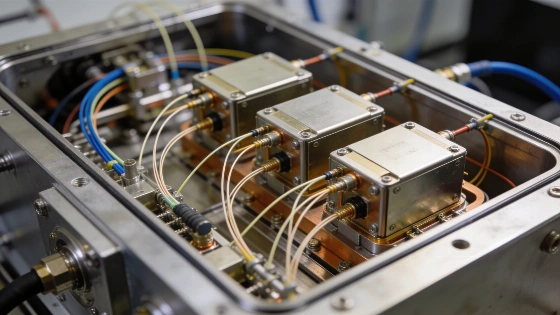
The architectural question is whether processors should grow as tightly packed systems or as networks of separate quantum processing units. Monolithic and pseudo-monolithic designs combine qubits on one die or connect chiplets using high-density microwave flex and cryogenic edge-couplers. GQI identifies heat dissipation and limited connectivity as constraints for those approaches.
From chips to networks
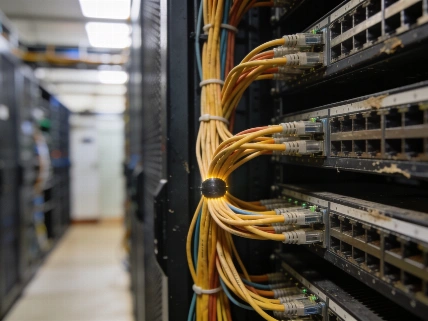
Distributed Quantum Computing (DQC) takes a different route. It links separate QPU modules over optical fibers, using photonic interfaces and Bell State Measurement (BSM) switching stations. GQI says this could separate thermal loads and support all-to-all logical connectivity, and names Photonic Inc., Nu Quantum and Quantinuum among companies focused on the architecture. The UK roadmap's discussion of quantum networking likewise describes systems built from optical links, single-photon sources, entangled photons, detectors and high-performance clocks. It identifies optical terminals, precise pointing and tracking, protocol interfaces and system-level reliability as engineering components, alongside integration with conventional ground infrastructure and basic-management systems. The highlights describe a scaling approach; they do not provide comparative system-level measurements showing that it has overcome the engineering challenges.
GQI sorts progress into eras using system size and Quops, which it defines as 1/LER, with LER meaning logical error rate. The Pioneer to Kiloquop era covers 103 Quops and near-term hybrid work. The Megaquop and Gigaquop eras correspond to 106 and 109 Quops, respectively, with active syndrome extraction and transversal logical gates. At 1012 Quops, the Teraquop era marks the commercial inflection point in GQI's baseline Bull Pathway model. These are the report's benchmarks and forecast structure, not a claim that systems at each level are already operating.
For near-term applications, the report points to Sample-based Quantum Diagonalization (SQD), QAOA warm starts, Out-of-Time-Order Correlators (OTOC) for NMR readout and quantum-boosted DMRG. It presents these as routes for exploring chemistry, materials science and improvement with hybrid methods. The supplied highlights do not give application-level performance results or establish an advantage over classical approaches.
GQI's account of quantum error correction emphasizes advanced quantum Low-Density Parity-Check (qLDPC) codes. It says QuEra's Affine Permutation Matrix and Alice & Bob's Cellular Automaton architectures can reduce physical-qubit overhead by up to 230-fold, using Qm ≤ 0.3 against Qm = 50.0 for standard Rotated Surface Codes. The highlights do not specify the full conditions behind that comparison, so the figure should be read as a reported model result rather than a universal hardware outcome.
Migration and security
GQI ties urgency around post-quantum cryptography to work on Shor's algorithm targeting ECC-256 and RSA-2048. It cites Daniel R. Simon's July 2026 preprint on the Dihedral Coset Problem, identified as IACR 2026/1591, along with technical reviews from MIT and Google. The report says the debate calls for scrutiny of mathematical assumptions underlying lattice cryptography. It does not describe a demonstrated attack that breaks those systems; its recommendation for immediate crypto-agility is a risk-management position.
The UK roadmap distinguishes post-quantum cryptography (PQC), which uses quantum-resistant mathematical algorithms for encryption and signatures, from quantum basic distribution (QKD), which exchanges keys using single photons or entangled photon pairs. It identifies PQC as the basic near-term migration route because compatible existing systems can largely adopt it through software. QKD, by contrast, relies on optical components and network infrastructure; satellite links can extend quantum-secure basic exchange beyond terrestrial fiber's distance limits for high-assurance communications. The roadmap also places the UK's Quantum Leap under the Department for Science, New idea and Technology's Office for Quantum, with £2 billion in government investment committed by 2030. It projects early niche deployments for high-assurance missions and initial multi-node demonstrations with integrated basic management over a five-to-ten-year horizon.
That focus on cryptographic readiness connects with a related insurance analysis, which covered work by Relm and Project Eleven to assess audited post-quantum controls for digital-asset coverage. GQI's highlights also describe a multi-tier communications market, from consumer and enterprise systems to High-Assurance (HA) and tactical communications. They project satellite-assisted QKD and quantum-secured networks as a strategic defense market through 2035-2045, while identifying enterprise software migration as the larger near-term spending area.
For the United Kingdom, GQI reports that the National Cyber Security Centre (NCSC) requires initial organizational roadmaps by 2028 and high-priority migrations by 2031. The UK roadmap separately states that the NCSC advises cryptographic migration be complete by 2035. It also cites parallel PQC certification activity involving the European Union (ENISA), France (ANSSI) and Germany (BSI). In the United States, the report names DARPA's Quantum Benchmarking Initiative (QBI Stage B/C) and US2QC; other programs include the UK's ProQure and NQCC testbeds, France's PROQCIMA, Germany's DLR QCI and the EU EuroHPC Joint Undertaking.
GQI recommends that hardware and software developers invest in second-generation modalities and modular DQC, and build teams for qLDPC decoding. Its guidance to investors is to assess companies for validated hardware-software co-design or roll-up opportunities. For policy leads, it flags supply bottlenecks in dilution refrigeration, optical modulators and specialty isotopes. Enterprise users are urged to inventory cryptographic assets before the stated 2030 compliance deadline.