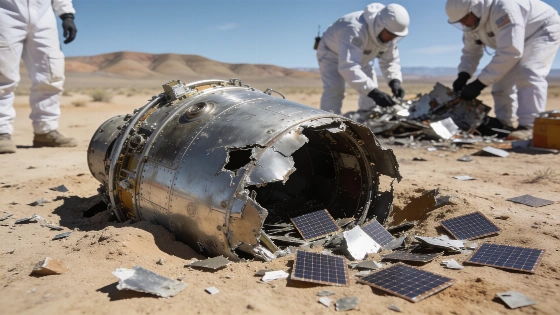
NASA's Genesis mission was meant to return solar wind samples from deep space but ended with its capsule shattered in the Utah desert after a parachute system failure. The mission's outcome forced a reexamination of spacecraft safety and sample recovery methods
When NASA's Genesis sample-return capsule slammed into the Utah desert on September 8, 2004, the impact was more than a technical mishap-it was a direct blow to the agency's confidence in established recovery procedures for high-value scientific payloads. The capsule, carrying the first extraterrestrial material since the Apollo era, was supposed to descend gently under parachute for midair capture. Instead, a basic design error left it plummeting uncontrolled, scattering fragile solar wind collectors across the ground.
Mission Ambitions and Technical Risks
Genesis was launched in August 2001 with a $264 million budget and a clear scientific goal: collect and return samples of the solar wind, the stream of charged particles constantly emitted by the Sun. The spacecraft spent over two years orbiting the L1 Lagrange point, a gravitationally stable region about 1.5 million kilometers from Earth, where it exposed arrays of ultrapure silicon, sapphire, and diamond wafers to capture atoms and ions from the solar wind. These wafers were designed to trap rare isotopes and elemental signatures that could reveal the Sun's composition and the early history of the solar system.
The return phase was engineered around a proven but unforgiving method. The capsule would reenter Earth's atmosphere, deploy a parachute, and be intercepted midair by helicopter-a technique previously used to recover classified film from military satellites. This approach demanded flawless timing and reliable sensor activation, as any failure would leave the capsule vulnerable to a destructive impact.
Failure Mechanism and Recovery Efforts
The Genesis capsule's parachute system never activated. Investigators traced the failure to a set of gravity switches installed backwards, a result of a schematic error that went undetected through assembly and testing. These switches were intended to sense deceleration during atmospheric entry and trigger the deployment sequence. With both primary and backup systems compromised, the capsule hit the ground at over 300 kilometers per hour, embedding itself in the desert floor and shattering the delicate sample wafers into thousands of fragments.
Despite the catastrophic landing, recovery teams managed to salvage a portion of the solar wind material. Scientists in protective gear painstakingly collected shards and dust from the wreckage, working to minimize terrestrial contamination. While the loss of pristine, uncontaminated samples limited the mission's scientific return, subsequent laboratory analysis still yielded valuable data on solar isotopic ratios and elemental abundances.
Consequences for Spacecraft Design
The Genesis crash forced NASA and its contractors to confront the risks of overreliance on legacy hardware and unchecked design assumptions. The gravity switch error was not a complex systems failure but a preventable assembly mistake, highlighting the need for rigorous verification even in established engineering practices. The incident triggered a review of similar systems on other missions, including the Stardust comet sample-return probe, which used the same type of gravity switches but had them installed correctly and landed successfully in 2006.
Sample-return missions remain among the most technically demanding in planetary science. The Genesis experience underscored that even small oversights in sensor orientation or deployment logic can jeopardize years of work and hundreds of millions of dollars in investment. The episode also prompted renewed scrutiny of recovery protocols, contamination control, and the balance between mission complexity and reliability. As reported earlier, even deliberate spacecraft impacts are now studied for their engineering and scientific implications, but unplanned crashes like Genesis expose the limits of risk mitigation in sample-return architecture.
Scientific Value and Ongoing Analysis
Although the Genesis mission did not deliver the uncontaminated samples originally envisioned, the fragments recovered have contributed to studies of solar isotopic composition and the processes shaping the early solar system. Researchers have extracted information about oxygen, nitrogen, and noble gas isotopes, refining models of solar and planetary formation. The compromised state of the samples, however, has required careful correction for terrestrial contamination and has limited the precision of some measurements.
Genesis remains a case study in the intersection of scientific ambition and engineering vulnerability. The mission's partial success has informed the design of subsequent sample-return efforts, emphasizing the need for redundant systems, clear assembly documentation, and independent verification at every stage. The lessons from Genesis continue to shape how agencies approach the recovery of irreplaceable extraterrestrial material.
Sample-return missions depend on a sequence of tightly coordinated engineering events, from atmospheric entry to parachute deployment and ground recovery. Gravity switches, like those used on Genesis, are designed to detect the onset of deceleration as a capsule enters the atmosphere, triggering the release of parachutes or other braking systems. If these sensors are misoriented or fail to activate, the entire recovery sequence can be lost, as happened with Genesis. The incident illustrates how a single overlooked detail in sensor installation can cascade into mission-wide failure, reinforcing the importance of exhaustive preflight checks and independent verification in spacecraft engineering.