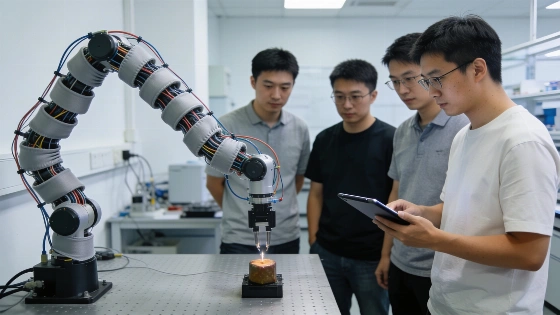
Feagine Robotics has introduced Fi0, a foundation model designed to transfer task knowledge across different soft robot arms, aiming to reduce retraining when hardware changes. Early tests used three tendon-driven manipulators with varying morphologies
Feagine Robotics has announced Fi0, a foundation model intended to enable robots with different physical structures to share task knowledge without extensive retraining. The company tested Fi0 on three tendon-driven soft manipulators-A01, A02, and A03-each with distinct lengths, segment counts, and degrees of freedom. This approach addresses a persistent challenge in robotics: most robot control systems are tightly coupled to specific hardware, making it difficult to transfer learned skills when the robot's body changes.
The three manipulators used for evaluation highlight the diversity of physical embodiments. The A01 arm features a single flexible segment, two degrees of freedom, a mass of 750 grams, and a 200-gram payload. The A02 increases complexity with two segments, four degrees of freedom, and a 400-gram payload. The A03, the most advanced in the series, offers three segments, 6+1 degrees of freedom, a 50-centimeter reach, and a 600-gram payload. These differences are not cosmetic: the number of segments and degrees of freedom directly affect the robot's workspace and ability to manipulate objects, while the soft, continuously bending design introduces additional complexity for control and perception.
Task Transfer and Demonstration
Fi0 is designed to reduce the need for retraining when robots encounter new tasks or hardware. According to Feagine, if the model faces a task outside its current capabilities, a human can provide a single demonstration. Rather than updating its internal parameters through further training, Fi0 uses the demonstration as context at inference time. The model attempts to extract the relevant objects, sequence of actions, and desired end state, then generates actions appropriate for the robot's own morphology. This method is intended to generalize across different robot bodies, moving away from the traditional approach of learning isolated policies for each machine.
Feagine's system incorporates an Embodiment Graph, a representation that encodes the robot's physical structure, sensing, actuation, and current state. The model also includes components for interpreting the physical environment and predicting the consequences of different actions. The company refers to this combination as soft embodied intelligence, emphasizing the integration of morphology and control. However, the evidence for Fi0's generalization remains limited to company demonstrations on the three in-house manipulators. Broader validation across more diverse hardware and real-world environments has not yet been reported.
Soft Robotics as a Test Case
Soft, tendon-driven manipulators present a particularly challenging test for cross-embodiment learning. Unlike traditional rigid arms, soft robots can bend continuously and interact compliantly with their surroundings, making their configuration more difficult to describe and control. Fi0's architecture is designed to account for these complexities by integrating detailed information about the robot's morphology and state into its decision-making process. This is a departure from conventional robot control, which often assumes fixed, easily modeled hardware.
The broader significance of this research lies in the possibility of decoupling intelligence from hardware. If a foundation model can reliably transfer task knowledge across specialized robots, it could reduce the engineering burden of developing new machines for different environments. This stands in contrast to the pursuit of a single universal robot body, such as the humanoid form, which has attracted significant attention but remains technically and economically challenging for many applications. For example, recent research on collaborative robots, such as the ergoCub system for shared lifting tasks, demonstrates the ongoing need for specialized designs tailored to specific environments and user needs.
Limitations and Open Questions
Fi0 remains an early-stage system, and its claims of cross-embodiment generalization have not been independently verified. The demonstrations to date have been limited to Feagine's own manipulators and controlled tasks. It is not yet clear how well the model will perform when faced with unfamiliar hardware, more complex environments, or tasks that require fine manipulation or safety-critical decision-making. The approach also depends on the quality and relevance of human demonstrations, which may vary in practice.
As robotics research moves beyond standardized industrial arms, the ability to transfer knowledge across diverse machines could become increasingly important. However, the technical and safety challenges of deploying such systems in real-world settings remain substantial. Further evaluation, including independent testing and broader hardware diversity, will be necessary to establish the reliability and limits of cross-embodiment foundation models like Fi0.
Foundation models in robotics are large-scale machine learning systems trained to capture general patterns across a wide range of tasks, environments, or robot bodies. Unlike traditional task-specific models, foundation models are designed to be adapted or prompted for new tasks without retraining their core parameters. In the context of robot control, this means encoding both the robot's physical structure and its sensory inputs, allowing the model to generate actions that are appropriate for different embodiments. However, the effectiveness of this approach depends on the diversity of training data, the accuracy of the robot's self-description, and the ability to interpret demonstrations in a way that generalizes beyond the original context. As with all foundation models, careful evaluation is required to ensure that apparent generalization is not the result of overfitting to a narrow set of examples.