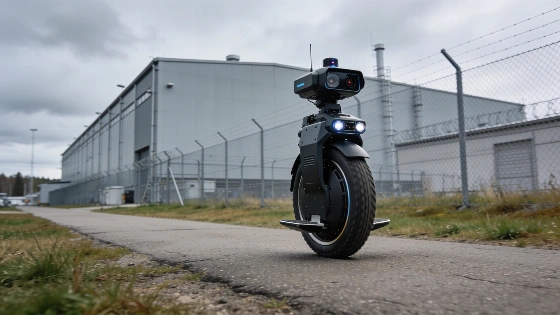
Rollo Robotics has introduced 1ROLLO, a single-wheel robot designed for autonomous patrols of large facilities, using computer vision and edge AI to monitor industrial sites and campuses with minimal human intervention
An Estonian company, Rollo Robotics, has announced the development of 1ROLLO, a single-wheel mobile robot intended for autonomous security patrols in large outdoor environments. The system is described as the first of its kind to achieve stable, real-world operation on a monowheel platform, with the company aiming to reduce the need for human patrols at industrial sites, data centers, airports, and similar facilities. The robot is currently at the prototype stage, with commercial availability targeted for 2027. No independent technical evaluation or peer-reviewed publication has yet been released.
Gyroscopic System Keeps the Monowheel Upright
1ROLLO's design centers on a 60-centimeter-wide wheel, inside which a high-speed flywheel is mounted vertically. This flywheel generates gyroscopic forces to keep the robot upright while moving, turning, or stopping, addressing a longstanding challenge in monowheel robotics. Directional changes are achieved by tilting the internal flywheel, allowing the robot to lean into turns in a manner similar to a motorcycle. The robot stands 110 centimeters tall and weighs approximately 45 kilograms. According to Rollo Robotics, the system can reach speeds up to 30 kilometers per hour and operate for up to eight hours on a single battery charge, after which it returns autonomously to a wireless charging station. The enclosure is rated IP65 for dust and water resistance, and the robot is specified to function in temperatures from -20°C to 55°C.
For perception and navigation, 1ROLLO integrates a 360-degree vision system using computer vision and edge AI to detect people, vehicles, open doors, and other anomalies. An RTK-GNSS positioning system provides centimeter-level localization along pre-mapped patrol routes. High-frequency sensors supply data to proprietary control software, which continuously adjusts balance and trajectory, including in windy or uneven conditions. When the robot detects unusual activity, it sends alerts to a cloud-based fleet management platform via 4G, 5G, or Wi-Fi. Operators can access live video, communicate through the robot's microphone and speaker, or dispatch human security personnel as needed. The platform supports simultaneous management of multiple robots from a central dashboard.
Modular Sensors and Subscription-Based Deployment
One practical advantage of the monowheel design is its ability to navigate narrow corridors, entrances, and crowded walkways that may be inaccessible to larger four-wheeled robots. The system's modular architecture allows for the integration of additional payloads, such as thermal cameras, pan-tilt-zoom cameras, night vision, and RFID readers, depending on the deployment requirements. Rollo Robotics plans to offer 1ROLLO as a subscription service, with customers paying a monthly fee that covers hardware, maintenance, software updates, and future upgrades, rather than selling the robot outright.
Rollo Robotics has not disclosed the full details of its testing procedures or failure rates, and the system's reliability in uncontrolled environments remains unverified by independent parties. The company's announcement follows a broader trend of automation in facility security, as organizations seek to reduce labor costs and increase coverage. The deployment of autonomous robots in sensitive environments raises questions about safety, privacy, and the adequacy of current regulatory frameworks. These issues are particularly relevant as the scale of automated infrastructure expands, as seen in recent large-scale technology investments such as the construction of hyperscale data centers for AI development.
1ROLLO's reported specifications include a single 60-centimeter wheel, a total height of 110 centimeters, a weight of 45 kilograms, a maximum speed of 30 kilometers per hour, and up to eight hours of battery-powered operation. The robot is designed to autonomously return to a wireless charging station when power is low, supporting continuous deployment. The enclosure is rated IP65, and the system is intended to operate in a wide range of weather and temperature conditions. The company claims the robot can be equipped with a variety of modular sensors and payloads, but has not provided detailed performance data for these configurations.
Autonomy Remains Limited by Human Oversight
Understanding the distinction between automation and autonomy is central to evaluating systems like 1ROLLO. While automation refers to the execution of predefined tasks without direct human input, autonomy implies the ability to make context-dependent decisions and adapt to changing environments with minimal oversight. In practice, most security robots—including 1ROLLO—operate within mapped environments and rely on human intervention for exception handling, system resets, and response to complex incidents. The degree of autonomy is therefore limited by the robot's sensing, control algorithms, and the reliability of its communication with human operators. As deployment expands, the boundaries between automated and autonomous operation will remain a critical area for technical, regulatory, and ethical scrutiny.