NASA and Boeing tested digital taxi guidance and runway sensing at Ames in March 2026, demonstrating how sensor data could detect obstacles and reduce communication errors without replacing pilots or air traffic controllers
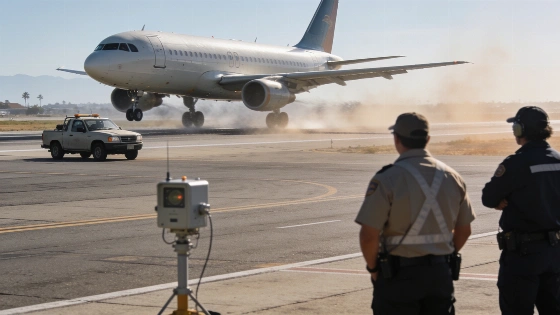
A runway vehicle or stray suitcase can become a serious hazard when an aircraft is landing. In March 2026, testing at NASA's Ames Research Center in California's Silicon Valley demonstrated sensors that identified an obstacle on a runway while a Boeing aircraft prepared to land. The result was not a deployment across commercial airports but a field test of technology intended to give pilots and controllers earlier and clearer information.
Large airports force aircraft, ground crews, baggage equipment, and service vehicles into the same tightly managed network of taxiways and runways. The danger is not limited to mechanical failure. A verbal instruction can be misunderstood, a vehicle can enter the wrong area, or an object can remain in an aircraft's path without being immediately visible to the crew.
NASA researchers worked with Boeing on three connected test areas described as digital taxi information, safe taxiway, and safe runways. During the digital taxi trials, pilots received taxiway guidance on cockpit displays or tablets instead of relying solely on spoken instructions from air traffic controllers. Aircraft followed digital routes with autonomous functions while sensors monitored the intended path for vehicles or other aircraft.
The system's proposed advantage is straightforward: it creates a shared digital route and checks that route against the physical movement around the aircraft. That could reduce workload for pilots and controllers while limiting the possibility that a spoken clearance is copied incorrectly or misunderstood. The concept is closer to decision support and human-machine coordination than to an autoland system.
The runway test supplied the clearest operational evidence. While the Boeing aircraft was being prepared for landing, the sensor suite successfully flagged a vehicle occupying the runway. The alert did not replace the pilot's judgment or guarantee collision avoidance. It supplied an additional layer of situational awareness at the point where a late discovery could leave less time to respond.
That distinction matters. NASA demonstrated that the system could identify an incursion during a controlled field test, not that it has eliminated runway incursions or demonstrated safety performance across the commercial aviation network. The available material gives no detection rate, response time, false-alarm rate, confidence interval, statistical significance test, or certification status, so the scale of any eventual safety improvement cannot yet be measured.
The broader aviation trend is moving in the same direction. By September 2026, the FAA's Surface Awareness Initiative had reportedly expanded to 100 air-traffic-control towers, illustrating how digital monitoring is being used to improve awareness of aircraft and vehicles operating near runways. This infrastructure complements, rather than validates, the NASA-Boeing prototype; operational deployment still requires integration, testing, certification, and procedures for responding to alerts. Further FAA coverage describes that wider modernization effort.
NASA's work also addresses delays after an aircraft leaves the gate. In a 2025 collaboration with Boeing, United Airlines, and international partners, researchers evaluated real-time trajectory sharing on domestic and transoceanic flights. A United Airlines Boeing 737 shared frequent flight information with airline operations centers and air traffic control, allowing NASA to study how often updates should be sent and which details improve arrival predictions.
More accurate trajectory information could help controllers sequence aircraft with fewer holding patterns and more direct descents. NASA has also developed pre-departure rerouting and digital exchange tools that allow dispatchers and controllers to view the same digital picture of flights preparing to depart. When a more efficient route is available, the change could be coordinated digitally rather than passed through a chain of verbal exchanges.
The routing technology has now been transferred to the Federal Aviation Administration, while airlines continue testing it. The agency's wider technology portfolio also includes space instrumentation described in an earlier NASA report. The connection is not a shared aviation application but a common engineering principle: convert complex sensor data into information that operators can use before a hazard or delay becomes harder to manage.
NASA plans to combine the sensor and digital taxi systems in a simulated air traffic control environment. That next stage is important because runway detection and route guidance will have to work within the wider traffic-management system rather than as isolated demonstrations. Researchers will need to assess how the tools interact with controllers, pilots, aircraft movements, and competing demands for runway access.
Parimal Kopardekar, director of NASA's Airspace Operations and Safety project, has framed additional autonomy as part of a future airspace in which multiple aircraft operate in coordination. The practical value of that autonomy will depend less on the novelty of the software than on whether it produces reliable information under busy airport conditions and remains understandable to the people responsible for acting on it.
Digital taxiing is best understood as decision support with autonomous functions rather than a replacement for pilots or air traffic controllers. A route displayed electronically is still a model of intended movement, while a sensor alert is a measurement that can contain uncertainty. NASA's tests therefore mark a credible step toward more data-driven airport operations, but the technology's real significance will be decided by integrated trials and airline use rather than by the demonstration alone.
At its core, trajectory sharing works by updating an aircraft's expected position over time. Weather, turbulence, traffic, and small changes in altitude can alter that estimate, so more frequent information can help controllers compare planned and actual movement. The evidence presented here shows that NASA is testing the machinery needed to make those updates and runway alerts more usable. It does not yet show a finished commercial system, but it does support a clear editorial judgment: aviation modernization will succeed only when digital autonomy improves human decisions without hiding the limits of the underlying measurements.