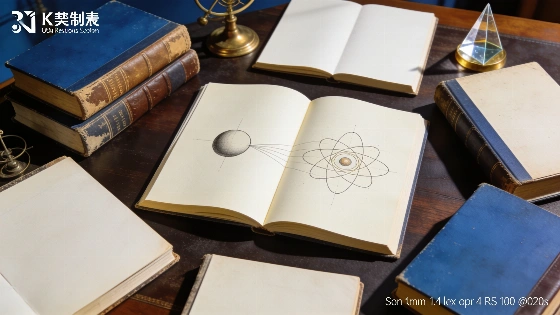
Across eight editions of the Encyclopedia Britannica the atom shifts from an indivisible particle to a quantum structure. The entries show how scientific models gain authority and lose it as evidence changes
The 15th edition sends readers from a short atom entry to a 52-page account of its structure and component particles. Across earlier editions of the Encyclopedia Britannica, the same subject moves from an indivisible speck of matter to a system governed by quantum principles. The changing entries preserve the history of scientific ideas in miniature.
From particle to theory
The first edition was issued between 1768 and 1771, though the collector's copy is a reprint. Its 34-word definition presents the atom as matter's smallest indivisible particle. In the seventh edition, published in 1830 after John Dalton's pioneering work on atomic theory, the entry remained unchanged. Dalton's ideas had not yet been fully accepted. His theory described elements as being made up of distinct atoms with characteristic relative weights, propositions later examined through chemical measurements and the study of gases.
The ninth edition, published in 1875, marked a sharp turn. James Clerk Maxwell served as scientific co-editor with Thomas Huxley and wrote the atom entry himself. Across 19 pages, Maxwell explained atomic theory as a serious alternative to "the view that matter was infinitely divisible." He discussed Dalton's account of gases and the then-popular proposal that atoms were vortices in a fluid. He also considered how atoms might explain spectral lines and gravitation. Nineteenth-century work on molecular weights, spectra and thermodynamics helped make the atom a subject of technical debate rather than simply a philosophical definition.
Maxwell compared kinds of atoms with animal species, while noting that atoms appeared uniform and discrete. That resemblance led him to suggest a manufacturer. Later editions would leave that explanation behind as the physical picture changed.
Radioactivity and quantum physics
By 1910, the 11th edition had a new account by Cambridge metallurgist Francis Neville. Published after radioactivity had been discovered and quantum theory had emerged, it explained the quantitative laws associated with atoms while acknowledging that some chemists expected atomic theory to be abandoned. Radioactivity, Neville argued, supported the reality of atoms while showing that they could change and decay. Henri Becquerel shared the 1903 Nobel Prize in Physics with Pierre and Marie Curie for work on spontaneous radioactivity; Ernest Rutherford received the 1908 Nobel Prize in Chemistry for investigations into the disintegration of elements and radioactive substances.
The experimental picture continued to develop: J. J. Thomson identified the electron in 1897, Rutherford's 1911 scattering work pointed to a compact nucleus containing positive charge and most of the atom's mass, and Niels Bohr proposed quantized electron states in 1913. Planck's 1918 Nobel Prize recognized his discovery of energy quanta, while Einstein received the 1921 Physics prize for the law of the photoelectric effect. Bohr received the 1922 prize for his investigation of atomic structure and radiation, as recorded by the Nobel Prize organization.
The 14th edition, published in 1929, gave the subject to Niels Bohr, who had received the 1922 Nobel Prize in Physics for his atomic model. Atoms, Bohr explained, consisted of a nucleus and electrons rather than indivisible units. His entry treated quantum theory as central to atomic structure and described the limits of what could then be explained. The edition was revised for 45 years before its successor was substantially rebuilt.
That distinction between a proposed architecture and demonstrated capability remains relevant to quantum technology. A review of hybrid qubit designs describes specialized near-term roles rather than a replacement for aluminum transmons.
What makes a model true?
The 15th edition, published in 2010, divided its material between a 10-volume Micropedia and a Macropedia of longer articles. The atom entry in the shorter section directs readers to Atoms: Their Structure, Properties, and Component Particles, a 52-page monograph. Its scope includes the atom's history and physical structure, among other topics. The added detail makes the account more comprehensive while making it less like a quick reference.
Philosopher Harvey Cormier, a Stony Brook colleague of the essay's author, offers a way to think about why the entries disagree. In the pragmatist tradition, truth concerns descriptions that work-not merely for a particular person or moment. Earlier atomic models could guide physicists in their own time and still prove inadequate when later evidence exposed their limits.
That standard leaves the current model open to the same test. The 15th edition's print run ended with its 2010 publication; in 2012, the Britannica ceased print publication and moved online, where its entries could be revised.