Beijing Lesentech says the RXR-M80D-AX2 stayed operational through a 30-minute 1,000°C furnace exposure. Its water-and-foam cannon is rated at 80 L/s, while the test does not establish performance amid smoke and falling debris
A mobile machine facing extreme heat has to protect its control electronics, motors, sensors and communications at once. That is the engineering hurdle behind this furnace demonstration.
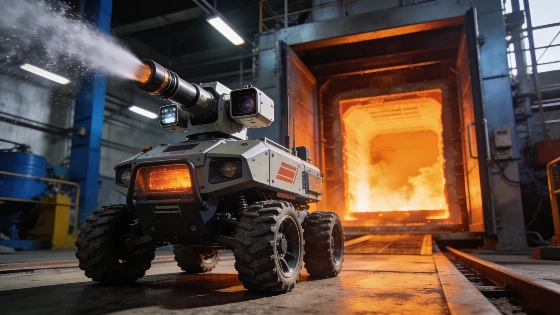
Beijing Lesentech's RXR-M80D-AX2 reportedly remained operational after 30 minutes in a furnace at 1,000°C (1,832°F). The company describes the robot as designed to enter the high-temperature core of a fire without external cooling and carry out suppression work for more than 30 minutes. Lesentech has said the model was launched in 2020. The reported demonstration supports a claim of heat resistance under those test conditions; it does not establish reliability in an active fire.
The roughly 800-kilogram robot measures 1,750 × 1,100 × 1,200 millimeters. Its reported mobility specifications include a maximum speed of 1.5 meters per second, the ability to climb a 30-degree slope, cross trenches up to 400 millimeters wide and clear obstacles 170 millimeters high. Reported endurance is four hours, and the enclosure is rated IP65. A Supercar Blondie report details these specifications and the furnace demonstration.
For firefighting, the machine carries a water-and-foam cannon rated for up to 80 liters per second and a stated range of 85 meters. It operates at 1.0 MPa and can switch between a concentrated jet and mist spray. The cannon rotates 60 degrees horizontally and adjusts vertically from -15 to +75 degrees. Gas sensors detect carbon monoxide, methane, hydrogen sulfide and hydrogen, alongside temperature monitoring; visible-light cameras and an infrared thermal camera provide imagery. Operators use a joystick-based remote controller, with wireless communication reaching up to 1,000 meters under line-of-sight conditions.
The account does not describe the furnace test protocol or the number of repeated trials. It also gives no independent assessment. A separate report on a climbing robot described overheating during a Mount Taishan course; that involved a different machine and a different test.
Real fires bring conditions the furnace demonstration does not reproduce: smoke and falling debris can obstruct operations, while heat distribution can shift and structures can be damaged. The test is evidence of a notable thermal-resistance demonstration, not proof that the robot can operate reliably across those hazards.