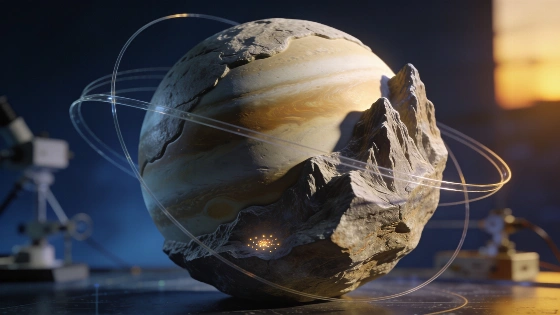
A mathematical explanation links spherical harmonic model failures to singularities shaped by planetary form and density, clarifying why some calculations hold inside the Brillouin sphere while others fail near the surface
The Brillouin sphere is the smallest sphere centered at the coordinate origin that contains a planet's mass, with its radius set by the body's greatest radial extent. It marks the traditional limit for guaranteed convergence in spherical harmonic gravity models: outside it, the series converges uniformly. But the sphere does not predict how well those models work closer to the surface.
Why convergence varies
Researchers use spherical harmonic expansions to model planetary gravity, with applications that include satellite navigation and Earth observation. Outside the Brillouin sphere, adding more harmonic terms improves accuracy. Inside it, results have differed: expansions can remain valid well within the sphere for smooth idealized bodies, yet fail much nearer the surface of rougher planets with complex topography. In geodesy, extending an exterior representation toward or below the sphere is known as downward continuation; the process is also used in attempts to continue the geopotential down to sea level, where topographic masses can introduce bias.
The study attributes that contrast to singularities in the mathematical gravitational potential. Their locations depend on physical properties of the body, including its shape and mass density. For smooth bodies, singularities can lie deep inside the planet. Mountains, edges and irregular terrain can bring them closer to the surface, limiting how far inward the expansion remains reliable. In related geodesy work, researchers warn that models can become unstable inside the spherical boundary, with errors intensifying near the body, particularly at higher spatial frequencies.
A 2020 mathematical study by Ovidiu Costin, Rodica D. Costin, Marjorie K. Drake and Gerald V. Dunne examined generic planets with varied topography. The authors concluded that, short of analyticity, the spherical harmonic expansion converges in the closure of the exterior of the Brillouin sphere. For a generic planet in their framework, the probability that the expansion converges anywhere below the sphere is zero. The paper also describes faster coefficient decay for smoother planets, while noting a sharp cusp as a pathological exception. Its results concern convergence of the expansion, not the existence of the planet's physical gravitational field. The authors' paper, published on arXiv, formalizes the distinction between guaranteed exterior convergence and exceptional cases of inward continuation.
What singularities show
The explanation shifts attention from the Brillouin sphere alone to the hidden mathematical features that govern the expansion. The sphere still defines the boundary of guaranteed convergence; the singularities help explain why performance inside it varies from one planetary body to another. The reported result concerns the accuracy of the calculation. It does not mean that gravity itself breaks down near a mountain or an irregular surface.
Geometry and coordinate choice also affect how a gravitational potential is represented. A peer-reviewed study of homogeneous ellipsoidal shells found that ellipsoids of revolution with the same total mass and linear eccentricity can share an external gravitational field even when their density, volume and semi-major axes differ. In spherical coordinates, the potential takes the form of an infinite, rapidly converging spherical harmonic series; in elliptical coordinates, the same study derived a finite series containing only degrees zero and two. Inside the massive ellipsoid, the governing equation is Poisson's equation rather than Laplace's equation.
Gerald Dunne of the University of Connecticut presents singularity analysis as a way to clarify the accuracy problem and pursue higher precision. The paper illustrates the approach with simple, familiar examples. Its title specifies axially symmetric planets: "Singularities and the divergence of spherical harmonic expansions: axially symmetric planets," by Gerald V Dunne et al., published in 2026 in Rep. Prog. Phys. 89 098301.
Models in practice
Gravity models support planetary exploration as well as satellite navigation and Earth observation. The convergence issue also matters for spacecraft operating around irregular small bodies: a vehicle can be physically outside the surface yet within the body's circumscribing Brillouin sphere when passing over concave terrain. A study of gravity estimation at Bennu considered recovery of spherical harmonic terms to at least degree 40 within months of observations for a small body with Bennu-like mass. The authors noted that concave regions are common among small bodies, so an orbit does not always remain outside the Brillouin sphere. A separate navigation approach uses magnetic fields rather than gravity harmonics; Science Report covered that distinction in its magnetic navigation report.
The finding offers a framework for assessing where spherical harmonic models may remain useful inside the Brillouin sphere. Related work includes "Divergence beneath the Brillouin sphere and the phenomenology of prediction error in spherical harmonic series approximations of the gravitational field," by M Bevis et al. (2024).