Researchers have identified the name of a Maya mathematician and astronomer in wall inscriptions at the San Bartolo-Xultun site in Guatemala, revealing new details about scientific activity in the region during the eighth century CE
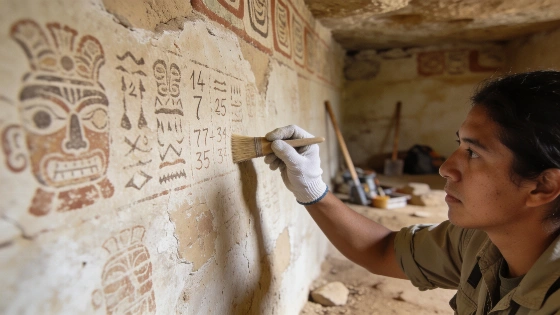
Archaeologists working at the San Bartolo-Xultun site in northern Guatemala have identified the name of a Maya mathematician and astronomer active in the eighth century CE, according to a report from Science Magazine. The discovery centers on a series of wall inscriptions found in a room near the border with Mexico, where more than 50 mathematical calculations and astronomical texts were preserved. The inscriptions include the name Sak Tahn Waax, translated as “White-chested Fox,” marking the first time a Maya astronomer’s personal name has been securely linked to such scientific records.
Classroom and Workshop
The room containing the inscriptions was excavated as part of ongoing research into Maya intellectual life. Archaeological evidence suggests the space functioned as both a classroom for mathematical instruction and a workshop for producing codices-folded books made from bark paper. Artifacts recovered from the room, including writing implements and fragments of codex material, support this interpretation. The wall texts were documented through direct observation, high-resolution photography, and digital enhancement, allowing researchers to reconstruct faded or damaged glyphs more accurately.
Analysis of the inscriptions revealed that the calculations were designed to synchronize the Maya calendar with the observed cycles of Mars and Venus, reflecting a sophisticated understanding of planetary motion. The name Sak Tahn Waax, written using the phrase che-he-na followed by the glyphs SAK-TAHN-wa-xi, appears alongside these calculations, indicating authorship or attribution. Although the identification is based on established epigraphic methods, the individual’s precise social status and wider role in Maya society remain uncertain.
Astronomical Records
More than 50 distinct calculations and astronomical notations were recorded on the room’s walls, representing one of the largest known assemblages of Maya scientific writing from this period. The inscriptions date to the eighth century CE based on their stratigraphic context and associated artifacts. The preservation of mathematical and astronomical content in a single archaeological setting provides unusual evidence for the relationship between scientific knowledge, instruction, and written production in Classic-period Maya society.
The identification of Sak Tahn Waax contributes to debates about authorship and the transmission of specialized knowledge in ancient Mesoamerica. Maya texts frequently record dates, political events, and royal names, but explicit attribution to scientific specialists is uncommon. The San Bartolo-Xultun evidence suggests that some astronomers and mathematicians may have received recognition for their work, although it remains unclear how widespread this practice was.
Reading the Glyphs
Epigraphic analysis-the study of ancient inscriptions-depends on careful documentation, comparison, and interpretation of written signs. Researchers examining the San Bartolo-Xultun inscriptions used field drawings, digital imaging, and comparative reference materials to reconstruct damaged or eroded glyphs. Maya writing combines logographic signs representing words with syllabic signs representing sounds, making the identification of personal names dependent on established reading conventions and contextual comparison.
The reading of Sak Tahn Waax is supported by current scholarship, but epigraphic interpretations can change as new inscriptions are discovered and analytical methods improve. The placement of the name beside the calculations supports attribution, yet it cannot by itself establish the individual’s official position, training, or social background.