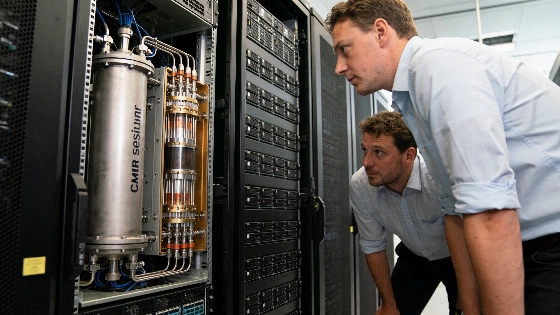
Diraq and Equinix plan to deploy an eight-qubit silicon spin quantum processor in a commercial Sydney data center, aiming to test hybrid quantum-classical integration and evaluate operational benchmarks for enterprise access
Diraq, a developer of silicon spin-qubit hardware, and Equinix, a global data center operator, have announced plans to install an eight-qubit quantum processor within an operational Equinix commercial data center in Sydney, Australia. The system, scheduled for deployment by October 2026, is described by the companies as the first silicon spin-based quantum computer to be integrated into a shared commercial data center environment. This deployment is intended to test the feasibility of running quantum processors alongside conventional enterprise computing infrastructure, including CPUs and GPUs, within standard data center conditions.
Device Architecture and Integration
The Diraq quantum processor is engineered to fit within a standard server rack, occupying a physical footprint comparable to conventional enterprise hardware. The system includes a self-contained cryogenic unit, silicon spin-qubit chip, and control electronics, all operating with a total power draw below 20 kilowatts. Unlike large-scale laboratory cryostats, this design is intended to minimize infrastructure modifications and allow direct integration with existing data center power and cooling systems. The processor's modularity is a central feature: scaling to higher qubit counts is achieved by swapping the silicon chip, without altering the surrounding infrastructure. Diraq's fabrication process leverages commercial CMOS foundries, using the same manufacturing techniques as mainstream semiconductor devices, which the company claims could support future scaling to much larger qubit arrays.
Operational Benchmarks and Hybrid Workflows
The Sydney deployment will focus on validating remote monitoring, secure networking, and low-latency connections between the quantum processing unit (QPU) and classical computing resources. The companies aim to establish operational benchmarks for hybrid quantum-classical and quantum-AI workflows, assessing how silicon spin QPUs can be integrated with accelerated AI clusters in a live data center setting. Once initial performance and integration tests are complete, Diraq and Equinix plan to provide enterprise partners and commercial customers with access to the system for application testing under data sovereignty, security, and compliance requirements. The project's stated goal is to move beyond isolated laboratory demonstrations and evaluate the practical challenges of deploying quantum hardware in environments governed by commercial standards and operational constraints.
Engineering Constraints and Scalability
While the eight-qubit processor represents a modest scale by current quantum computing standards, the deployment is intended as a testbed for engineering integration rather than a demonstration of quantum computational advantage. Key technical challenges include maintaining qubit coherence and gate fidelity in a noisy data center environment, ensuring reliable cryogenic operation, and managing control electronics within the power and cooling limits of standard racks. The modular chip-swapping approach is designed to enable future upgrades, but the practical scalability of silicon spin qubits to hundreds or thousands of high-fidelity devices remains an open engineering question. The companies have not released detailed performance metrics for the processor, and independent benchmarking will be necessary to assess the system's stability and error rates under operational conditions.
Context in Quantum Workforce and Training
This initiative reflects a broader trend toward integrating quantum hardware into conventional IT infrastructure and making quantum resources accessible to enterprise users. As quantum processors move from laboratory prototypes to operational testbeds, workforce training and system operation become increasingly important. Recent efforts, such as the launch of simulator-based training platforms for quantum processor operation, including hands-on quantum hardware simulation academies, highlight the need for practical skills in device measurement, tuning, and system management. The Diraq-Equinix deployment will provide a real-world environment for testing not only hardware integration but also operational procedures, monitoring, and compliance in a commercial context.
Silicon spin qubits are quantum bits realized by controlling the spin state of single electrons confined in silicon quantum dots. These devices are attractive for their compatibility with established semiconductor manufacturing and their potential for high-density integration. However, maintaining quantum coherence and achieving high-fidelity gate operations in realistic environments remain significant challenges. Coherence times are limited by charge noise, magnetic fluctuations, and device variability, while gate fidelities are affected by control errors and crosstalk. The distinction between physical and logical qubits is critical: while physical qubits are the basic building blocks, logical qubits require error correction across many physical devices. Demonstrations of small-scale silicon spin qubit arrays are an important step, but scaling to useful, fault-tolerant quantum computation will require substantial advances in fabrication, control, and error correction.