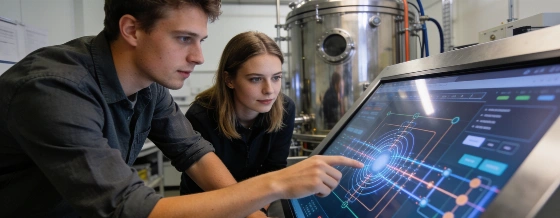
QuantrolOx and QURECA have introduced the Quantum EDGE Academy, a simulator-based platform designed to train experimentalists and engineers in quantum processor measurement, tuning, and system operation without direct access to physical quantum hardware
QuantrolOx, a developer of quantum measurement and control software, has partnered with QURECA to launch the Quantum EDGE Academy, a training platform aimed at addressing the shortage of experimentalists and technicians with practical experience in quantum hardware. The initiative integrates a flight-simulator-style software environment into QURECA's educational offerings, allowing users to practice the automated workflows required for quantum processing unit (QPU) development, qubit characterization, and system troubleshooting.
Simulator-Based Quantum Hardware Training
The Quantum EDGE Academy is structured to replicate the laboratory conditions and procedures encountered in real quantum hardware environments. The platform enables learners to execute automated QPU tuning, perform qubit measurement, and diagnose setup errors using the same control sequences and diagnostic routines deployed by QuantrolOx engineers. This approach is intended to build laboratory intuition and technical proficiency without requiring immediate access to dilution refrigerators or risking damage to sensitive superconducting devices.
Courses offered through the academy are accredited for Continuing Professional Development (CPD) and are available via per-seat or departmental subscriptions, making them accessible to universities, national laboratories, and corporate research teams. The first pilot cohort is scheduled to begin in September 2026, with enrollment open to academic, government, and industry partners.
Bridging the Skills Gap in Quantum Engineering
While theoretical quantum education has expanded rapidly, the practical skills needed to operate and maintain quantum hardware remain in short supply. The Quantum EDGE Academy targets this gap by providing a simulation-first pathway for training on automated measurement and control systems. The curriculum is designed to familiarize participants with the operational challenges of dilution refrigerators, multi-qubit calibration, and error diagnosis-skills that are essential for scaling quantum processors beyond laboratory prototypes.
For institutions seeking to progress from simulation to hands-on experimentation, the academy offers a bridge to physical hardware. Graduates can transition to working with systems such as QuantrolOx's VIDYAQAR, an open-architecture superconducting QPU platform intended for education and research. This staged approach is intended to reduce the learning curve and minimize the risk of hardware damage during early training.
Technical Architecture and Delivery Model
The Quantum EDGE Academy is built on the QuantrolOx Quantum EDGE Platform, which supports automated QPU tuning and qubit characterization workflows. The software environment is designed to scale from single-user training to departmental deployments, supporting both individual learners and institutional cohorts. The simulation environment models the behavior of superconducting qubits under realistic noise, drift, and calibration conditions, providing feedback on measurement accuracy and control fidelity.
Certification is delivered through QURECA's CPD-accredited framework, with flexible subscription models to accommodate varying institutional needs. The platform is positioned as a preparatory step for direct engagement with physical quantum hardware, supporting the development of a technically skilled workforce capable of operating advanced quantum systems.
Context in Quantum Workforce Development
The launch of the Quantum EDGE Academy reflects a broader trend toward practical skills development in quantum technology. As more countries and companies invest in quantum infrastructure, the demand for technicians and engineers with hands-on experience is increasing. Similar efforts to build local quantum expertise can be seen in initiatives such as the deployment of neutral-atom quantum processors in Saudi Arabia, where Pasqal and Eleven Ventures are establishing regional training and infrastructure to support workforce growth.
By focusing on simulation-based training, the Quantum EDGE Academy aims to make quantum hardware education more accessible and scalable, particularly for institutions without direct access to cryogenic facilities or operational QPUs. The effectiveness of this approach will depend on how closely the simulated environment matches the complexities of real hardware and whether graduates can transfer their skills to physical systems with minimal additional training.
Quantum hardware training requires familiarity with both the underlying physics and the engineering constraints of superconducting devices. Superconducting qubits, which operate at millikelvin temperatures inside dilution refrigerators, are highly sensitive to noise, calibration drift, and environmental disturbances. Automated measurement and control workflows are essential for tuning qubit parameters, diagnosing errors, and maintaining system stability. Simulation-based platforms can provide exposure to these challenges, but hands-on experience with real devices remains critical for mastering the full range of operational variables encountered in experimental quantum computing.