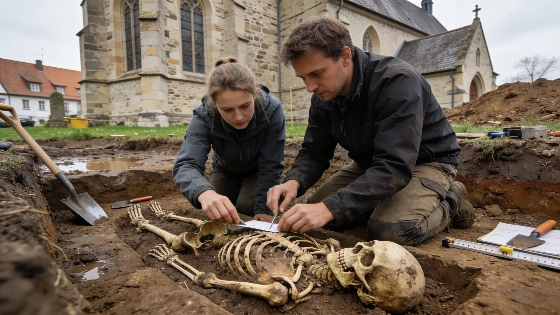
Radiocarbon dating of human remains from excavations at St John the Baptist Church in Altenberge, Germany, has established the presence of an early medieval cemetery, providing direct evidence for Christian burial at the site over a millennium ago
Archaeological investigations at the Catholic parish church of St John the Baptist in Altenberge, North Rhine-Westphalia, have produced the first direct scientific evidence that the site was used for Christian burial during the Early Middle Ages. Human skeletal remains uncovered during sewer renovation works were subjected to radiocarbon dating, confirming that the cemetery dates to between the 8th and early 11th centuries CE. This result substantiates longstanding historical hypotheses about the church's origins and its role in the early Christianization of the region.
Excavation and Context
The cemetery was identified during infrastructure works in autumn 2025, when archaeologists documented 11 west-east oriented graves adjacent to the church. The excavation was limited to areas directly affected by the sewer project, restricting the exposure of the burial ground. Despite these constraints, the skeletal remains were notably well preserved, allowing for reliable sampling and analysis. The graves' orientation and location are consistent with Christian burial practices of the period, but prior to this investigation, the chronology of the cemetery had not been established through direct scientific dating.
Radiocarbon analysis was conducted on four bone samples by a specialist laboratory in Vilnius, Lithuania. The results placed the burials within a calibrated range from the 8th to the early 11th centuries CE, confirming their attribution to the Early Middle Ages. This provides a secure chronological anchor for the cemetery and, by extension, for the earliest phase of the church's use as a Christian site.
Material Evidence and Interpretation
In total, 11 graves were recorded, all oriented west to east, a pattern typical of Christian burial customs in early medieval Europe. The skeletal material was sufficiently intact to permit radiocarbon dating, a method that measures the decay of carbon-14 in organic remains to estimate the time since death. The preservation of the bones was described as exceptional for the region, which often presents challenges due to soil conditions and later disturbance.
Historical sources have suggested that the church may have been founded by Saint Liudger, the first Bishop of Münster, who died in 809 CE, and that it was established on the site of a bishop's estate. While the new evidence does not directly confirm the founder, it does demonstrate that the location was used for Christian burial during the period of early ecclesiastical expansion in Westphalia. The findings align with broader patterns of rural church foundation and cemetery use in early medieval Germany, as seen in other recently investigated sites such as the pre-existing cemetery beneath Hermann Göring's former residence at the Wolf's Lair, discussed in a related Science Report article.
Additional Discoveries and Limitations
Beyond the early medieval graves, the 2024 fieldwork also revealed the remains of a substantial rubble-stone cellar, with associated ceramics indicating use in the 13th century CE. This suggests a long sequence of occupation and construction at the site, but the primary focus of the current analysis remains the early medieval cemetery. The limited excavation area means that the full extent of the burial ground is not yet known, and only a small sample of graves could be analyzed. No grave goods or associated artifacts were reported from the early medieval burials, which is consistent with Christian mortuary practice in the region during this period.
Local officials have noted that the archaeological discoveries add significant historical depth to the ongoing infrastructure project, but the primary scientific value lies in the secure dating of the cemetery and its implications for the early history of Altenberge. The results provide one of the clearest archaeological indicators yet for the settlement's origins and its integration into the Christian landscape of early medieval Westphalia.
Radiocarbon Dating in Archaeology
Radiocarbon dating is a widely used method for establishing the age of organic archaeological materials, including human bone. The technique relies on measuring the remaining carbon-14, a radioactive isotope, in a sample and comparing it to known atmospheric levels over time. Calibration curves are used to convert radiocarbon years into calendar dates, accounting for fluctuations in atmospheric carbon-14. While radiocarbon dating provides a probabilistic date range rather than an exact year, it remains the most reliable direct dating method for most archaeological human remains from the past 50,000 years. The accuracy of the result depends on sample preservation, contamination control, and the quality of the calibration dataset.