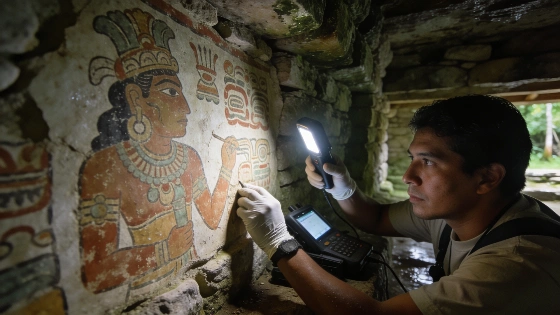
A mural from Structure II at Calakmul, Mexico, has been identified as one of the earliest known depictions of the Maya figure Juun Ajaw. Researchers used digital reconstruction to analyze the mural's iconography and its architectural context
Archaeologists working at the ancient Maya city of Calakmul in Campeche, Mexico, have identified a mural within Structure II as a rare early representation of the mythical figure Juun Ajaw. The identification follows three years of documentation and digital analysis, offering new insight into the intersection of Maya mythology, ritual timekeeping, and architectural design during the Preclassic period.
The mural, located in a chamber of Structure II, was documented using advanced digital techniques, including photogrammetry, digital illustration, and virtual architectural modeling. This approach allowed the research team to reconstruct both the mural's imagery and its original architectural setting, despite the challenges of preservation and partial loss. The analysis focused on iconographic details, spatial arrangement, and the relationship between the painted scene and the surrounding built environment.
Iconography and Interpretation
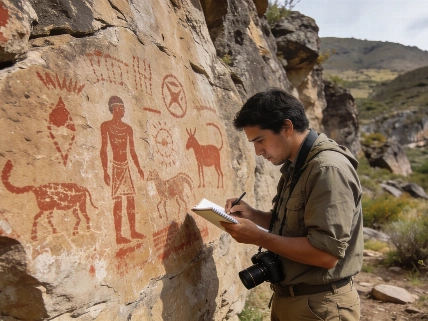
The central figure in the mural has been interpreted as Juun Ajaw, a prominent character in Maya mythology. The scene appears to depict a hunting episode set in a watery environment, consistent with known mythological narratives. Researchers also identified a symbol within the mural that may correspond to a marker in the 260-day ritual calendar known as the Tzolk'in, suggesting a deliberate association between mythic events and calendrical cycles.
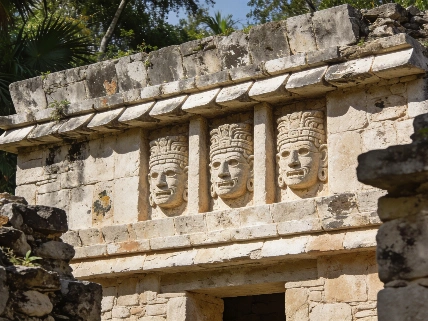
The chamber housing the mural was constructed to evoke the interior of a cave, a setting with deep cosmological significance in Maya belief systems. Caves were often conceptualized as entrances to the underworld and as places of emergence or transformation. The deliberate architectural mimicry of a cave context may have reinforced the mural's mythological themes and ritual functions.
Chronology and Context
The mural is currently regarded as the earliest known painted scene at Calakmul, dating to the Preclassic period. While the precise chronological range has not been published, the context within Structure II and the style of the mural suggest an early phase of Maya mural painting. The research forms part of a broader project led by archaeologist Daniel Salazar Lama, who has specialized in Maya and Mesoamerican iconography since 2011 and has directed the documentation of Substructure II C at Calakmul since 2020.
The project is a collaboration between French and Mexican institutions, including Archaïos, the French Centre for Mexican and Central American Studies (CEMCA), and Mexico's National Institute of Anthropology and History (INAH). The international team includes specialists from Mexico, France, Spain, and Italy, and has previously published on related Maya sites and iconographic themes.
Material Evidence and Limitations
The mural's preservation is partial, with some areas lost or obscured due to environmental and post-depositional factors. Digital reconstruction has enabled a more complete visualization, but interpretation remains dependent on surviving fragments and comparative iconography. The identification of Juun Ajaw is based on stylistic and narrative parallels rather than direct inscription, and alternative readings of the scene remain possible.
The presence of a possible Tzolk'in calendar marker within the mural is significant, as it may represent one of the earliest known attempts to link mythological events to specific ritual dates in Maya art. However, the interpretation of this symbol is provisional, pending further analysis and comparison with securely dated examples from other Preclassic sites.
According to a report from HeritageDaily, the findings will be presented in a public lecture at the Museum of Mayan Architecture, Baluarte de la Soledad, in July 2026. The event is organized by Mexico's Ministry of Culture through INAH and the INAH Campeche Centre, and will be moderated by Adriana Velázquez Morlet, director of the INAH Campeche Centre.
In total, the project has documented and analyzed murals and architectural features from multiple Maya sites, including Balamkú, Becán, Chicaná, Hormiguero, Río Bec, and El Tigre, in addition to Calakmul. The research contributes to a growing body of evidence on the development of Maya mural painting, the integration of myth and ritual in early Maya society, and the use of architecture to structure cosmological meaning.
Understanding the relationship between mural art, architectural space, and calendrical symbolism in the Preclassic Maya world remains a developing area of research. The Calakmul mural provides a valuable case study, but further discoveries and comparative analysis will be necessary to clarify the broader patterns of mythological representation and ritual practice in early Maya civilization.
In Maya archaeology, the interpretation of murals and iconography often relies on a combination of direct observation, digital reconstruction, and comparative analysis with better-preserved or more securely dated examples. The identification of mythological figures such as Juun Ajaw is typically based on recurring visual motifs, narrative structure, and contextual clues, rather than explicit textual labels. As a result, alternative readings are always possible, and new discoveries may prompt revisions to current interpretations. The integration of digital methods has improved the ability to document and analyze fragile or incomplete material, but the limits of preservation and context continue to shape what can be known about ancient Maya art and belief.