Archaeologists have uncovered a 2,500-year-old marble statue at Sardis in western Turkey, offering rare evidence of early Classical monumental sculpture and highlighting the interplay of local Lydian and wider Mediterranean artistic traditions
Archaeological excavations at the ancient city of Sardis in western Turkey have revealed a monumental marble statue dating to the early Classical period, providing new evidence for the artistic and cultural landscape of ancient Lydia. The find was made during ongoing fieldwork at the UNESCO World Heritage Site in the Salihli district of Manisa Province, under the supervision of Turkey's General Directorate of Cultural Heritage and Museums.
Excavation Context and Preservation
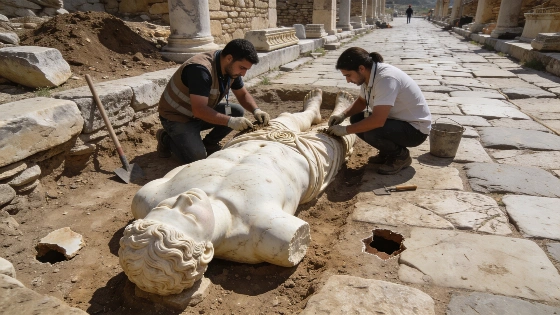
The statue, carved from marble and standing approximately 2.2 meters tall, depicts a young man and has been dated to between 470 and 450 BCE based on stylistic analysis. Archaeologists recovered the sculpture in two large sections, with the feet and several smaller fragments missing. The statue was found reused as paving material in a Roman-period colonnaded street at the city's entrance, where it had been laid face-down beneath the pavement. This secondary deposition protected the facial features and much of the carved detail from weathering and damage, resulting in a level of preservation that is unusual for marble sculpture of this age.
While the upright stance and long hair of the figure reflect sculptural conventions of the sixth century BCE, the modeling of the face and hands is consistent with early fifth-century BCE artistic developments. The young man is shown wearing a thick himation over a thin chiton, with a distinctive horizontally striped garment beneath. Researchers note that this combination of clothing has no known parallels among comparable sculptures from Anatolia or mainland Greece, suggesting a strong influence of local Lydian traditions on the representation.
Interpretation and Cultural Significance
In the statue's right hand, the figure holds what is believed to be a quince, interpreted as a possible votive offering to a deity. This detail may provide insight into ritual practices and religious symbolism at Sardis during the Achaemenid Persian period, when the city served as the capital of the empire's western satrapy. The reuse of the statue as building material in the Roman period reflects changing attitudes toward earlier monumental art and the practical realities of urban development in antiquity.
According to Turkey's Ministry of Culture and Tourism, the sculpture is one of the rare surviving examples of monumental marble statuary from the early Classical period in the region. The find adds to a growing body of evidence for the complexity of cultural interaction and artistic exchange in western Anatolia during the first millennium BCE. Comparable discoveries, such as the recovery of elite grave goods and ceremonial objects from shipwrecks in the wider Mediterranean, have also contributed to our understanding of cross-cultural connections, as seen in the recent finds of Byzantine regalia in Adriatic shipwrecks.
Site Background and Future Research
Sardis was the capital of the ancient Kingdom of Lydia and later a major administrative center under the Achaemenid Persian Empire. The site is known for its extensive archaeological remains, including the Temple of Artemis, one of the world's largest ancient synagogues, and significant Roman-period architecture. The newly discovered statue will undergo conservation and restoration before being exhibited at the Manisa Museum.
Measured at 2.2 meters in height, the statue represents one of the largest early Classical marble sculptures found in Anatolia. Its preservation, despite the loss of the feet and some fragments, allows for detailed study of both artistic technique and clothing style. The context of its reuse as paving material provides a rare opportunity to examine the taphonomic processes affecting monumental sculpture in urban environments.
Understanding the significance of this statue requires careful attention to archaeological context, stylistic analysis, and the broader patterns of cultural interaction in the region. While the identification of the object in the figure's hand as a quince is plausible, alternative interpretations remain possible, and further research may clarify its symbolic meaning. The find underscores the importance of controlled excavation and multidisciplinary analysis in reconstructing the social and artistic history of ancient Anatolia.
Archaeological context is central to interpreting monumental sculpture. The original location, stratigraphic association, and evidence for reuse all affect what can be inferred about the statue's function and meaning. In this case, the secondary deposition as paving material complicates efforts to reconstruct the statue's original setting and purpose. Stylistic dating relies on comparison with securely dated examples, but regional variation and local tradition can introduce uncertainty. The preservation of carved detail, especially in marble, is strongly influenced by burial environment, exposure, and later human activity. Careful documentation and conservation are essential for maximizing the research value of such finds.