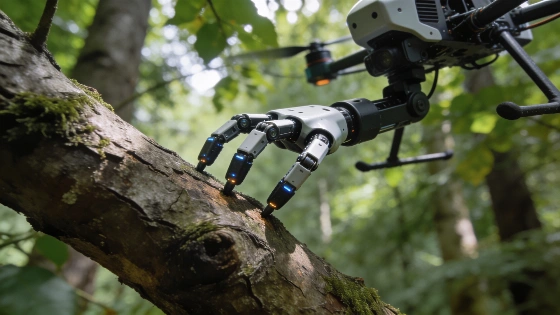
Researchers at TU Delft have built a drone that uses tactile sensors to locate and grip branches, allowing it to perch in cluttered environments and conserve battery by shutting down its motors once attached
Researchers at TU Delft have demonstrated a drone capable of perching on branches using tactile sensing, rather than relying exclusively on cameras or pre-mapped visual models. The system integrates a lightweight, three-fingered robotic hand equipped with soft capacitive sensors, enabling the drone to detect physical contact with a branch and adjust its position before attempting to grip. This approach is designed to address the limitations of vision-based perching, particularly in environments such as forests where visual occlusion and clutter can make reliable landing difficult.
The drone's perching mechanism centers on a robotic hand with three fingers, each constructed from a combination of rigid 3D-printed PLA backbones and soft silicone interfaces. The fingers are articulated with revolute joints and torsional springs, providing passive stiffness and allowing the hand to close around a branch with minimal active control. Embedded capacitive pads distributed along the phalanges detect contact at multiple points, with changes in electrical capacitance processed by an onboard controller to generate real-time binary contact signals. This tactile feedback is used in a closed-loop control system that guides the drone's approach, orientation, and grasping sequence.
During perching, the drone executes a search pattern around the estimated branch location, moving in a sinusoidal figure-eight while opening and closing its fingers. Upon initial tactile contact, the system transitions to a state-based control architecture, using contact information to refine its position and orientation relative to the branch. The perching sequence includes takeoff, searching, touch detection, approach, positioning, rotation, finalization, perching, and abort states, allowing the drone to dynamically respond to contact events and abort or retry if a stable grasp is not achieved. If the grasp is confirmed as secure, the drone can shut down its propulsion motors, reducing noise and conserving battery power while remaining attached to the branch.
In laboratory tests, the researchers evaluated the drone's ability to perch on branches of varying diameter and material, measuring the success rate of stable attachment and the energy savings achieved by motor shutdown. The system's lightweight design and use of passive mechanical elements were intended to minimize the energy required for perching and holding, addressing a key constraint for small aerial vehicles. While the approach has not yet been validated in extended field trials or under adverse weather conditions, the demonstration highlights the potential for tactile sensing to improve drone endurance and operational flexibility in complex environments.
This research builds on a growing body of work exploring biologically inspired robotics and sensor fusion for improved mobility and adaptability. Related efforts, such as the development of legged robots that adapt their gait using insect-inspired strategies, have shown promise in enabling robots to navigate unpredictable terrain. For example, a recent project applied stick insect movement data to train a six-legged robot for adaptive walking, as described in this report on insect-inspired locomotion. Both lines of research reflect a trend toward integrating multiple sensing modalities and control strategies to overcome the limitations of single-sensor systems in real-world environments.
Understanding tactile sensing in robotics requires attention to both hardware and control software. Tactile sensors, such as capacitive pads, provide direct feedback about physical contact, enabling robots to detect, localize, and characterize objects or surfaces even when visual information is unreliable or unavailable. In aerial robotics, integrating tactile feedback with flight control presents unique challenges, including the need for rapid response, lightweight construction, and robust failure recovery. The use of state-based control architectures allows robots to transition between behaviors based on sensor input, supporting dynamic adaptation to uncertain or changing conditions. As research advances, the combination of tactile and visual sensing is likely to play a central role in enabling more reliable and energy-efficient autonomous systems.