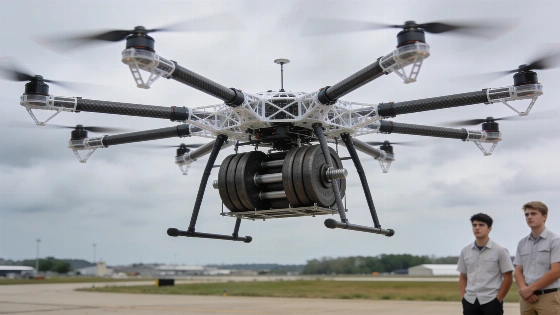
Texas A&M aerospace students flew a 50-pound battery-powered drone carrying 110 pounds over four nautical miles in 12 minutes at the first DARPA Lift Challenge, demonstrating the limits and promise of lightweight heavy-lift engineering.
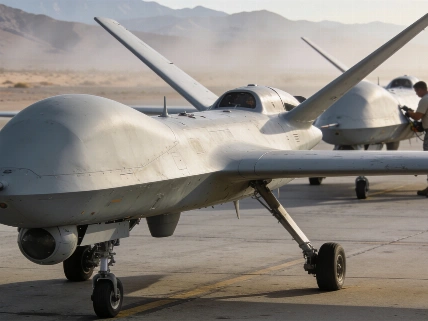
A 50-pound drone carrying 110 pounds completed a four-nautical-mile flight in 12 minutes at the first Defense Advanced Research Projects Agency (DARPA) Lift Challenge. Built by aerospace engineering students at Texas A&M University, the aircraft carried barbell weights more than twice its own mass and was one of only six teams to finish the course, according to Texas A&M's account.
That result is a demanding engineering demonstration rather than evidence of a deployment-ready autonomous aircraft. The available reporting does not establish that the drone navigated independently, operated beyond human supervision, avoided obstacles or met requirements for routine flights. What it does show is that the team produced a lightweight multirotor capable of lifting a substantial payload over a defined competition route.
The central design decision was structural. The aircraft uses a carbon-fiber frame with a central battery and eight arms carrying its motors and propellers. The students bonded the structure instead of relying on conventional nuts and bolts, reducing the frame to six pounds without the battery. The team's stated innovation was the ability to make that structure strong enough to support a 110-pound load, a problem governed by the interaction of bending, torsional rigidity, vibration and fatigue rather than by static strength alone.
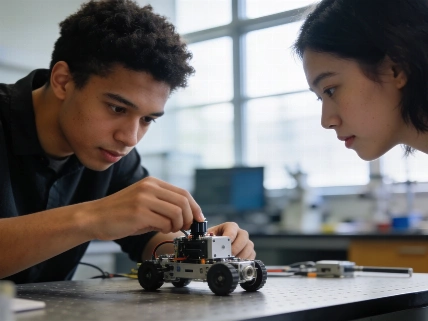
Five prototypes were built in eight months. Professor Moble Benedict led the Advanced Vertical Flight Laboratory team, which developed the final configuration through repeated design changes and virtual simulations. Benedict said a normal development process would ideally take a couple of years, making the speed of this student effort notable while also underscoring how little time was available for extended physical testing, repeated-flight statistics or long-duration component qualification.
The competition itself provides useful context for the result. About 480 concepts were submitted to the DARPA Lift Challenge, 110 teams were invited to compete and 87 reached the fly-off at the National Museum of the U.S. Air Force in Dayton, Ohio. Only six completed the course on August 9, 2026. Texas A&M's drone therefore cleared a demanding course that defeated most entrants, but the available evidence covers one reported payload flight rather than a broad reliability assessment with confidence intervals, failure rates or independently replicated trials.
The event also establishes a performance benchmark. Aerospace America reported that AVIDrone Inc. won the first Lift Challenge with a 3.84:1 payload-to-weight ratio and received a $1.25 million prize. DARPA is preparing a second challenge for 2028, reportedly with larger lift goals. Those results place the Texas A&M flight within a competitive engineering landscape while preserving an important distinction: a payload ratio measured under contest rules is not the same as useful payload capacity across weather, altitude, range and maintenance conditions.
Battery mass shaped nearly every part of the aircraft. The battery made up more than half of the drone's total weight, and unlike fuel it did not become lighter as the flight progressed. The students had to account for the same battery mass at takeoff and landing. A gasoline-powered propulsion system might have reduced that burden, according to team member Cayden Brown, but it would have added complexity to a multirotor design.
That trade-off is familiar across mobile robotics: energy storage is part of the payload problem rather than a free source of endurance. A battery-powered aircraft must lift its power source throughout the mission, leaving less mass available for cargo or structure. The design therefore achieved its headline ratio through coordinated choices in materials, assembly and propulsion rather than through a software capability described in the reporting. The same systems-level accounting is central to aircraft studies at NASA and to experimental robotics work at MIT, where mass, power, control authority and safety margins are treated as coupled constraints.
The reported materials cost was approximately $10,000. The team has identified disaster relief, package delivery and surveillance as possible future uses, but those are proposed applications rather than demonstrated operations. The competition established payload-carrying capability under its course conditions; it did not establish performance in bad weather, congested airspace, repeated missions, communications loss or real disaster zones.
This distinction matters because physical capability and operational readiness are separate engineering claims. The aircraft may carry a remarkable load, yet useful deployment would also require evidence about control reliability, failure procedures, battery management, maintenance, noise, safety distances and regulatory compliance. None of those measurements is provided here. The result should be read as a successful prototype flight with a striking strength-to-weight achievement, not as proof that heavy-lift drones are ready to replace conventional aircraft or rescue systems.
The contrast with software-centered engineering is useful: an earlier analysis of machine anomaly detection concerns statistical monitoring, while this Texas A&M project is an embodied system whose limits are imposed by materials, energy and flight conditions. In both cases, the important question is not the promotional label but the boundary of the test. The reporting provides no p-values, confidence intervals or controlled comparison among airframes, so conclusions should remain descriptive rather than statistical.
Research traditions represented by NASA, MIT and journals such as Nature likewise emphasize that a successful demonstration is only one stage in validation. For an aircraft, the next stages would normally include repeated flights, controlled payload sweeps, environmental testing and systematic tracking of failures and near-failures. Those measurements would help determine whether the observed performance is reproducible and how quickly structural or propulsion margins decline as payload and mission duration increase.
Texas A&M's aircraft deserves attention because the measurable achievement is concrete: a six-pound carbon-fiber frame formed part of a 50-pound drone that carried 110 pounds across four nautical miles in 12 minutes. Its industry significance is narrower and more credible than the broad mission list attached to it. The flight shows how far careful lightweight engineering can push a prototype; it does not yet show that the machine is reliable, autonomous or safe for operational use.