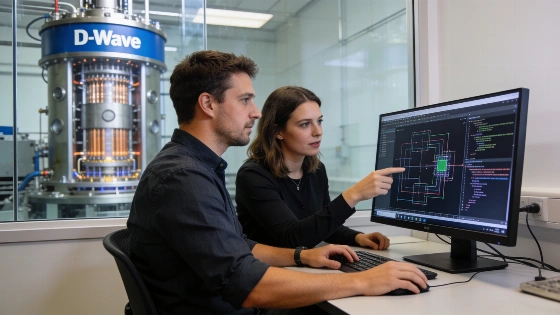
D-Wave Quantum Inc. has secured up to CAD $300,000 from Canada's National Research Council to engineer new graph-embedding algorithms and open-source tools for its quantum annealing hardware, targeting more complex commercial optimization tasks
D-Wave Quantum Inc. has been awarded up to CAD $300,000 by the National Research Council of Canada (NRC) to advance software and algorithmic infrastructure for its quantum annealing systems. The funding, provided through the NRC's Applied Quantum Computing Challenge program, supports the development of next-generation graph-embedding algorithms and open-source software tools at D-Wave's Quantum Centre of Engineering Excellence in Burnaby, British Columbia. The project aims to address a central bottleneck in quantum annealing: the translation of complex, highly connected optimization problems onto the physical qubit topology of D-Wave's processors.
Graph Embedding and Hardware Constraints
Quantum annealing processors, such as D-Wave's Advantage2(TM) system, rely on a specific qubit connectivity graph-in this case, the Zephyr(TM) topology. Many real-world optimization problems, including those in logistics, manufacturing, and finance, require mapping dense or irregular graphs onto this fixed hardware structure. The process, known as minor embedding, determines how efficiently a problem can be represented and solved on the quantum device. Inefficient embedding can lead to increased qubit overhead, reduced problem size, and degraded solution quality due to additional noise and error sources.
Algorithmic Improvements and Open-Source Integration
The NRC-funded initiative focuses on engineering advanced minor-embedding algorithms tailored to the Zephyr(TM) architecture. By integrating these algorithms into D-Wave's open-source Ocean(TM) Software Development Kit (SDK), the company aims to enable users to natively solve larger and more complex problems on its 4,400+ qubit Advantage2(TM) processors. The project's open-source approach is intended to support reproducibility and community-driven improvement, while also providing transparency around algorithmic performance and limitations. The targeted application domains include supply chain optimization, manufacturing scheduling, portfolio management, machine learning, and quantum chemistry simulations.
Commercialization and National Quantum Strategy
This collaboration is part of Canada's broader National Quantum Strategy, which seeks to align federal research infrastructure with domestic industry to accelerate the commercialization of quantum technologies. The NRC's Applied Quantum Computing Challenge program is designed to bridge the gap between laboratory research and practical deployment by supporting projects with clear industrial relevance. D-Wave's software development effort is led by Chief Development Officer Dr. Trevor Lanting and complements the company's ongoing work on superconducting gate-model architectures. For context on D-Wave's hardware progress, see the recent demonstration of a high-fidelity two-qubit gate for dual-rail qubits described in this related report.
Technical and Engineering Challenges
While the NRC grant supports algorithmic and software advances, significant engineering challenges remain before quantum annealing can routinely address large-scale, real-world problems. Embedding algorithms must balance solution quality, qubit overhead, and computational efficiency, all while contending with hardware noise, calibration drift, and limited connectivity. The open-source integration of new embedding methods will allow for broader benchmarking and validation, but the practical impact will depend on how well these algorithms scale with problem size and complexity. Independent verification and comparison with classical optimization methods will be essential to establish the true utility of these advances.
Minor embedding is a critical step in quantum annealing workflows. It involves mapping a logical problem graph-often with arbitrary connectivity-onto the physical qubit graph of the quantum processor. The efficiency of this mapping determines how many logical variables can be represented, how much qubit overhead is required, and how robust the solution is to noise and error. Improvements in embedding algorithms can directly increase the size and complexity of problems that can be addressed on current hardware, but do not by themselves guarantee quantum advantage or practical utility. The effectiveness of quantum annealing ultimately depends on the interplay between algorithmic innovation, hardware performance, and fair comparison with classical optimization techniques.