Quobly and Absolut System have qualified a 100 mW sub-kelvin cryogenic platform to support silicon spin-qubit quantum processors, marking a key step toward scalable quantum computing hardware and revealing the engineering limits of thermal management
Scaling silicon spin-qubit quantum processors to practical sizes has long been constrained by the challenge of removing heat at sub-kelvin temperatures. Now, Quobly and Absolut System have jointly qualified a dedicated cryogenic platform delivering 100 milliwatts of continuous cooling at 500 millikelvin, a figure that sets a new operational baseline for integrating control electronics with quantum chips on industrial wafer lines.
Sub-Kelvin Cooling Platform
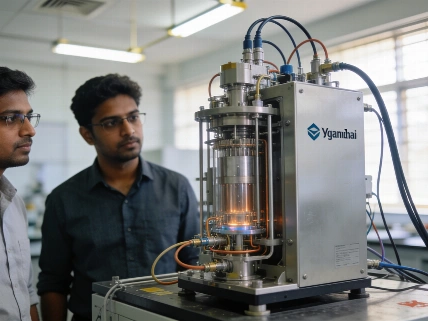
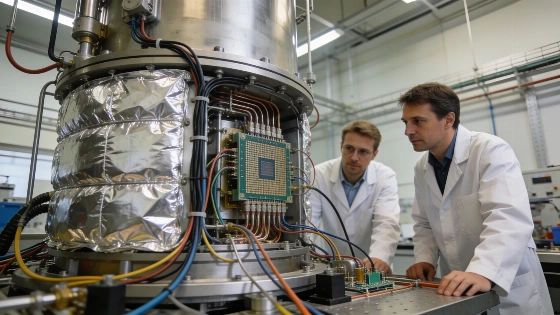
The QCube(R) 100-Class 3 system, engineered by Absolut System and tailored for Quobly's Alloy processor family, is designed to dissipate the thermal load generated by both spin-qubit devices and their co-packaged cryogenic control electronics. This platform provides integrated thermal, mechanical, and radio-frequency interfaces, enabling operation of quantum processors fabricated on 300 mm fully depleted silicon-on-insulator (FD-SOI) wafers. The system's 100 mW cooling power at 500 mK is a significant increase over typical laboratory dilution refrigerators, which often operate at lower cooling capacities and are not optimized for large-scale integration.
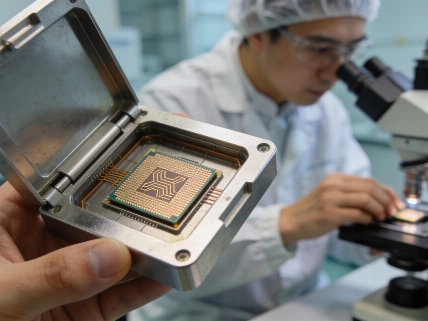
Quobly's architecture incorporates on-chip control logic using very large-scale integration (VLSI), shifting the primary scaling bottleneck from chip area to cryogenic heat dissipation. As more control electronics are brought into the cryogenic environment to reduce latency and wiring complexity, the demand for robust sub-kelvin refrigeration grows sharply. The QCube(R) 100-Class 3 platform is the first in a planned series of industrial cryogenic systems intended to support this transition from laboratory demonstration to manufacturable quantum hardware.
Roadmap and Engineering Targets
The partnership's roadmap, structured in four phases, begins with the current qualification of the QCube(R) 100-Class 3 platform for initial Alloy quantum processing unit (QPU) deployment and cloud access, targeted for late 2026. The next phase aims to double thermal dissipation capacity to enable multi-chip prototype integration. By 2027-2029, the companies plan to develop a high-density, multi-watt sub-kelvin platform capable of supporting up to 100,000 physical qubits. The final phase, projected for 2030-2032, targets volume production of modular cryogenic units for systems with up to one million physical qubits and fault-tolerant operation.
These milestones are not simply marketing targets. Each step requires concrete advances in refrigeration engineering, thermal interface design, and integration with silicon-based quantum devices. The €115 million Series A funding round completed by Quobly in June 2026 is earmarked for securing the European silicon-28 supply chain and expanding manufacturing partnerships with Soitec, Air Liquide, and Orano. The roadmap's credibility will depend on whether these technical and supply-chain dependencies can be resolved at scale.
Physical Limits and System Integration
At the heart of the challenge is the physical limit imposed by cryogenic cooling power. As the number of qubits and on-chip electronics increases, so does the heat load that must be removed to maintain quantum coherence. The QCube(R) 100-Class 3's 100 mW at 500 mK is sufficient for initial devices, but scaling to hundreds of thousands of qubits will require multi-watt cooling at sub-kelvin temperatures-a regime where even small inefficiencies or thermal leaks can compromise system performance.
Unlike superconducting qubit platforms, which often rely on off-chip control and room-temperature electronics, Quobly's approach integrates control logic directly on the quantum chip. This reduces wiring complexity but places additional demands on the cryogenic infrastructure. The partnership's focus on modular, mass-manufacturable refrigeration units reflects a recognition that quantum processor scaling is now as much an engineering problem as a physics one. Related efforts to benchmark quantum hardware for industrial tasks, such as those reported earlier, highlight the growing need for robust, reproducible system integration across platforms.
Remaining Barriers and Commercial Timelines
Quobly and Absolut System's roadmap aligns with a broader push to standardize quantum hardware manufacturing in Europe, leveraging the Grenoble deep-tech ecosystem. Initial cloud access for research users is scheduled for late 2026, but the transition from prototype to commercial-scale quantum computing will depend on sustained progress in cryogenic engineering, device yield, and supply-chain reliability. The partnership's public milestones provide a transparent framework for tracking technical progress, but the gap between laboratory demonstration and fault-tolerant, million-qubit systems remains substantial.
While the qualified QCube(R) 100-Class 3 platform marks a real advance in sub-kelvin refrigeration for silicon spin-qubit devices, the path to practical, large-scale quantum computing is defined by the unforgiving physics of heat removal and the realities of industrial integration. The next few years will test whether engineering can keep pace with quantum device ambitions, or whether thermal bottlenecks will continue to set the limits of what is possible in silicon-based quantum hardware.
Cryogenic operation is a defining constraint for most quantum computing hardware. Maintaining quantum coherence in silicon spin qubits requires temperatures well below 1 kelvin, where thermal noise is suppressed and quantum effects dominate. However, every control line, amplifier, and on-chip logic element adds heat that must be extracted without disturbing the fragile quantum states. The cooling power of a cryogenic system is not simply a matter of reaching low temperatures-it is the ability to remove a specific amount of heat at those temperatures, which becomes exponentially more difficult as the system grows. Engineering scalable refrigeration platforms is therefore as critical as improving qubit fidelity or error correction, and will determine the practical limits of quantum processor integration for years to come.