The Swiss startup's 2D trapped-ion design faces a control-wiring bottleneck as arrays grow. A new agreement targets electronics near the qubits, but the announcement reports no integrated-system performance data
In a trapped-ion processor, control signals must reach the electrodes that move and address the ions. Carrying each signal from room-temperature equipment into a cryogenic vacuum chamber can make wiring a serious constraint as systems grow. ZuriQ and Rhonexum are aiming to shift some of that control work closer to the hardware.
The wiring burden
On October 22, 2026, the companies announced a multi-year commercial structure agreement covering cryogenic integrated circuits and customization services for ZuriQ's trapped-ion quantum-computing roadmap. Rhonexum is to supply the circuits and custom engineering for ZuriQ to evaluate. The structure also provides for future orders, product deployments and technical cooperation, and the first quantity of Rhonexum's inaugural product is scheduled for delivery by the end of 2026, as The Quantum Insider reported.
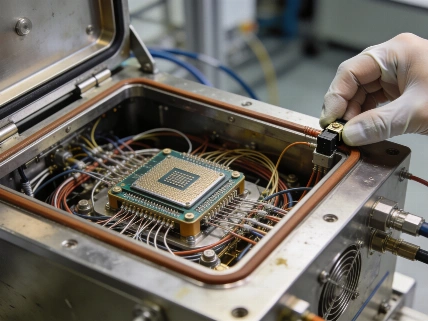
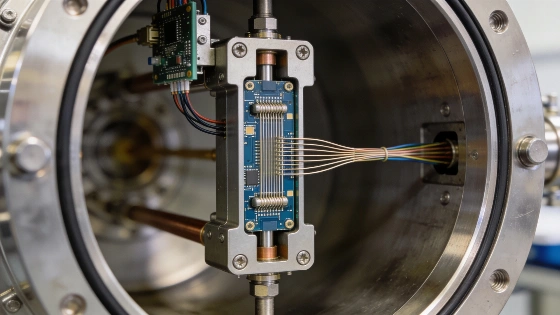
The scaling problem is physical. Conventional designs route radio-frequency signals and direct-current voltages from equipment at about 300 kelvins through feedthroughs into the cryogenic chamber. The announcement describes reducing the overhead in control signals per qubit as a longstanding challenge as architectures pursue denser arrays. More wiring also brings thermal load and limits the space available for connections.
ZuriQ, spun out of Professor Jonathan Home's laboratory at ETH Zurich in 2024, is developing a reconfigurable, natively two-dimensional ion-trap architecture. It combines static magnetic fields with dynamic electric fields. The companies describe the architecture as intended to support denser qubit arrays while retaining flexible reconfiguration capabilities.
Electronics near the ions
Rhonexum, spun out of EPFL's AQUA Lab in 2025, develops ICs intended to operate at sub-kelvin and 4-kelvin stages. The partnership's proposed approach places digital-to-analog converters and fast-switching electronics at the cryogenic stage. Multiplexing circuits could then select among control signals locally, reducing the number of physical feedthroughs needed per qubit.
That is an engineering objective, not a measured outcome in the announcement. No reduction in wiring or heat load is quantified, and the agreement sets out supply and evaluation rather than reporting completed integration or testing in ZuriQ's processor. The announcement also gives no operating temperature for ZuriQ's processor, no thermal budget for the proposed electronics, and no measurements of ion-control fidelity after integration.
The intended control functions matter because trapped ions need precise electrode voltages for movement and individual addressing. ZuriQ's architecture is designed for dynamic reconfiguration, so control circuits would have to support those operations without compromising shuttle fidelity. Whether the proposed ICs can do so under the processor's operating conditions remains a question for future evaluation.
Evidence still needed
The agreement establishes a commercial development structure and a route for feedback: ZuriQ's operational performance metrics are intended to inform Rhonexum's cryogenic semiconductor models and later ASIC iterations. It does not establish that a complete control system has been built, that performance has improved, or that the design can be manufactured at scale. The announcement provides no measured fidelity, error rate, device yield, or comparison with the existing room-temperature control setup.
A separate cross-site processor test involving a superconducting design addressed performance across facilities in an earlier hardware report. The ZuriQ-Rhonexum announcement concerns a different question: how to route control signals in a trapped-ion system as its electrode array grows. The two hardware approaches face distinct integration demands, so results from one do not validate the other.
The scheduled first delivery by the end of 2026 is the next stated key stage. Assessing the collaboration's technical value will require data from the integrated electronics, including how they affect heat entering the cryogenic stages and how reliably they control the ions.
Cryogenic multiplexing moves part of the signal-selection task from room temperature toward the processor. That can reduce the number of separate wires entering a cold chamber, but the circuits placed there still dissipate heat and must function at their assigned temperature. The useful comparison is so system-level: fewer feedthroughs matter only if control quality is maintained within the refrigerator's thermal limits.