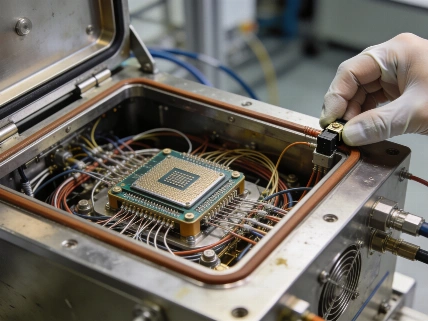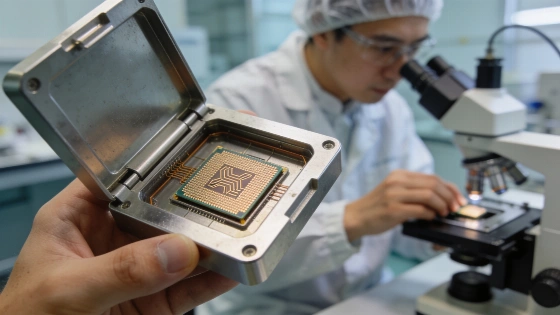
A Gothenburg-made superconducting processor was evaluated at facilities in Sweden and Singapore. The reported tests found no loss of functional performance across the two sites, though detailed measurements have not yet been presented.
ConScience fabricated the QiB1 processor in Gothenburg before the five-qubit device was assessed at measurement facilities in Sweden and Singapore. The cross-site trial found that its measured operating frequencies differed by about 1% between facilities, as reported by Chalmers Next Labs. After the chip returned to Sweden, measurements in August 2026 remained within approximately 1% of the January baseline. The results indicate that QiB1 maintained its functional performance through transport and testing on different measurement infrastructure.
A portability test
The work was carried out through the WACQT-NQFF Twin Testbed initiative, funded by the Swedish new idea agency Vinnova under the QUASI (Quantum Advancement through Sweden-Singapore Integration) structure. Chalmers Next Labs AB and ConScience AB worked with Singapore's National Quantum Federated Foundry (NQFF) on the cross-facility evaluation.
The measurement sequence began with calibration at the WACQT quantum technology testbed in Gothenburg in January 2026. Several months later, the same chip was sent to Singapore, where NQFF specialists repeated the measurements. After its return to Sweden, the team recalibrated it in Gothenburg in August. WACQT, the Wallenberg Centre for Quantum Technology, is a national Swedish research programme coordinated by Chalmers, and its testbed supports the development and testing of quantum hardware and algorithms.
The result addresses a practical concern for quantum hardware: whether a component's measured behavior survives transport between laboratories. A superconducting chip can be sensitive to its fabrication history and surroundings, so measurements at a single site do not by themselves establish that results will transfer to another facility. The reported frequency difference of about 1% provides a quantitative measure of the cross-site comparison for QiB1.
The device physics
Superconducting qubits use Josephson junctions, in this case made with nanometer-thin aluminum oxide. These junctions help set the microwave frequencies at which the qubits operate. Fabrication variation can affect those frequencies, while physical stress during shipping is another concern.
Ambient magnetic fields can differ between regions, adding another environmental variable. The Gothenburg-to-Singapore test so probes whether a processor remains functional under a change of laboratory setting. The measured frequency difference was about 1%, but the result does not identify which environmental factor accounted for the remaining variation.
What was measured
The reported hardware was a five-qubit QiB1 processor fabricated by ConScience in Gothenburg and tested at facilities in Sweden and Singapore. Also to comparing operating frequencies, the project tracked the relaxation time, T1; the best-performing qubit recorded more than 100 microseconds. Following the return shipment, the August measurements placed frequencies within approximately 1% of the January baseline.
The published figures describe one processor and an engineering cross-validation between two testbeds. They provide an aggregate frequency comparison and the best-qubit T1 result; full measurement data are scheduled for presentation at the APS March Meeting 2027. The result concerns QiB1 under the reported test conditions and does not establish that every superconducting processor will show the same transport stability.
A separate chip study examined propagating spin waves coupled to a superconducting resonator and reported power isolation at a transmission peak; it addressed a different device function from QiB1's portability test. That distinction matters: that earlier device study focused on microwave isolation, while this collaboration tested whether hardware performance remained stable across facilities.
Service still to come
The collaboration is commercializing the Gothenburg-Singapore Twin Testbed as a standardized cross-facility measurement service for quantum component suppliers. The service is in development, and its measurement specifications have not yet been announced.
The collaboration follows an October 2025 Memorandum of Understanding between Singapore's National Quantum Office (NQO) and the Quantum Sweden New idea Platform (QSIP). Full measurement data are scheduled for presentation at the APS March Meeting 2027. The project has also established the WACQT-NQFF Twin Testbed platform for future cross-validation work between Sweden and Singapore.
Josephson junctions are thin insulating barriers between superconducting materials. In a superconducting qubit, the junction helps define an energy scale that determines the microwave transition used to control the device. Small changes in junction properties can shift that frequency, which is why stability across fabrication and measurement environments matters. QiB1's reported cross-site frequency difference was about 1%, with the August measurements after its return remaining within approximately 1% of the January baseline.