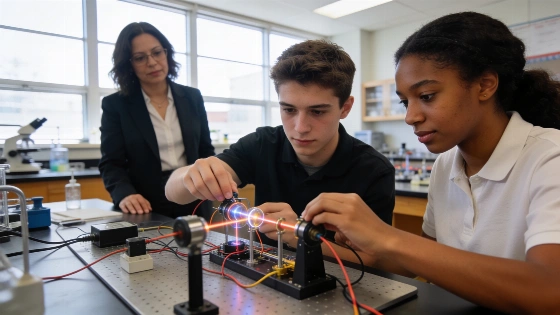
PsiQuantum has committed $250,000 to support STEM education, higher education, and technical training in South Chicago, aiming to build a local talent pipeline for the region's developing quantum technology sector
PsiQuantum, a developer of photonic quantum computing hardware, has announced a $250,000 philanthropic investment to expand quantum-focused STEM education and workforce training in South Chicago. The funding is intended to support a range of educational initiatives, from K-12 STEM programs to higher education and vocational pathways, as the company continues construction of its utility-scale quantum computing facility at the Illinois Quantum and Microelectronics Park (IQMP).
Targeted Education Initiatives
The investment will be distributed across several local institutions and community organizations. At the higher education level, direct grants will support Chicago State University's Quantum Education, Science, and Technology Center (CQuEST), as well as STEM Explorations Camp and Quantum Teacher Training programs. Olive-Harvey College, part of City Colleges of Chicago, will receive curriculum support focused on supply chain, data analytics, and quantum technologies. At the secondary level, George Washington High School and St. Francis De Sales High School will receive funding to expand STEM course offerings, upgrade classroom technology, and provide specialized teacher training. Community-based organizations such as Project SYNCERE and Phalanx Family Services will use grants to increase extracurricular STEM learning opportunities for local students.
Building a Quantum Talent Pipeline
PsiQuantum's workforce development initiative is designed to address the growing demand for technical skills in quantum information science, photonics, and advanced manufacturing. The company's presence as the anchor tenant at IQMP is expected to create new opportunities for local residents to participate in the quantum technology sector, which requires expertise in experimental physics, semiconductor fabrication, photonic device engineering, and cryogenic systems. The $250,000 investment follows earlier equipment grants to local schools, including support for virtual reality, robotics, and drone technology at Bowen High School. By funding educator certification, research hubs, and vocational pathways, PsiQuantum aims to connect South Chicago communities directly to the industrial ecosystem emerging around the state's quantum park.
Infrastructure and Regional Context
Construction of PsiQuantum's quantum computing site at IQMP began in September 2025, with the facility intended to support large-scale photonic quantum hardware development. The company's approach relies on integrated photonic circuits and single-photon sources, which require specialized skills in optics, nanofabrication, and device packaging. The regional focus on workforce development is part of a broader effort to localize quantum supply chains and technical expertise in the Midwest. This strategy is reflected in other recent developments at IQMP, such as the establishment of cryogenic and precision engineering operations by Zero Point Cryogenics and Ability Engineering Technology, as reported in coverage of new supply chain anchors at the IQMP FaQtory.
Measurable Impact and Remaining Challenges
The $250,000 commitment is distributed across multiple educational levels and community organizations, but the long-term impact will depend on sustained engagement, curriculum development, and the ability to translate training into technical employment. While the initiative addresses immediate gaps in STEM access and teacher training, the transition from educational programs to roles in quantum hardware development remains a significant challenge. The effectiveness of these investments will be shaped by ongoing collaboration between industry, educational institutions, and local communities, as well as by the evolving technical requirements of quantum computing hardware and supporting infrastructure.
Quantum workforce development involves preparing students and workers for roles that require specialized knowledge in quantum mechanics, photonics, and advanced engineering. Unlike traditional IT or electronics training, quantum technology roles often demand familiarity with quantum state preparation, measurement, error correction, and device fabrication at the nanoscale. Building a sustainable talent pipeline requires not only technical instruction but also hands-on experience with laboratory equipment, photonic devices, and cryogenic systems. As quantum hardware moves from laboratory prototypes to larger-scale deployment, the need for accessible, inclusive, and regionally relevant training becomes increasingly important for both scientific progress and equitable participation in the quantum economy.