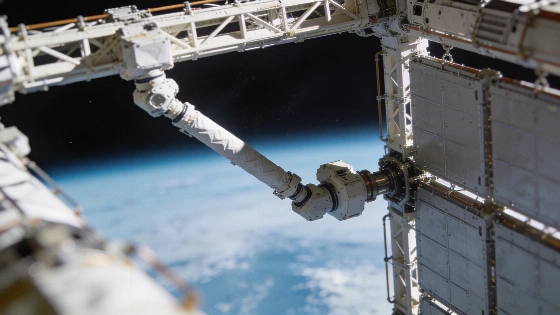
The DARPA-backed ASTRA payload used a robotic arm to assemble a third section of a perimeter truss in low Earth orbit. The test stopped short of completing its planned reflector antenna
ASTRA launched from Vandenberg Space Force Base on March 30, 2026, aboard Momentus Inc.'s Vigoride 7, one of 10 payloads on SpaceX's Transporter-16 rideshare mission. Its task was to build sections of a perimeter truss in orbit. DARPA announced the orbital construction milestone on November 5, describing ASTRA as the first structure autonomously built in space without astronaut assistance. The project was developed by Caltech researchers under DARPA's Novel Orbital and Moon Manufacturing, Materials, and Mass-efficient Design (NOM4D) program. Caltech's announcement described the robotic truss builder and the orbital demonstration.
The robotic manipulator assembled a third truss bay without astronaut assistance. Ground controllers first instructed the onboard computer to release the launch restraints and deploy two bays that had been assembled before launch; the robot then began constructing the next section from individual components. The reported result was an autonomously assembled truss section, not completion of the entire reflector.
ASTRA collects components from onboard dispensers and joins them on an assembly plate. Composite fiber tubes form the struts, and aluminum joints connect them; perforated Kapton film provides the reflective surface. The planned reflector was designed to measure 1.4 meters (about 4.6 feet) in diameter.
The demonstration did not complete the planned reflector antenna. Its intended configuration comprised 11 truss bays, with two sections carried into orbit already assembled and the robot assembling a third from loose components. The flight demonstrated assembly of a truss section in low Earth orbit, rather than a completed antenna or construction at larger scales.
The payload combines a robotic arm with motorized dispensers, an assembly plate and an onboard computer. After a bay is assembled, the system attaches a reflective cable net. Springs prestress two nets against each other, and the finished section is pushed outward so the manipulator can repeat the sequence. The planned reflector configuration uses 11 bays.
In orbit, the team had to troubleshoot through images sent by the spacecraft and revise commands. Communication was limited to about seven or eight windows of roughly 15 minutes each day. Researchers tested proposed fixes on a flight spare in Caltech's Pellegrino laboratory before sending instructions to the orbital system. Remote operation also features in robot surveys at Fukushima, though ASTRA's task was construction rather than inspection.
ASTRA is part of DARPA's NOM4D program, which aims to advance orbital and lunar manufacturing, materials and mass-efficient design, including the assembly of large structures in space rather than launching them fully assembled. Caltech professor Sergio Pellegrino leads the ASTRA team. The first two phases of NOM4D developed the assembly concept and tested it in a laboratory. The program's longer-term aim is to enable structures hundreds of meters or even kilometers in size.
The reflector film was co-developed by Caltech researchers and collaborators at the University of Pennsylvania. Its perforated design requires less prestress than conventional knitted metallic mesh, a feature that could help reduce the mass of future structures. Possible applications include large space telescopes and radio-frequency antennas; solar arrays are another proposed use.