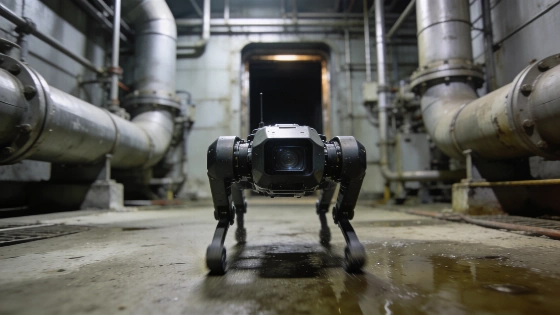
Hitachi's PMORPH crawler enters Unit 1 through a narrow pipe before changing shape. Underwater vehicles survey deposits while HUMALT is designed for remote work in high-radiation areas
PMORPH is fed through a pipe about 10 centimeters wide in an I-shaped configuration, then changes into a U-shape inside Unit 1's containment vessel. The first unit entered in April 2015 to inspect conditions outside the reactor pedestal. Its camera recorded the interior; a thermometer and radiation dosimeter measured conditions.
A second version followed in March 2017. A winch lowered its sensor unit to examine submerged deposits and measure radiation on the basement floor. Hitachi later developed six types of underwater remotely operated vehicles to survey the deposits. They create three-dimensional surface maps, measure thickness and radiation levels, prevent cable entanglement, and collect samples. From February 2022 to March 2023, the vehicles gathered information for developing a deposit-recovery method inside Unit 1.
One tool is built for a different problem: contaminated water in bent piping. Hitachi's Telescopic Active Scope Camera (TASC) uses short cilia on a hose to move through motor-generated vibrations. Wheels at its tip steer the device, while an inner hose carries water out. An active scope camera lets operators monitor the tip as it travels through the piping.
For high-radiation work, HUMALT uses flexible arms powered by cylinder-type water-hydraulic actuators. Its joints bend and rotate for controlled movement, and water serves as the hydraulic fluid, limiting environmental impact if a line is damaged. Operators control the system remotely through hoses connected to a pump and control panel. A predecessor with two flexible arms was deployed in Unit 3's turbine building in 2019 to remove obstacles. Remote supervision is also basic to other robot projects, though the tasks and settings differ.
Radiation remains a constraint. Hitachi uses radiation-resistant sensors and shielding, and separates sensitive electronics from robot bodies. Components may need replacement as they approach accumulated dose limits. The company is developing automation for repetitive work such as rubble removal in comparatively low-radiation areas; operators remain responsible for more complex tasks. Reported figures cited in the source material say more than 53,000 Fukushima cleanup workers exceeded an annual exposure of 5 millisieverts in the period since 2011, with 17 occupational illnesses recognized.
Hitachi is also developing external stereo-camera systems to estimate robot positions and map nearby structures. The cameras can track articulated arms when sensors cannot be mounted on the machines themselves. The company plans to combine these platforms with AI, sensor data, workers' expertise and digital twin technologies, with people supervising operations and making decisions when needed.