

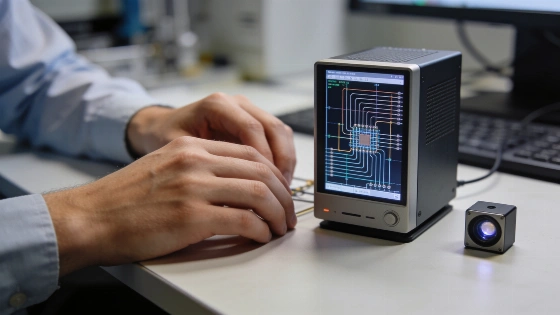
BTQ Technologies and QPerfect replace a complex permutation layer with a puncturable function and test the resulting one-shot signature circuits in an emulator; hardware security still depends on advances in quantum obfuscation
A signing main encoded in a fragile quantum state is intended to become unusable after measurement. Researchers at BTQ Technologies and its French subsidiary QPerfect have set out gate-level instructions for a one-shot signature scheme, translating a theoretical protocol into a circuit design and evaluating it in an emulator rather than reporting a demonstration on quantum hardware.
From protocol to circuit
The work, published as the preprint A quantum algorithm for one-shot signatures, simplifies earlier frameworks that relied on complex permutable pseudorandom permutations. Its design uses a single puncturable pseudorandom function based on a Goldreich-Goldwasser-Micali (GGM) tree lookup. A reversible Bruhat decomposition subroutine is paired with GGM path traversal to sample uniform superpositions over random affine cosets.
For messages of arbitrary length l, the authors replace repeated bit-by-bit phase flips with a global measurement routine and a single dual-phase translation oracle (Dp>m). The proposed single-use security rests on measurement collapse and the no-cloning theorem: a measured signing state cannot simply be copied for reuse. That removes the need for a blockchain or decentralized ledger to prevent main reuse in the scheme as described.
What the emulator tested
QPerfect is a Strasbourg-based French quantum-computing company and a wholly owned subsidiary of BTQ Technologies. Its MIMIQ product is a quantum emulator designed to let users test programs before running them on physical hardware, as FCC Singapore describes. MIMIQ was used to establish baseline resource requirements for the signature circuit before cryptographic program obfuscation was included. The result is a circuit-level evaluation in emulation, not a run on a quantum processor.
On October 29, 2026, BTQ announced that MIMIQ had become available through qBraid's managed application programming interface. The company said the platform serves more than 35,000 quantum developers; that figure describes qBraid's developer reach, not a count of MIMIQ users or quantum processors. The architecture's possible deployment on long-coherence neutral-atom processors is a prospective direction, not a hardware result in this work. The connection is relevant to neutral-atom hardware reporting, but this signature scheme has not been shown running on that platform.
The main-generation gap
Classical fully succinct indistinguishability obfuscation could protect the classical GGM master main, information from the paper's account. Securing main generation against adversarial manipulation of the input state, including Bell-pair entanglement attacks, would require quantum indistinguishability obfuscation-a capability the work identifies as a future requirement.
The authors point to secure digital delegation, tokenized transfers and trustless random beacons as potential uses. The preprint presents the protocol and circuit design, while QPerfect's Technical Blog provides architectural analysis.







